The selective politics of student protests in India
August 24, 2026
  • Read Ecopy
  • Circulation
  • Advertise
  • Careers
  • About Us
  • Contact Us
Android AppiPhone AppArattai
Organiser
  • ‌
  • Bharat
    • Assam
    • Bihar
    • Chhattisgarh
    • Jharkhand
    • Maharashtra
    • View All States
  • World
    • Asia
    • Europe
    • North America
    • South America
    • Africa
    • Australia
  • Editorial
  • International
  • Opinion
  • RSS @ 100
  • More
    • Op Sindoor
    • Analysis
    • Sports
    • Defence
    • Politics
    • Business
    • Economy
    • Culture
    • Special Report
    • Sci & Tech
    • Entertainment
    • G20
    • Azadi Ka Amrit Mahotsav
    • Vocal4Local
    • Web Stories
    • Education
    • Employment
    • Books
    • Interviews
    • Travel
    • Law
    • Health
    • Obituary
  • Subscribe
    • Subscribe Print Edition
    • Subscribe Ecopy
    • Read Ecopy
  • ‌
  • Bharat
    • Assam
    • Bihar
    • Chhattisgarh
    • Jharkhand
    • Maharashtra
    • View All States
  • World
    • Asia
    • Europe
    • North America
    • South America
    • Africa
    • Australia
  • Editorial
  • International
  • Opinion
  • RSS @ 100
  • More
    • Op Sindoor
    • Analysis
    • Sports
    • Defence
    • Politics
    • Business
    • Economy
    • Culture
    • Special Report
    • Sci & Tech
    • Entertainment
    • G20
    • Azadi Ka Amrit Mahotsav
    • Vocal4Local
    • Web Stories
    • Education
    • Employment
    • Books
    • Interviews
    • Travel
    • Law
    • Health
    • Obituary
  • Subscribe
    • Subscribe Print Edition
    • Subscribe Ecopy
    • Read Ecopy
Organiser
  • Home
  • Bharat
  • World
  • Operation Sindoor
  • Editorial
  • Analysis
  • Opinion
  • Culture
  • Defence
  • International Edition
  • RSS @ 100
  • Magazine
  • Read Ecopy
Home Politics

The Selective Lens: Who decides which protests truly matter?

India’s student protests have increasingly become a test not only of democratic expression but also of how public grievances are amplified, ignored or politically appropriated. While the Gen-Z agitation at Delhi’s Jantar Mantar drew significant national attention, examination and recruitment-related protests in states such as Jharkhand, Kerala and Karnataka received comparatively less visibility

Induchoodan RameshInduchoodan Ramesh
Aug 24, 2026, 06:50 pm IST
inPolitics, Bharat, Opinion, Delhi, Jharkhand
Follow on Google News
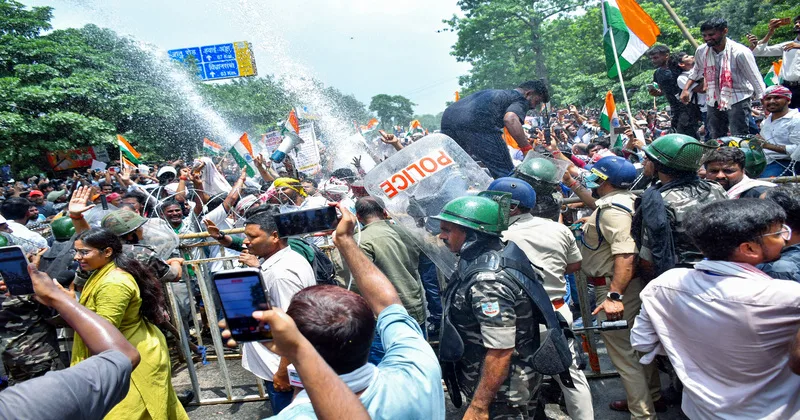
Ranchi, Aug 10 (ANI): Police use water cannons at protesters during students' march towards Jharkhand Assembly to protest against the government over alleged JPSC and JSSC-CGL examination paper leak, in Ranchi on Monday. (ANI Photo)

Ranchi, Aug 10 (ANI): Police use water cannons at protesters during students' march towards Jharkhand Assembly to protest against the government over alleged JPSC and JSSC-CGL examination paper leak, in Ranchi on Monday. (ANI Photo)

Facebook
Twitter
WhatsAppTelegramEmail

The Indian Constitution guarantees fundamental freedoms under Article 19(1)(a): safeguarding the right to freedom of speech and peaceful assembly. However, public discourse often overlooks Article 19(2), which empowers the state to enact reasonable restrictions on these freedoms in the interest of the sovereignty, integrity, and public order of the nation. Recently, imagery from the Gen-Z protests at Jantar Mantar in New Delhi has dominated social media feeds. When the Cockroach Janta Party (CJP) and aligned student organisations mobilised students over national examination lapses and accountability, the agitation quickly evolved into a clash between civil expression and law enforcement. While the eventual political accountability and ministerial resignations were framed as a triumph of student resolve, the movement also exposed how quickly genuine student grievances can be co-opted or overshadowed by political manoeuvring.

While national media amplified events in Delhi, thousands of job aspirants in Jharkhand took to the streets at Ranchi’s Jaipal Singh Munda Stadium, protesting recurring question paper leaks in the Jharkhand Staff Selection Commission (JSSC-CGL) exams. Advocacy groups and platforms like the CJP did not immediately rally to support Jharkhand; they became involved only after public momentum had already peaked. When political groups led by AISA and AISF tried to hijack the Jharkhand protest, the student community of Jharkhand resisted, stating that “their struggle was strictly for academic integrity and livelihoods” and refusing to let outside actors use their platform for partisan optics. Student leaders from Akhil Bharatiya Vidyarthi Parishad (ABVP) showed constructive support to protesting students by calling for a Vidhan Sabha march following the brutal lathi charge towards students on 10th August. More than 200 ABVP activists were arrested following the protest. Even so, they did not engage in showboating or claim credit. The CJP nexus, which once claimed that only a minister’s resignation means accountability, is now silent.

Read More: Piyush Goyal leads India’s biggest business delegation to Japan; Pitches deeper ties in infra, energy & frontier tech

This is not just one isolated event. A conspicuous pattern of institutional silence emerges when examining youth agitations in non-central jurisdictions. Job aspirants in Keralam have engaged in recurring protests over delays in the Public Service Commission, back-door regularisations, and stalled rank lists. The rank holders of the Lower Primary School Teachers examination were seen eating grass outside the Secretariat as a symbol of protest, alleging that the government had ignored their pleas for appointment orders. Despite widespread youth distress, these protests received negligible attention from national coalitions and left-wing student networks that were vocal elsewhere. In Karnataka, the Karnataka Public Service Commission (KPSC) cashed 400 veterinary officer posts for nearly 1 crore each. ABVP was the the only student organisation in Karnataka to protest against this issue and demand a CBI enquiry into it.

The treatment of institutional heads who fall out of favour with dominant campus unions starkly illustrates the hypocrisy of student and campus politics. At the Sree Sankaracharya University of Sanskrit in Kalady, Kerala, the female vice-chancellor, Dr Ciza Thomas, was subjected to a public “mock funeral” ceremony alongside severe physical blockades by the left-wing extreme groups. Such acts of intimidation against a female academic leader received little to no condemnation from national civil-liberty groups or self-proclaimed progressive forums. When agitation aligns with dominant regional unions, they routinely minimise aggressive conduct rather than hold it to constitutional standards of decency.

The modern public square is no longer mediated by journalistic objectivity or civic consensus; it is instead engineered by engagement-maximising recommendation algorithms designed to monetise affective polarisation. In this asymmetric information war, reality is subordinated to digital virality. Digital platforms run on neural recommendation architectures that treat outrage, moral indignity, and conflict as high-value currency. Content that fits sensationalist, polarising, anti-establishment narratives is algorithmically prioritised in trending feeds, short-form reels, and viral loops. Conversely, ground-level youth crises,  such as the paper leaks in Jharkhand or examination stalls in Keralam and the southern states, often lack the geopolitical friction or elite media curation required to trip the algorithms’ engagement triggers, effectively rendering them invisible in national feeds. The danger of this algorithmic ecosystem lies in how easily partisan collectives and ideological networks transform legitimate student grievances into tools for narrative warfare. Sincere demands for educational transparency, examination integrity, and administrative responsiveness are frequently co-opted as a Trojan horse by partisan collectives and ideological networks.

Overcoming algorithmic manipulation requires active intellectual vigilance. Modern civil society must develop the literacy to distinguish between genuine democratic accountability and manufactured narrative warfare. We must champion institutional reforms, meritocratic recruitment, and administrative transparency for students across every state without exception, while resolutely rejecting polarising campaigns that seek to fracture the social and constitutional fabric of the nation. The future of democratic discourse depends on our ability to look beyond the curated feed, see the ground reality unfiltered, and demand accountability without compromising national integrity.

Topics: Akhil Bharatiya Vidyarthi ParishadAISAJharkhand Staff Selection CommissionGen ZAISF
Share
Tweet
SendShareSend
✮ Subscribe Organiser YouTube Channel. ✮
✮ Join Organiser's WhatsApp channel for Nationalist views beyond the news. ✮
Previous News

ED Attack Accused and CPM Leader Binu Celebrate Onam at Police Station with Police | CMRL-Exalogic case

Next News

Kerala High Court suspends life sentence of Padmarajan Master in Palathayii rape case

Related News

Youth and Social Media: Weaponising the cockroach

YogiConnectsUPJapanGenZ: Vasudhaiva Kutumbakam for a Selfie-Age Generation

CM Yogi Meets Gen Z: How an ascetic-politician is bridging Lucknow and Japan’s Yamanashi

Modi Govt’s ‘One Day, One University’ Plan: Union Ministers to Interact With Students Across India (This image is generated from AI)

One Day, One University: Modi Govt plans direct outreach to Gen Z students; Check details

Youth and social media: Weaponising the cockroach

(Left) Student leader Devendra Nath Mahato (Right) Students waged peaceful protest in Jharkhand against the irregularities sin paper leak

Jharkhand Exam Scam: Students hail JSSC-CGL cancellation; All activities linked to TDPL scrapped

Representative Image

Gen Z: Channel your energy towards building Bharat

Load More

Latest News

Dimagi Naxals: Decoding the cognitive virus

“A result of a gang war”: Former Envoy to Canada Sanjay Verma on Goldy Brar’s purported claim of hand in Nijjar killing

Tamil Nadu: Tirunelveli POCSO court awards death sentence to church pastor Abraham, for sexually assaulting minor girls

AI Generated Image

West Asia: 20,000+ Pakistanis deported; Gulf countries flag illegal entry, drug trafficking & national security threat

RSS Sarsanghchalak Dr Mohan Bhagwat on August 15 hoisted the Tiranga at the RSS headquarters in Nagpur on the occasion of the 80th Independence Day

RSS and Independence Day Celebrations: Message of sacrifice, purity and prosperity

Kerala High Court suspends life sentence of Padmarajan Master in Palathayii rape case

Kerala High Court suspends life sentence of Padmarajan Master in Palathayii rape case

Ranchi, Aug 10 (ANI): Police use water cannons at protesters during students' march towards Jharkhand Assembly to protest against the government over alleged JPSC and JSSC-CGL examination paper leak, in Ranchi on Monday. (ANI Photo)

The Selective Lens: Who decides which protests truly matter?

ED Attack Accused and CPM Leader Binu Celebrate Onam at Police Station with Police | CMRL-Exalogic case

ED Attack Accused and CPM Leader Binu Celebrate Onam at Police Station with Police | CMRL-Exalogic case

‘Vamana Conquering Mahabali Is Absolute Nonsense’: Attempt to Rewrite Onam and Sever Kerala from Its Cultural Roots

‘Vamana Conquering Mahabali Is Absolute Nonsense’: Attempt to Rewrite Onam and Sever Keralam from Its Cultural Roots

Kerala VC Dr. Mohanan Kunnummel Says ‘Bharat Is Ruled by Those Who Believe in RSS’, Asks: ‘Why Do They Need My Support?’

Kerala VC Mohanan Kunnummel Says ‘Bharat Is Ruled by RSS Believers’, asks: ‘Why Do They Need My Support?’

Load More
  • Privacy
  • Terms
  • Cookie Policy
  • Refund and Cancellation
  • Delivery and Shipping

© Bharat Prakashan (Delhi) Limited.
Tech-enabled by Ananthapuri Technologies

  • Home
  • Search Organiser
  • Bharat
    • Assam
    • Bihar
    • Chhattisgarh
    • Jharkhand
    • Maharashtra
    • View All States
  • World
    • Asia
    • Africa
    • North America
    • South America
    • Europe
    • Australia
  • Editorial
  • Operation Sindoor
  • Opinion
  • Analysis
  • Defence
  • Culture
  • Sports
  • Business
  • RSS @ 100
  • Entertainment
  • More ..
    • Sci & Tech
    • Vocal4Local
    • Special Report
    • Education
    • Employment
    • Books
    • Interviews
    • Travel
    • Health
    • Politics
    • Law
    • Economy
    • Obituary
  • Subscribe Magazine
  • Read Ecopy
  • Advertise
  • Circulation
  • Careers
  • About Us
  • Contact Us
  • Policies & Terms
    • Privacy Policy
    • Cookie Policy
    • Refund and Cancellation
    • Terms of Use

© Bharat Prakashan (Delhi) Limited.
Tech-enabled by Ananthapuri Technologies