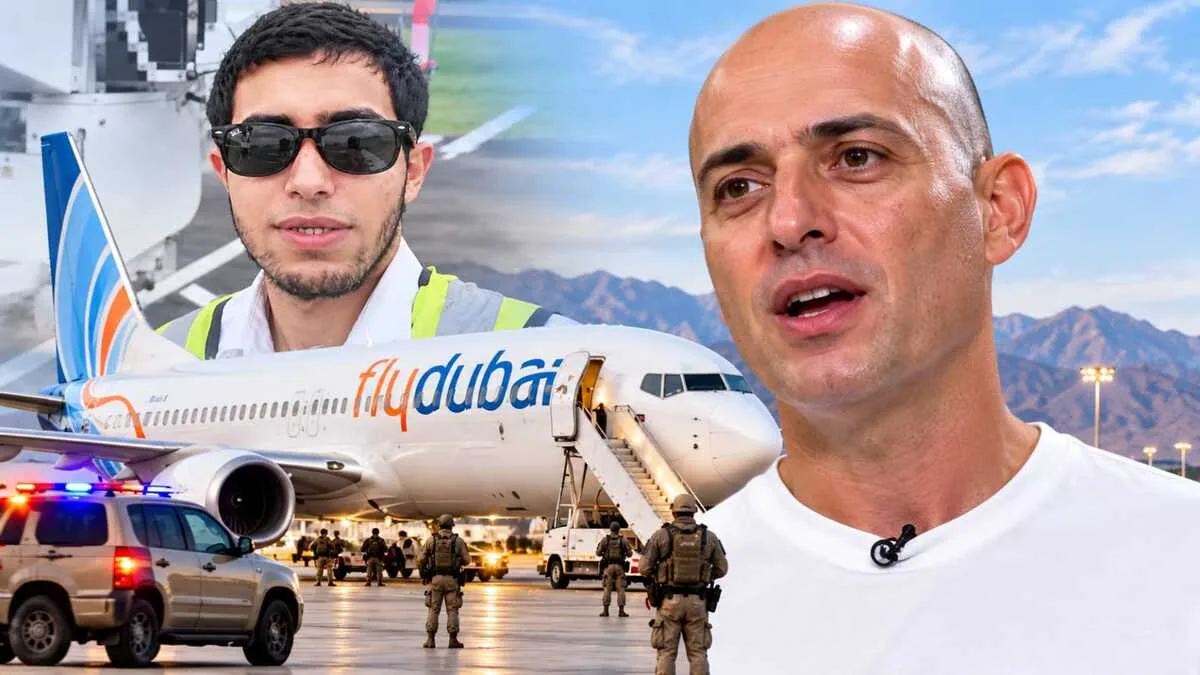
Passengers aboard a Flydubai flight bound for Tel Aviv were plunged into a terrifying mid-air struggle after an Omani co-pilot attacked the Indian captain with a crash axe, leaving the aircraft in a dangerous dive and triggering a desperate fight inside the cabin.
What followed was an extraordinary sequence in which three Israeli passengers rushed towards the cockpit, overpowered the attacker and restrained him, only to become suspicious when some members of the flight crew demanded that the restrained man be released.
“They were asking us to untie the terrorist, we had no idea why,” banking executive Tzvika Manes, one of the three passengers who confronted the attacker, told the media.
Another passenger, real estate professional Daniel Schlichter, said the crew’s demands immediately raised concerns among those who had just fought to prevent the attacker from regaining control.
“They were saying to free the terrorist, we got instantly suspicious of them,” Schlichter said.
The co-pilot was identified by media as Omani national Hamam al-Hammami. The Indian captain was identified as Capt. Smit Machchhar.
The dramatic confrontation unfolded after al-Hammami began striking Machchhar with a crash axe inside the cockpit. Despite being seriously wounded, the Indian pilot managed to open the cockpit door, allowing passengers near the front of the aircraft to see what was happening and react.
Manes, along with plumber Yaniv Hayoun and Asaf Rajuan, immediately moved towards the attacker. The three men confronted him and eventually managed to overpower and restrain him.
The aircraft was simultaneously struggling to maintain a safe flight path. Hayoun, who had no formal aviation training, helped stabilise the aircraft using techniques he had learned from watching the television programme “Air Disasters”.
The situation remained chaotic as the plane descended sharply. The passengers who had intervened eventually forced the suspected attacker face-down and restrained his hands behind his back. Initially, zip ties were used. Later, headphone wires collected from passengers by Schlichter were also used to keep him restrained.
Passengers take control amid fears of a second threat
According to Manes, the subdued attacker repeatedly cried, “Kill me, kill me.” Manes interpreted the words as a possible expression of desperation after the jihadist attack had failed.
Despite the violence, the Israeli passengers said their intention was not to kill the attacker. They even provided him with oxygen while keeping him restrained, believing he should remain alive to face an investigation.
“We wanted him to live so he could be investigated,” Schlichter said.
The situation became more complicated when members of the cabin crew began insisting that the restrained man be released.
An argument followed between the passengers and crew members. The Israelis refused to allow the suspected attacker to be freed, fearing that he could pose another danger to passengers and the aircraft.
“They said, ‘You are not God, you are not going to kill him,’” Manes recalled.
The passengers’ response, he said, was straightforward: “We didn’t want to kill him, we just wanted him not to kill us.”
The confrontation created a second layer of uncertainty inside the aircraft. The crew insisted that they remained responsible for the aircraft and wanted control of the area immediately outside the cockpit.
But the passengers who had just fought the attacker were unwilling to allow anyone they regarded as potentially suspicious to approach the cockpit.
“We told them, ‘Now the policy is we’re in charge and you do what we say,’” Manes said. “We didn’t know what to think, we were in a suspicious mode for every steward.”
Schlichter and other passengers subsequently escorted members of the cabin crew away from the cockpit area and ordered them to sit several rows back. “We shouted at them and told them to sit down,” Schlichter said.
The passengers also arranged for a large man to guard the cockpit and prevent anyone from entering without authorisation, Manes said.
At the same time, reserve pilots who had been seated towards the rear of the aircraft had already reached the cockpit and taken over control of the plane.
Once the crew had been moved away from the cockpit, the immediate confrontation gradually subsided. Schlichter said the crew eventually appeared to recognise that the situation was extraordinary and began helping passengers who had been traumatised by the incident.
They distributed blankets and water as passengers attempted to recover from the ordeal.
Family holiday turns into fight for survival
Manes, 40, had been returning from a family holiday in Japan with his wife and three daughters, aged 11, 7 and 6, when the attack occurred.
For him, the decision to intervene was not driven by any desire to become a hero. It was the reaction of a father who heard his children fearing that they were about to die.
“When I heard my daughters crying ‘Father I don’t want to die’, that was the trigger for me to run and fight, I wasn’t thinking of anything, it was just fight or flight,” Manes said.
The struggle with the attacker was violent and chaotic. The three men did not know whether he still possessed a weapon. “Punches were flying, we were kicking him, we didn’t know if he still had his knife, we couldn’t see it,” Manes said.
He rejected the description of himself and the other passengers as professional fighters. “None of us were fighters or heroes, we were just normal guys who wanted to save our families.”
Schlichter, 59, who was also returning from Japan with his wife, described the incident as something that seemed almost unreal. “It was sounds you only hear in a movie,” he said.
The aircraft had plunged thousands of feet during the crisis, leaving passengers convinced that they might not survive. Schlichter said he believed he was preparing to die as the plane nosedived approximately 17,000 feet in a matter of moments. “It was the longest minute I’ll ever have in my life,” he said.
He recalled thinking about the September 11 attacks and then about his own children and family. “I remember everything, I remember clearly thinking about 9/11, then I thought about my children, my family, how awful it would be for them to hear what happened,” Schlichter said.
Manes, who serves as CEO of Barak Capital Underwriting, described the physical sensation during the aircraft’s rapid movements as unlike anything he had experienced.
“The G-Force was like something I never felt like in my life, it felt like everything was soaking, it was a crazy feeling,” he said.
He later discovered bruises across his body as the adrenaline of the confrontation began to fade.
Safe landing brings emotional aftermath
Manes said he remained beside the restrained attacker until the aircraft finally reached Tabuk in Saudi Arabia.
“I stayed with the terrorist until we landed safely in Tabuk, Saudi Arabia. After that I hugged my daughters and told them they were going to be OK, and that they are heroes,” he said.
Only after the aircraft landed did many passengers begin to process what they had experienced.
Manes said some passengers suffered panic attacks, while others broke down crying. The psychological impact was particularly severe among those who had believed for several minutes that the aircraft might crash.
Some passengers were reportedly unwilling to return to Israel on another Flydubai aircraft. According to Manes, several refused to board until they had received personal assurances that the pilots had been cleared by Israeli authorities.
The incident also left the passengers reflecting on the extraordinary sequence of events that had allowed the aircraft to survive.
Schlichter said the survival of those aboard depended on numerous circumstances coming together at precisely the right moments.
“Statistically this kind of miracle can not be happening, the chance that each one of us, especially would be on the same second where they had to be, I can’t even fathom how unlikely it is,” he said.
Manes, meanwhile, viewed their survival through a spiritual lens. “I believe that definitely we had divine protection,” he said. “Someone up there is watching over us.”
For the three passengers who intervened, the episode began as a family journey returning from Japan and suddenly became a fight to prevent an aircraft from turning into a catastrophe.
Manes said he never imagined that, as he put it, a “regular finance guy” would find himself involved in a life-or-death struggle thousands of feet above the ground. But when his daughters cried that they did not want to die, he reacted instinctively.
The passengers who confronted Hamam al-Hammami now face questions about the sequence of events inside the aircraft, including why some crew members demanded that the restrained attacker be released. Flydubai has not accused its crew of involvement in any conspiracy and has said that the matter remains under investigation.
For those aboard the aircraft, however, the most immediate concern was survival. The attacker was eventually restrained, reserve pilots took control of the cockpit, the aircraft reached Saudi Arabia safely, and the passengers walked away from an ordeal that many believed could have ended very differently.