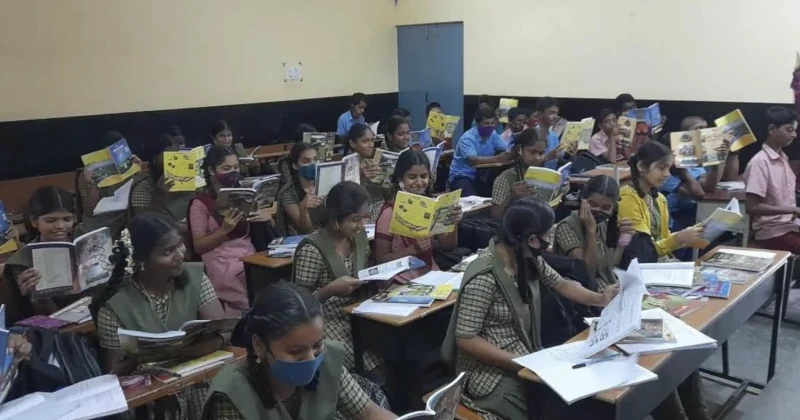
Bengaluru: Two months into the new academic year, several private aided and unaided schools across Karnataka are still waiting for complete supplies of textbooks, despite having paid the required amount in advance. The delay has disrupted classroom teaching and forced students in some schools to depend on photocopies of textbooks to keep up with lessons.
Private school associations have raised concerns over the delay, noting that schools paid 100 per cent of the indent amount when the first phase of textbook orders was invited in January. The orders were placed based on enrolment figures from the previous academic year. However, student strength often changes after the beginning of a new academic year, making an additional or second indent necessary.
According to school management representatives, the second indent was expected in June, but the process has not yet begun. As a result, schools that have seen an increase in admissions are struggling to obtain enough textbook copies for all students.
D Shashikumar, general secretary of the Karnataka Associated Managements of Primary and Secondary Schools (KAMS), said the shortage was making it difficult for schools to conduct classes smoothly.
He said schools had submitted their requirements and paid the full amount for the first indent. However, since enrolment numbers can change after the academic year begins, the second indent is essential to address the additional requirement.
The absence of adequate textbooks has left teachers and students with limited options. In some schools, students are reportedly making photocopies of the available textbooks. In others, students share books until additional copies become available.
School managements have expressed concern that the continued shortage could affect students’ learning, particularly in subjects where textbooks are essential for following classroom instruction and completing assignments.
The Organisation for Unaided Recognised Schools has submitted a representation to the Commissioner of the School Education Department, urging immediate intervention. The organisation said the matter could not be ignored as schools had already paid for the books several months ago.
The organisation also pointed out that schools could not submit requirements for additional books because the second-indent process had not been opened. It urged the department to take immediate steps to ensure that the pending textbooks are supplied and that schools are allowed to place additional orders.
The shortage has also become a concern for parents. Several parents have already paid textbook charges through schools and are now questioning school managements about the delay. Representatives of private schools said parents expected the books to be supplied on time and were unlikely to accept repeated explanations for the shortage.
School associations have suggested an immediate alternative to address the problem. They said textbooks lying unused in schools with lower enrolment could be transferred to institutions facing shortages.
According to school representatives, the Student Achievement Tracking System (SATS) provides student enrolment details. Education officials could use this data to identify schools with surplus books and those facing shortages.
Shashikumar suggested that the Deputy Directors of Public Instruction (DDPIs) at the district level could coordinate the redistribution of books. Instead of waiting for new supplies, schools could move surplus textbooks from one school to another to address immediate shortages.
Such a mechanism, school associations said, would be particularly useful in districts where significant differences exist between the number of books supplied during the first indent and the actual number of students enrolled.
The Organisation for Unaided Recognised Schools has also urged the government to consider allowing schools to buy textbooks from the open market if the Karnataka Textbook Society cannot complete the supply process within a reasonable time.
The organisation said making textbooks available through the open market would give schools an alternative and ensure that students do not suffer because of delays in the official supply system.
The issue has raised broader questions over the planning and distribution of textbooks for private schools. While the first indent is based on the previous year’s enrolment, school managements have pointed out that the system needs to be flexible enough to accommodate changes in student numbers after admissions.
With the academic year already progressing, schools have urged the Education Department and the Karnataka Textbook Society to expedite the distribution of pending books and immediately initiate the second-indent process.
School managements said a coordinated approach involving education officials, textbook authorities and schools could help resolve the shortage quickly. They also called for a system that allows faster redistribution of surplus books between schools.