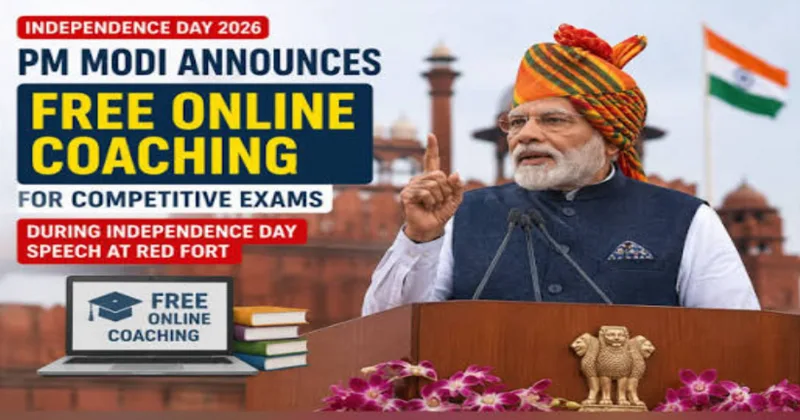
Prime Minister Narendra Modi’s Independence Day 2026 speech from the ramparts of the Red Fort has become an inflection point for positive growth in Bharat’s educational teleology. The speech reflected on our past while simultaneously articulating a blueprint for the country’s pedagogical future. In his inclusive and inspiring Independence Day address, the Prime Minister announced an important initiative aimed at fostering the potential of Bharat’s youth: the creation of a network offering free online coaching for various competitive examinations. The proposal directly bridges one of the most persistent inequalities in our education ecosystem-the affordability variable. The announcement was made at an opportune moment when we are witnessing greater self-expression from the youth.
Competitive examinations have a long history in Bharat. Driven by TB Macaulay’s idea of a hegemonised brown governing class, the British Raj introduced ICS examinations in 1855, an elite competitive test to recruit high-level administrators for governing colonised Bharat. Since then, such exams have become crucial gateways to higher education, government employment and professional opportunities. Yet, preparation for these examinations can impose a substantial financial burden on families. For many poor and middle-class households, the expense of coaching, study material, accommodation and travel can become a major hindrance. Students with academic ability may therefore find themselves competing against candidates who have access to expensive coaching institutions, personalised guidance and extensive learning resources. The Prime Minister’s announcement seeks to close this disparity by making quality preparation accessible through digital platforms.
The central idea is to bring together three important resources: Digital Public Infrastructure, talented educators and teachers, and the aspirations of India’s youth. Rather than employing digital frameworks merely as a medium for delivering recorded lectures, the envisioned network can potentially create an integrated educational ecosystem in which students receive lectures, study materials, assessments, doubt-resolution facilities, mentorship and examination-oriented guidance. The government’s position on this is specific. It states that Bharat’s digital public infrastructure and available talent and teachers would be brought together to establish a robust network for free coaching.
The significance of the proposal lies in its potential to level the playing field. Equal access to educational opportunity will facilitate preparation parity. Bharat’s digital transformation has already created an environment in which learning resources can reach students beyond metropolitan centres. A student in a village or a Tier-II or Tier-III city need not necessarily relocate to Delhi, Hyderabad, Kota or another coaching hub to acquire quality instruction. If designed effectively, a national online coaching network could remove geographical barriers and allow merit to become a stronger determinant of educational and career outcomes.
The initiative also reflects a broader transformation in the meaning of Digital Public Infrastructure (DPI). Digital infrastructure is often associated with payments, identity, governance and public services. Extending this infrastructure into education represents another stage of India’s digital public ecosystem. It suggests that technology can be used not simply to make existing systems faster but to expand the reach of opportunities traditionally concentrated among those who can pay for them.
Free online coaching, gradually, will be capable of providing a replacement for private coaching. Its success will depend on the quality and accessibility of the ecosystem created around it. Students require reliable internet connectivity, affordable devices, regional-language content, accessible interfaces and mechanisms for personalised academic support. The government may also consider these factors while developing the network. The programme will need continuous assessments, interactive classes, doubt-clearing mechanisms, mentoring and high-quality test series to ensure that students receive preparation comparable to the best available coaching resources.
Language will also be a critical factor. Our existing competitive-examination ecosystem serves students from diverse linguistic backgrounds. A genuinely inclusive digital coaching network should therefore provide learning resources in multiple vernacular languages, while ensuring that students are not disadvantaged because of their linguistic background. Such an approach would also complement the broader educational emphasis on accessibility and inclusion.
The announcement has another considerable dimension: social mobility. Competitive examinations have historically functioned as mechanisms through which individuals from modest socio-economic backgrounds can enter institutions and professions that transform their lives. By lowering the cost of preparation, free coaching can potentially widen this pathway. The benefit would extend beyond individual students: when talented young people from economically weaker backgrounds gain access to opportunity, families and communities can experience upward mobility.
The initiative also fits into the larger project of Viksit Bharat 2047, articulated in the Prime Minister’s Independence Day address. The speech placed considerable emphasis on youth, technology, self-reliance and innovation. Free digital coaching can be understood within this framework as an investment in human capital. A developed India requires not only physical infrastructure and technological capabilities but also a skilled, educated and confident young population.
Ultimately, the real promise of the announcement lies in changing the relationship between talent and opportunity. A student’s ability to succeed should not be determined primarily by the purchasing power of the family. By combining India’s digital infrastructure with its vast pool of teachers and educational talent, the proposed initiative seeks to move competitive-examination preparation from an expensive private service to a more accessible public resource. Its success will depend on implementation, quality assurance and sustained accessibility. Nevertheless, the vision marks an important step towards an education system in which technology can become an instrument of equality—and where financial limitations need not become a permanent barrier to the aspirations of Bharat’s youth.