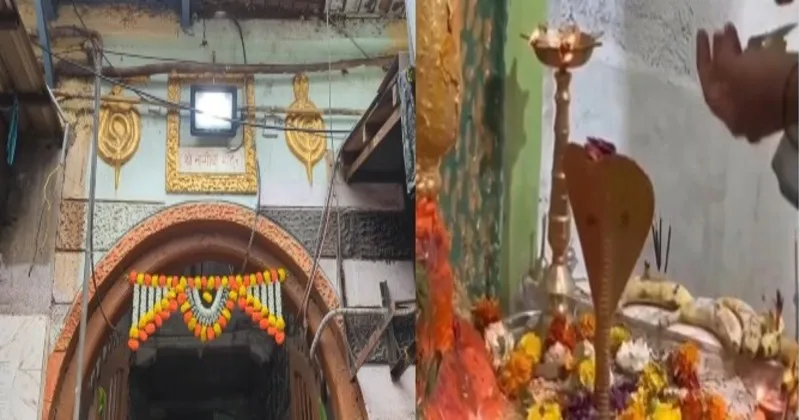
Social Media has been abuzz with several videos that highlight how a mandir dedicated to the serpent Bhagwan Nagdevtaa in Mumbai’s Nagpada area is now shut all days of the year except on Nag Panchami day.
This is not Pakistan; this scene is from Nagpada, Mumbai.
Just look at what your secularism has done
Since the Muslim population is high, the temple cannot remain open every day.
It opens only once a year, and even then under police security.
Now, the “Naxalite puppies”… pic.twitter.com/ZA4S5g9w5n
— Comman Man (@CommanMan777589) August 21, 2026
Trustees open the historically important and ancient Nagoba (serpent God) temple in Nagpada only once every year for devotees and that is only on Nag Panchami day in the monsoon month of Shravan – the annual festival of Naga Devtaa worship as per the Hindu calendar.
On asking the Nagpada Police Station officials, it was learnt that the area falls under the Sir JJ Marg Police Station. Certain sources had already told on the condition of anonymity that it was but natural that who will dare to run a temple 24X7 in an area where not a single Hindu family resides anymore and is a tightly built cluster of Muslim households. Another had informed that even on the Nag Panchami Day when devotees flock to the region, police personnel are appointed on vigil.
On quizzing why this temple is shut all round the year, the JJ Marg Police Station authorities put the onus on the temple trustees. They say say that there are other 15 Hindu temples under their jurisdiction that are open across the year. The temples dedicated to Lord Ganapati, Hanuman ji, Laxmi Narayan – to name a few deities, are open all-round the year. It is just the Nagpada based Nagoba Mandir which has a once-a-year darshan day, as decided by the trustees of the temple, they say.
It is learnt that the landlord of the premises within which the temple falls, is also a Hindu but is not known to be residing in the area. That led me to a person who has been working with Kamlesh Singh Chouhan the owner/trustee of the Nagpada mandir.
He said they could not find a single Maharaj (Hindu priest) who was ready to take on the job of priesthood at the temple for everyday worship, and that is why no one has been appointed.
On August 17, in its Facebook post, Khaki Lab, a renowned Mumbai-based conclave of the city’s ancient (and recent) history experts shared, “Today is Naga Panchami, a day dedicated to the worship of the nine principal serpent deities. #DidYouKnow? Two Mumbai areas are named after serpent deities – a Nag Devi and a Nagoba! Nagdevi Street, near Crawford Market, gets its name from the Nagdevi Mandir, while the Shri Nagoba Mandir gives Nagpada near Byculla its name.”
Certain websites say that the area’s name is an old Prakritized form of “Nag-patakha,” which appears in historical Marathi texts dating from the 15th to 17th centuries.
Hat is when this reporter came across an article in the Mumbai Tarun Bharat posted in August 2023 which offers far more clarity on the issue than any other source. The author of the piece is Malhar Krishna Gokhale a Karyakarta of the Rashtriya Swayamsevak Sangh who not only researched the piece by visiting the place and going through archival material but also fearlessly shared it for posterity.
Here’s a rough translation of what he writes:
“For the past three months or so, I had been hearing that in an area of Mumbai called Nagpada, there is a temple dedicated to Nagoba, the serpent deity, and that the locality itself was named ‘Nagpada’ after this shrine. However, the temple is situated right in the middle of a Muslim-dominated locality. I was told that it was perhaps even under the control of a Muslim person. This was supposedly the reason why the temple is opened only once a year, on Nag Panchami.
Once I learned this, I began looking through old books and references relating to Mumbai, while simultaneously trying to find out exactly where this Nagoba temple was located today. On Nag Panchami, I finally reached the temple myself. This is an account of that experience.
A reference to the temple appears in the book “Mumbai Cha Vrittaant” (An Account of Mumbai), written in 1889 by Balakrishna Bapu Acharya and Moro Vinayak Shingne.
According to the book, the locality of Nagpada in Mumbai was named after a serpent that would supposedly manifest itself on Nag Panchami and accept milk and sali (puffed rice) offered by devotees.
Among the original seven islands of Mumbai, Nagpada was a village or hamlet situated at the extreme eastern end of the main Bombay Island, near the shore of Mazgaon Island. The same book reproduces a map published in 1843 during the rule of the English East India Company. On that map, Nagpada is actually marked as the “Village of Nag.”
Looking at the demographic character of Mumbai during British rule, it appears that the Fort area was primarily inhabited by the British, wealthy Parsis, wealthy Gujarati merchants and affluent Marathi traders. Kalbadevi and Chirabazar were home to wealthy and middle-class residents. Girgaon was inhabited by the babu class, clerks employed in government offices and private commercial establishments in Fort. From Grant Road through Lalbaug and Parel, the working classes predominantly lived. Thus, even at that time, Nagpada already had a substantial Muslim population.
However, a definite difference can be noticed after the 1992-93 riots: the Muslim population in the Nagpada-Byculla area has remained largely as it was, while the Hindu population has declined. Against this backdrop, the question was: how does one find this Nagoba temple?
RSS workers are usually very good at tracking down such things. But many of the old and knowledgeable RSS workers from this area have now moved to the suburbs. Consequently, my search was not yielding results.
Finally, on the day before Nag Panchami, I received reliable information from an RSS worker. There is a place called Mastan Talao in the vicinity of the old Nagpada Road, now known as Mohammed Ibrahim Sarang Marg.
A Muslim saint named Syed Mastanshah Qadri is believed to have come to Mumbai around 1817 and settled here. Since his dargah was located on the banks of the pond, the place came to be known as Mastan Talao. In 1917, the pond was filled in and the site was converted into a playground.
Very close to this ground, in a narrow passage between two buildings, stands the temple. It remains open throughout the day only on Nag Panchami. However, contrary to what I had initially heard, I learned that the present owners of the temple are not Muslims but Hindus. I was also told that they themselves would be present there.
Accordingly, on the morning of Nag Panchami, August 21, I went to Nagpada with my RSS volunteer friend, Vishal Nakhwa.
It is an extremely rundown neighbourhood. The Mastan Talao ground itself has been modernised through the efforts of the local corporator, who is also a prospective MLA. But surrounding it are open meat shops, commercial stalls, chawls, lanes and narrow alleys.
In one of these narrow alleys was a neat wooden doorway with a signboard above it reading: “Shri Nagoba Temple.”
Curiously, I entered.
Inside was a small four-pillared shrine containing an idol of Nagoba with five raised serpent hoods. At the feet of the idol were several human-like figures, somewhat resembling the demons depicted beneath the feet of Hanuman or goddesses, as though they had been trampled underfoot. However, everything had become indistinct because of the layers of vermilion (shendur/sindoor) applied to the idol over many years.
The original idol appears to have been carved from black stone. It is approximately 5 to 5.2 feet tall. There is an extremely narrow passage behind the idol for devotees to perform pradakshina, or circumambulation.
While I was speaking to the priest, Dharmeshji (Dharmesh Chawda), the owner himself, Kamlesh Singh Chauhan, arrived.
According to the information he provided, the shrine has been owned by his family since the time of his great-great-grandfather, meaning it has remained in their possession for at least six or seven generations. He himself is a lawyer by profession and lives in Lohar Chawl near Kalbadevi.
He said the shrine is believed to be a powerful and living place of worship, where devotees’ wishes are fulfilled. People offer small silver cradles and other items to Nagoba as offerings.
When I asked why the temple is kept open only on Nag Panchami, he replied: “We have to do this only because we have no other option. There isn’t a single Hindu house in the surrounding area. Even if I appoint a permanent priest, it would be impossible for him to live here. During the 1992-93 riots, there was a strong attempt to destroy this place. Even today, troublemakers continue to dump garbage and waste in the lane opposite the temple.”
At the very least, on Nag Panchami, there is a need for the Hindu community to visit this shrine in large numbers and once again establish a Hindu presence and regular Hindu use of the place.
Just as God is expected to protect us, we too have a duty to protect and preserve our God and our places of worship.
This reporter could then contact Gokhale ji. He corroborated the above incident and findings.
He also shared some other insights and facts about the other Nag Temples in Mumbai with ancient heritage.
“The Nag Temple everyone is talking about today is in New Nagpada. But there are three other Nag Devtaa temples in the extended area that I found fascinating facts about,” Gokhale ji said.
He spoke about a temple in the Juna (Old) Nagpada area also called the Memonwada Bambkhana off the Sandhurst Road Station to the West. He said there is daily worship over there but again, Muslim majority population around it – yet thankfully due to some other conducive factors such as police station and quarters nearby etc., worship there continues.
“There is a third Naga temple in the Nagdevi Street but that mandir lies in a densely populated commercial area and out of sheer paucity of space, the roadside vendors and the permanent shop owners there have encroached upon temple area.
He also narrated an interesting story or shall I say history to the Naga mandir at Gol Deool Null Bazar area which sits right at the centre of a very busy road. “It is called the Shiv Pind Nageshwar Shiva and traffic moves on the road onits either sides. It is recorded in history that when the British East India Company (EIC) officials wanted to widen the road by felling the mandir, the workers revolted against the proposal. Yet the British officer who dared to attempt the demolition was made to eat the humble pie when several Nag emerged from the Mandir, scaring the gorra sahib who then gave up the idea and reported the scene to his senior.
Some such miracle now waits the Nagpada Naga Devtaa mandir so that regular worship begins at the place and Hindus are able to worship their jaagrit deity fearlessly.