



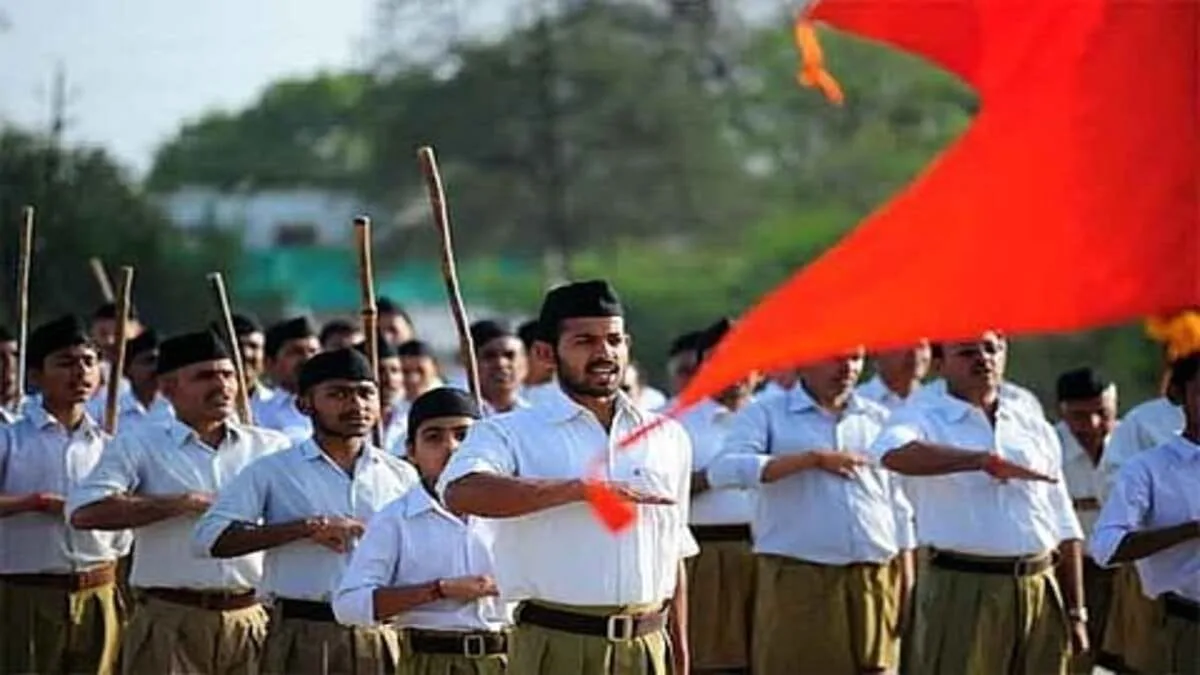
The Path Sanchalan held by swayamsevaks of the Rashtriya Swayamsevak Sangh (RSS) on the campus of Jawaharlal Nehru University (JNU) on the occasion of Vijayadashami was a remarkable sight, brimming with enthusiasm and energy. The march, which ran from Chandrabhaga to Vedant Sthal, conveyed a message of discipline, unity and dedication.
At JNU, regarded as a major centre of ideological debate in the country, this activity can also be seen in the context of the Sangh’s journey, which began in Nagpur on 27 September 1925. Having completed a century, the organisation has now entered its second centenary. In that light, the Path Sanchalan brings to the fore, with continuity, the Sangh’s founding idea, cultural nationalism, individual-building, social service and the conversation with the new generation.
A journey that began on a Nagpur ground
On the morning of September 27, 1925, the fragrance of the Vijayadashami festival hung in the air in Nagpur. For years, Dr Keshav Baliram Hedgewar had been troubled by one question: why had the ancient land of 30 crore Hindus remained under foreign colonial rule? Through his participation in various phases of the freedom struggle, his contacts with revolutionaries, his involvement in Congress activities and his imprisonment on charges of sedition, he came to feel that national liberation required not only political struggle but also the building of an organised, disciplined and self-confident society.
With this thought, he gathered a few young men on the grounds of Dr B.S. Moonje’s Shivaji School in Nagpur’s Mahal area. There, Dr Hedgewar said simply, “Come, let us play kabaddi.” From this ordinary scene of play, collective spirit and discipline, the organisational journey of the Rashtriya Swayamsevak Sangh developed. In his view, national unity is born less of any law or declaration than of its taking root in people’s conduct, mutual trust and shared responsibility.
Route March at JNU!
RSS Swayamsevaks from JNU participated in the #RSSVijayaDashami Utsav, marching across the campus from Chandrabhaga to Vedant Sthal, reflecting discipline, unity, and dedication. pic.twitter.com/5eqLqD05T8
— Friends of RSS (@friendsofrss) October 20, 2026
Cultural nationalism and ideological struggle
The year 1925 was significant in Indian political history for another reason. That year, the Communist Party of India was formally founded at the Kanpur conference. On one side, the Sangh regarded India’s civilisational heritage, Sanatan tradition, spiritual unity and cultural national consciousness as the basis for binding society together; on the other, Communist ideology placed at its centre the historical materialism of Marx and Lenin, the theory of class struggle and ideas of foreign origin.
A study of primary material relating to M.N. Roy’s book India in Transition and the Sixth Congress of the Comintern, held in Moscow in 1928, shows a deep divide between the two ideologies over India’s cultural identity and nationalism. Dr Hedgewar’s view was that it is not appropriate to understand a diverse civilisation like India solely through the conflict of economic classes, to form one’s conception on that basis and to insist on building rules or future arrangements accordingly; nor, he held, would it be possible to succeed while acting in this way. In his view, it would be difficult to bind society into one thread without awakening India’s historical consciousness and cultural soul.
RSS VijayaDashami Celebrations LIVE From Nagpur | Dr Mohan Bhagwat | Sanjay Gupta https://t.co/dP3RFrFaLS
— Organiser Weekly (@eOrganiser) October 20, 2026
Revolutionary life and role in the freedom movement
Dr Hedgewar’s life was linked from childhood with episodes of patriotism. In 1897, when sweets were distributed to mark Queen Victoria’s Diamond Jubilee, the boy Keshav questioned the idea of joining in the celebration of foreign rule. In 1908, he was even expelled from the Neel City School in Nagpur for inspiring students to support Vande Mataram.
In 1910 he went to Kolkata, where he became connected with the revolutionary network of the Dhaka Anushilan Samiti. Material relating to Trailokyanath Chakravarty’s memoirs, Thirty Years in Prison and India’s Struggle for Freedom, also shows in the historical record his contacts with revolutionaries and his participation in clandestine activities. These include contacts with revolutionaries such as Shyam Sundar Chakravarty, Pulin Behari Das and Rash Behari Bose, and mention of his alleged code name in British CID reports. It has also now come to light, on the basis of facts, that the RSS gave shelter to the revolutionary Rajguru in Nagpur.
After returning to Nagpur in 1916, Dr Hedgewar gave up the medical profession and dedicated his life to public and national activities. The resolutions on complete independence and an exploitation-free socio-economic order at the 1920 Congress session can be seen in the context of his political vision. He sought to build the Sangh’s shakha system as an organisational method that developed out of Maharashtra’s akhara culture and the public festivals of Lokmanya Tilak.
Emergence of the Sangh on Vijayadashami: A century-long journey of RSS from individual development to nation-building……
Read more at: https://t.co/eDXUwLxjBz
— Organiser Weekly (@eOrganiser) October 20, 2026
The shakha: The foundation of individual-building
In the Sangh’s shakha, physical exercise, games, yoga, collective activities, baudhik discussion and discipline are regarded as the means of individual-building. Its stated aim is to develop leadership, cooperation, devotion to duty and a sense of responsibility towards society among swayamsevaks. Dr Hedgewar’s speeches emphasised self-purification, character-building, the removal of caste discrimination and national unity, which is why, in the Sangh’s thinking, nation-building begins with the building of the individual. For this reason, the shakha is seen as the basic unit of organisation and individual-building.
A major aspect of the Sangh’s journey is social service. Its broad field of work, which one can experience firsthand, includes efforts in education, health, rural development, disaster relief, environmental protection, social harmony and reaching out to disadvantaged communities. Subjects such as kutumb prabodhan, swadeshi, civic duty, respect for women and scientific thinking have also been linked to the needs of modern times.
The Sangh completed 100 years of its founding in 2025. In 2026, the organisation is in the 101st year of its journey. This milestone also places upon it the responsibility of clarifying its role amid challenges such as dialogue with the new generation, misinformation spread through digital media, employment, economic inequality, environmental crisis and social diversity.
Indeed, the relevance of any large social organisation is determined also by how effectively it engages with different sections of society amid changing circumstances, and by how it puts its ideas into practice. For the Rashtriya Swayamsevak Sangh, nation-building for young people means more than emotional attachment: it depends on their discharging with full commitment their duties of honest performance of obligations, respect for the law, environmental protection, social sensitivity and respect for the dignity of every citizen. That young people channel their energy into creative work and contribute to making India self-reliant, developed and values-based is what the Sangh expects of the country’s youth.
#Vijayadashami | “A storm underway in the West, see what is happening in France, Albania, Nepal, Bangladesh; they think regime change will also change the situation, it has never happened.”
— RSS Sarsanghchalak Dr Mohan Bhagwat, at the RSS Vijayadashami Celebrations in Nagpur pic.twitter.com/Wov3p7eIs4
— Organiser Weekly (@eOrganiser) October 20, 2026
The message of Vijayadashami and the JNU Path Sanchalan
Vijayadashami is an occasion to remember the ideals of Bhagwan Shri Ram: duty, sacrifice, devotion and maryada. The characters of the Ramayana inspire us to put strength at the service of others, to place duty above personal interest and to make self-restraint the foundation of life. The tradition of seeing Ravana’s ten heads as symbols of ego, anger, greed and other human frailties conveys a message of victory over the self.
Indeed, the swayamsevaks’ Path Sanchalan at JNU, from Chandrabhaga to Vedant Sthal, can be viewed against this broad historical and ideological background. In the Sangh’s view, organisation, discipline and service are the foundations of the journey from individual-building to nation-building. At the same time, in any democratic society, respect for diversity of ideas, dialogue, constitutional values and the equal dignity of all citizens is just as essential.
It must therefore be said that, after a century of journey, the Sangh faces, as always, a journey that flows on like a river: linking its tradition to the future, strengthening social unity and turning dedication to the nation into concrete work for public good. The JNU Path Sanchalan is one scene from this journey, and it offers an occasion to discuss cultural nationalism, organisation, service and the role of the younger generation in India’s future.