



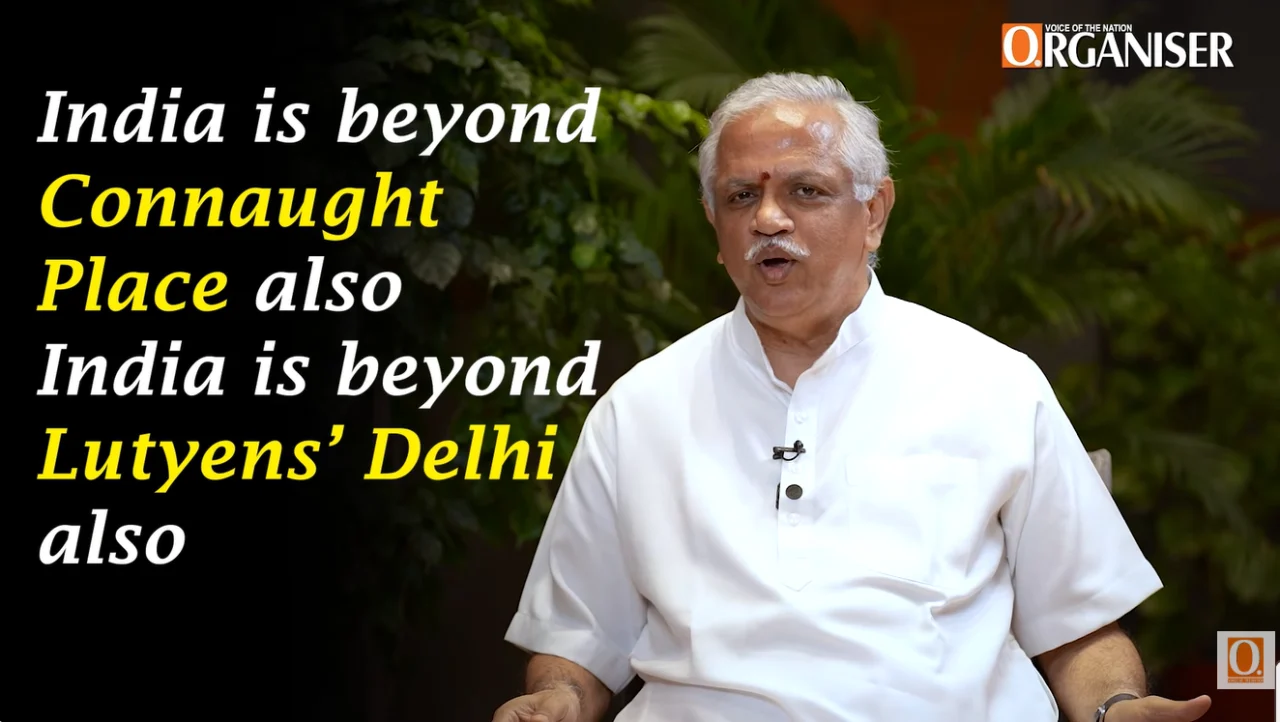
On the foundation day of Bharatiya Jana Sangh, BJP general secretary (organisation) B. L. Santhosh speaks with Organiser. In his detailed interview with Editor Prafulla Ketkar, he rejects the comparison between the Emergency of 1975 and claims of an “undeclared Emergency”, arguing that India extends far beyond Delhi’s political circles and social media debates.
Santhosh says the Emergency was the darkest chapter in Indian democratic life, imposed because of the political ambitions of a single person and family. He recalls restrictions on protests, blank newspaper pages and the role of RSS and Jana Sangh workers in resisting the Emergency.
India is not Connaught Place
B. L. Santhosh has rejected the narrative of an “undeclared Emergency” in India, arguing that the country cannot be viewed through the limited perspective of Connaught Place, Delhi, or the people who dominate social media discussions.
Responding to a question about comparisons between the Emergency imposed in 1975 and the present-day political situation, Santhosh said that India extends far beyond Delhi’s political and media circles. He argued that the debate over an “undeclared Emergency” does not reflect the concerns of people across the country.
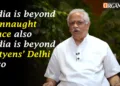
“India is beyond Connaught Place also. India is beyond Lutyens’ Delhi also,” Santhosh said during an interview with Organiser.
He added that people in many parts of the country are not necessarily concerned with the arguments dominating social media. According to him, the noise on these platforms is often viewed more critically by ordinary people than by those actively participating in online debates.
“I don’t feel there is any logic or there is any truth behind this undeclared emergency,” he said.
‘Emergency was the darkest chapter in democratic Indian life’
Santhosh drew a distinction between the Emergency imposed in June 1975 and restrictions on protests or other activities under ordinary regulations.
“The Emergency was the darkest chapter in democratic Indian life,” he said, arguing that it was neither the result of a natural disaster nor caused by externally created disturbances within the country.
“It was because of the political aspiration of a single person or a single family or a little more, a single coterie,” he said.
According to Santhosh, the country suffered the consequences of these political ambitions for almost two and a half years.
He said that restrictions on protests in particular locations should not be equated with a situation in which protests are prohibited altogether.
“Regulations are regulations. You should not protest here. You can protest at a second place is a regulation. You cannot protest at all,” he said, drawing a distinction between regulating demonstrations and prohibiting them.
‘People could not sit in the chaupal of a village’
Recalling the restrictions during the Emergency, Santhosh said its impact extended beyond political leaders and major cities to ordinary people in villages.
“People could not sit in the chaupals of a village also,” he said.
He also recalled the restrictions imposed on newspapers during the period.
“The newspapers carried empty papers because there was regulation,” Santhosh said.
Contrasting that period with the present, he argued that media organisations continue to publish criticism of the government and that independent voices operate openly on digital platforms.
“Now all the media houses are free. Nobody controls them. They write against the government also. Some of them write very nastily against the government also,” he said.
He also pointed to the presence of YouTubers who openly criticise the government.
“There are hundreds of YouTubers on the ground who are anti-government also. They are free. They’re roaming around recording everything,” he said.
Santhosh described the “undeclared Emergency” argument as a convenient narrative used by some people to create a disturbed situation within the country.
RSS and Jana Sangh’s role in the emergency resistance
Santhosh also spoke about the role of the Rashtriya Swayamsevak Sangh (RSS) and the Bharatiya Jana Sangh in resisting the Emergency.
He said RSS and Jana Sangh workers played a principal role in organising protests, supporting the leadership of other political parties and standing with democratic institutions, including the media and the courts.
“It was the RSS and the Jana Sangh leadership who took on the cudgel of protest. It was organising. It was keeping the leadership of other parties in a somewhat comfortable position and confident position,” he said.
He recalled that thousands of workers were imprisoned during the Emergency, including senior leaders and workers in villages across the country.
“Thousands and thousands of workers, they went to jail also,” he said, referring to the imprisonment of workers from the RSS and Jana Sangh.
Santhosh also highlighted the contribution of families who supported those involved in the resistance, saying that mothers and other family members provided emotional strength to the movement.
“It is a wonderful story where the society involved itself in fighting against a dictator and fighting against a system,” he said.
He expressed confidence that Indian society would resist any attempt to impose dictatorship in its social and political life.
‘Indian society will never bow down to such dictatorship’
Santhosh said the Emergency remains an important lesson for India’s political parties, administration and society.
He argued that the experience of the period had demonstrated the consequences of suspending democratic freedoms and restricting political activity.
“Indian politicians and Indian society and Indian administration has learned a very much lot from that Emergency,” he said.
He added that the experience should serve as a reminder of the consequences of authoritarian rule.
“Indian society will never bow down to such dictatorship in its social life,” Santhosh said.
He also argued that democratic traditions have deep roots in Indian society, even though the formal system of parliamentary democracy came from the West.
For Santhosh, the Emergency remains a defining episode in India’s democratic history, while the contemporary “undeclared Emergency” debate represents a different situation that, in his view, should not be equated with the restrictions imposed in 1975.