



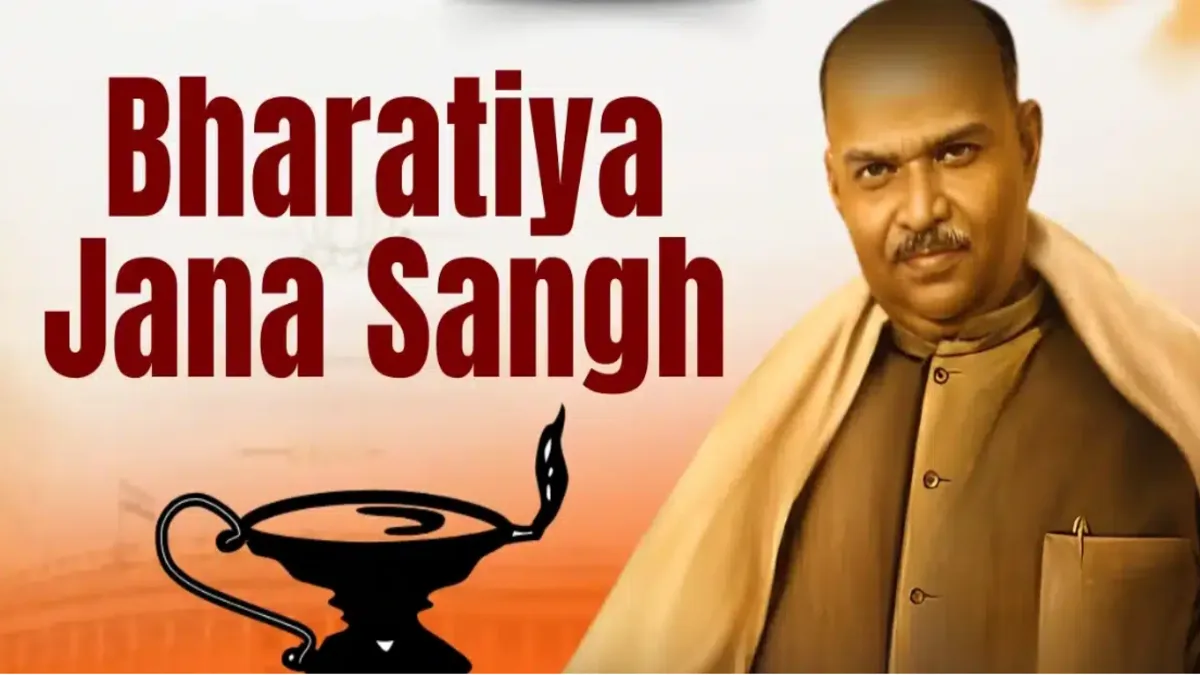
The Bharatiya Jan Sangh was established on October 21, 1951, in Delhi by Dr Shyama Prasad Mookerjee, representing the inception of a political party with a “Nation First” ideology, which later evolved into the Bharatiya Janata Party (BJP). Commemorating Dr Mookerjee’s 125th Birth Anniversary (born July 6, 1901) marks a significant historical moment. Linking these two pivotal events offers a comprehensive insight into the development of a nationalist political alternative that has transformed into Bharat’s leading ruling party today. Dr Mookerjee acted as a foundational link between the early post-independence governance and a structured political nationalist viewpoint. Following his resignation as Bharat’s first Minister for Industry and Supply in protest of the 1950 Liaquat-Nehru Pact, Dr Mookerjee aimed to create a democratic political alternative rooted in Bharat’s cultural and national values.
Collaborating with cultural and intellectual figures from the Rashtriya Swayamsevak Sangh (RSS), including Pandit Deendayal Upadhyay, Dr Mookerjee established the Bharatiya Jan Sangh (BJS) on October 21, 1951. His call for the full integration of Jammu and Kashmir (asserting that “a nation cannot have two constitutions, two leaders, or two flags”) shaped the party’s direction, vision, and fundamental principles. Dr. Mookerjee’s sacrifice in Kashmir in 1953 reinforced territorial integrity, national unity, and sparked a surge of patriotic sentiment among the broader community, serving as a guiding force for the movement’s objectives.
The development of this nationalist political movement progressed through several stages
The Bharatiya Janata Sangh (BJS) participated in its first general elections, securing three seats. Pandit Deendayal Upadhyay introduced “Ekatma Manavdarshan,” the party’s formal ideology that merges Bharatiya philosophy with contemporary social and economic welfare concepts. In 1967, the BJS became part of coalition governments in various states.
The BJS strongly opposed and worked to restore the democracy against the state of emergency declared by Prime Minister Indira Gandhi between 1975 and 1977. To combat the authoritarian and unconstitutional regime, the BJS merged with the multi-party Janata Party in 1977, with prominent leaders like Atal Bihari Vajpayee and L. K. Advani joining the union cabinet.
After disagreements with the Janata Party, former members of the Jana Sangh left to form the Bharatiya Janata Party (BJP), with Atal Bihari Vajpayee as its founding president. Starting from just two seats in 1984, under L. K. Advani’s leadership, the BJP strongly adopted a culturally nationalistic approach and advanced the Hindutva principles, spearheading the Ram Janmabhoomi movement throughout the nation. The party quickly grew, becoming the largest single party in the 1996 general elections. Under Atal Bihari Vajpayee, the National Democratic Alliance (NDA) government proved that a non-Congress coalition could complete a full five-year term while promoting developments in nuclear capabilities, the economy, and infrastructure.
Currently, under Prime Minister Narendra Modi, the BJP achieved full parliamentary majorities in the 2014 and 2019 general elections, fulfilling fundamental commitments that stem from Dr. Mookerjee’s vision and “Nation First” ideology from 1951, including the repeal of Article 370 in Jammu and Kashmir in 2019. The influence of dynastic politics and vote bank politics has diminished during Modi’s administration.
Economic, Political and Cultural Framework
In the 1950s, Bharat’s economic framework was largely shaped by then PM Jawaharlal Nehru’s Five-Year Plans and a strong emphasis on central planning and public-sector dominance. In contrast, the Jana Sangh, led by Dr. Syama Prasad Mookerjee and later articulated by Pandit Deendayal Upadhyaya, offered a different approach:
– Opposition to State Socialism and Centralization: The BJS criticized the Soviet-style state planning, asserting that excessive governmental control leads to bureaucratic corruption and hinders individual entrepreneurship.
– Emphasis on Small Enterprises and Agriculture: The BJS manifesto of the 1950s championed agriculture, small-scale village industries, and local artisans over large, state-run heavy industries.
– Swadeshi (Self-Reliance): There was a strong focus on domestic production to reduce dependence on foreign debt or aid, aiming for economic independence shortly after gaining independence.
Support for Traders & Small Businesses: BJS has established itself as a champion for small traders, merchants, and self-employed individuals in response to increasing state taxes and licensing requirements.
While maintaining the core principles of Swadeshi and Antyodaya (catering to the most marginalized), the contemporary BJP has adapted its strategies to thrive in a globalized, tech-oriented 21st-century economy:
Pragmatic Market Economy: The modern BJP’s policies integrate market-oriented growth with state involvement, promoting private investment, foreign capital, and large-scale industry while also financing substantial public infrastructure projects (such as highways, railways, ports, and digital networks).
Atmanirbhar Bharat (Reimagined Swadeshi): Unlike the isolationist self-sufficiency of the 1950s, the current Atmanirbhar Bharat initiative seeks to position Bharat as a resilient player within global supply chains through programs like Production Linked Incentive (PLI) schemes.
Digital Public Infrastructure (DPI): The party has led the charge in developing Bharat Stack (including Aadhaar, UPI, and DigiLocker), using technology to formalize the economy and reduce inefficiencies in public welfare distribution.
Capital Expenditure and Supply-Side Reforms: Contemporary policy emphasizes capital investment (CapEx), tax reforms (including corporate tax reductions and GST standardization), and improving the business environment to draw in global investors. The Antyodaya initiative has transitioned from a community-driven voluntary concept to a data-oriented, state-managed welfare program that provides housing, sanitation, electricity, and health insurance to millions of families.
Historically, Bharatiya electoral strategies relied on specific caste alliances (Mandal politics). The BJP introduced an additional cross-caste voter segment known as Labharthis, which includes individuals benefiting from direct government assistance such as housing (PM Awas), LPG connections (Ujjwala), sanitation facilities, and cash transfers (PM-KISAN).
The BJP developed an unparalleled organizational framework by mobilizing at the panna pramukh (page-in-charge of electoral rolls) level and employing real-time digital communication, resulting in a continuous campaign structure. By directly transferring subsidies, pensions, and assistance payments into bank accounts through Unified Payments Interface (UPI) and Aadhaar, the state established a direct connection with citizens, promoting its welfare delivery as effective and secure.
Instead of utilising welfare as selective political incentives, the government adopted a strategy focused on “saturation,” aiming for complete coverage of designated initiatives and emphasizing governance as a matter of service delivery rather than policy discussions. For years, the BJP’s core ideological commitments were dismissed by political rivals as mere electoral strategies that wouldn’t endure due to the constraints of coalition politics. With Modi’s majority rule, the BJP implemented its historic ideological, constitutional and national agenda:
Abrogation of Article 370 (2019): This measure eliminated the special autonomous status of Jammu & Kashmir, fully integrating the region into the Bharatiya constitutional system—fulfilling a promise made during Syama Prasad Mookerjee’s founding of the party in 1951.
Ram Mandir Construction (2024): This initiative addressed a long-standing movement of significant cultural importance, establishing cultural nationalism (Hindutva) as a key national force.
Citizenship Amendment Act (CAA): This law introduced changes allowing faster citizenship for persecuted religious minorities from neighboring countries.
Infrastructure as Political Capital: The construction of highways, high-speed rail, airport expansions, and digital infrastructure shifted from being mere technical administrative concerns to key highlights in electoral campaigns.
Foreign Policy as National Pride: Foreign policy became a tool for domestic political messaging, with significant international events (like the G20 presidency) and strong national security policies showcased to voters as evidence of Bharat’s increasing prominence on the global stage (Vishwamitra / Global South leadership).
By extending its influence into less traditional regions (like the Northeast) and uniting non-dominant voter groups such as the Backward Class (OBC) and Dalits, the BJP elevated the baseline required for national electoral success. This prompted opposition parties to unite in multi-party national coalitions (like the I.N.D.I.A. bloc) and strive to challenge the BJP’s combination of welfare initiatives and nationalist perspective.
Time for the BJP to move strongly keeping the vision of Dr Shyama Prasad Mookerjee’s to make nation developed by 1947.