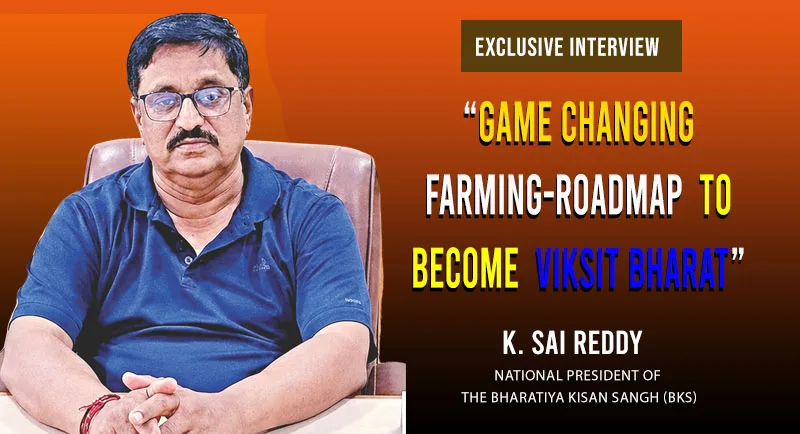
On the verge of creating a record economic transformation, Bharat is rapidly establishing itself & is surpassing the world’s leading economies. It is certain that the goal of becoming a developed nation by 2047 will not be achieved through industrial growth alone, but also by agriculture. In this huge shift, rural Bharat is playing a big role. This has been possible due to hard work & perseverance of our farmers as well as Bharatiya Kisan Sangh (BKS), which was set up by Rashtra-Rishi Dattopant Thengadi. BKS has played a seminal role in boosting Bharat’s agriculture by consistently advocating for indigenous agricultural models. However, farmers across the globe are nowadays grappling with as climate change, & depletion of natural resources. Against this background, K. Sai Reddy, National President of the Bharatiya Kisan Sangh (BKS), recently had a conversation with Organiser’s representative Dr Mayank Chaturvedi. Excerpts
Bharat is securing a place among the world’s leading economies. How do you view the current situation of the Bharatiya farmer in this context?
Bharat’s economic progress is certainly encouraging, and it is currently among the world’s fastest-growing economies. However, if the farmer does not become economically strong during this journey of development, that growth will remain incomplete. Bharat’s soul resides in its villages, and the farmers are the consciousness of those villages. Therefore, the vision of a developed Bharat will only be realised once farmers are prosperous, self-reliant, and earn a dignified income.
Despite limited resources, Bharatiya farmers have made the country self-reliant in food grain production. Bharat holds a significant global position in the export of rice, wheat, fruits, vegetables, dairy products, spices and various other agricultural commodities. This achievement is the result of the tireless hard work of crores of farmers; yet the reality that the cost of farming continues to rise also remains. Escalating expenses for diesel, electricity, seeds, fertilisers, pesticides, agricultural machinery, and labour have placed increasing financial pressure on small and marginal farmers. There remains a pressing need for both the central and state governments to pay close attention to this issue.
The Bharatiya Kisan Sangh holds the firm view that increasing farmers’ income should be the central focus of agricultural policy. For years, agriculture was evaluated based on “yield per hectare,” but the time has now come to make “income per farmer” the key benchmark for national development. If farmers receive remunerative prices commensurate with their costs, along with stable markets, modern technology, processing facilities and export opportunities, Bharat can not only emerge as an agricultural superpower but also assume global leadership in the agricultural economy.
What is the BKS’s current stance regarding the Minimum Support Price (MSP), remunerative prices and agricultural markets?
The Bharatiya Kisan Sangh holds clear view that farmers should receive a truly remunerative price for their crops, rather than just the declared MSP. While MSP serves as a crucial safety net for farmers, merely announcing a price is insufficient. If a farmer does not actually get the opportunity to sell their produce at that price, the very purpose of the MSP remains unfulfilled.
Most farmers in the country sell their produce in the open market, where they often receive prices lower than the declared support price. Therefore, there is a need for a system that makes the market more transparent, competitive and farmer-friendly. Farmers should have a wider range of options; they should not be dependent on a single ‘mandi’ or a single buyer.
Does India now need a comprehensive and long-term national agricultural policy? What role will it play in achieving the goal of a ‘Viksit Bharat’ by 2047?
The time has certainly come for Bharat to formulate a comprehensive, long-term national agricultural policy that addresses the needs of the next 25 years. The challenges are manifold. Issues such as climate change, the water crisis, global trade, food security, agricultural exports, modern technology and farmers’ income are interconnected; therefore, a coordinated approach is required rather than fragmented schemes.
We envision a policy that offers States sufficient flexibility, given India’s geographical diversity, to implement state-level, farmer-centric policies tailored to their local conditions. Indeed, the dream of a ‘Viksit Bharat-2047’ will only be realised if villages are economically strong, and villages will only be strong if farmers are prosperous. We must all recognise today that agriculture generates employment, supplies raw materials to industries, boosts exports, and serves as the foundation of the nation’s economic stability.
What is the Bharatiya Kisan Sangh’s perspective on natural farming, organic farming and the growing reliance on chemical fertilisers?
The Bharatiya Kisan Sangh believes that the future of Bharatiya agriculture lies in farming practices that protect nature, the soil and the farmer, alongside ensuring productivity. Natural farming is the core tradition of Indian agriculture. For centuries, our farmers cultivated the land using local resources while maintaining soil fertility. In recent decades, the excessive use of chemical fertilisers and pesticides has boosted production but has also adversely affected soil health, water sources, and farmers’ input costs.
“The Bharatiya Kisan Sangh holds clear view that farmers should receive a truly remunerative price for their crops, rather than just the declared Minimum Support Price (MSP). While MSP serves as a crucial safety net for farmers, merely announcing a price is insufficient.”
Rising cultivation costs have become the biggest challenge facing farmers today. The increasing dependence on chemical fertilisers and pesticides is making farming expensive. In this context, natural farming offers a superior alternative; it reduces production costs, improves soil quality, and boosts farmers’ income in the long run. We believe that with government support, natural farming can become a practical, sustainable and profitable agricultural model for India.
If you were to offer the Government the five most important suggestions for increasing farmers’ income and implementing agricultural reforms, what would they be?
If we were to set priorities for agricultural reforms in the country, the foremost suggestion would be to make “farmers’ income” the central focus of the National Agriculture Policy. Sustainable transformation in the agricultural sector is impossible unless the ultimate objective of policymaking is to strengthen the farmer’s economic standing. The second key suggestion is to turn water conservation into a national campaign. Although significant work is already underway in this area, many regions still require focused attention.
The third priority is to promote natural and low-cost farming based on scientific principles. Reducing input costs for farmers will naturally lead to higher profits. The fourth suggestion involves developing infrastructure for agricultural processing, storage and value addition right at the village level. If farmers bring processed products to the market instead of just raw produce, their income could increase manifold. Finally, the fifth suggestion is to establish direct communication among agricultural research institutes, agricultural universities, ‘Krishi Vigyan Kendras’, and farmers themselves. Technology developed in laboratories can only be considered successful if it reaches the fields and directly resolves farmers’ actual problems.
What role will agriculture play in achieving the goals of ‘Atmanirbhar Bharat’ and ‘Viksit Bharat–2047’? What is your message to the country’s farmers?
The Government is already doing commendable work in this direction. Over the past 12 years, the Modi Government at the Centre has taken several significant and swift policy decisions to empower farmers across the entire value chain, from “seed to market.” Union Agriculture Minister Shri Shivraj Singh Chouhan recently adopted a ‘Team India’ approach during the National Agriculture Conference to formulate a shared agricultural roadmap with the States, thereby fostering better coordination between the Centre and the states. To enhance convenience for farmers, more than 15 distinct digital information platforms have been integrated into a single unified digital platform, making access to all Government services much easier.
Furthermore, a nationwide mass movement, the “Khet Bachao Abhiyan“- was launched on June 1st to promote balanced fertiliser use and improve soil health. The Bharatiya Kisan Sangh believes that in the coming years, it is essential to move beyond a purely production-centric mindset in agriculture and work towards a long-term plan that integrates value addition, processing, technological innovation, water management, natural farming and global competitiveness.