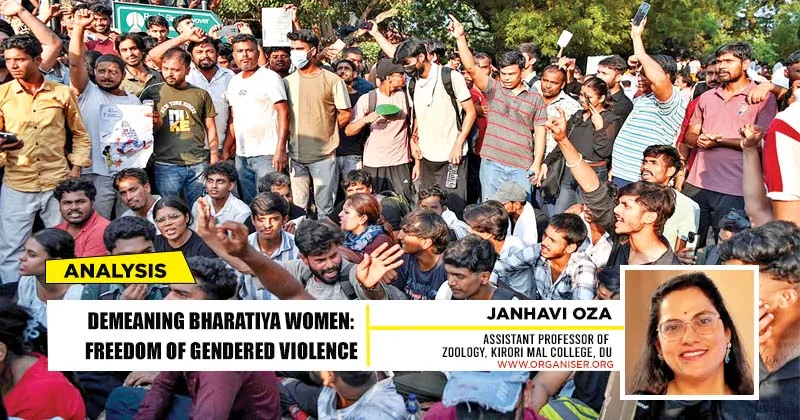
Democracy is not measured by the silence of its people, but rather by the voice of their dissent. Dissent is how a republic honours its own promises; the way in which the ruled hold the rulers accountable for what they have been promised and have not delivered. Generation Z in India has embraced this legacy with great passion and zeal, protesting against gender-based violence, unemployment, caste discrimination, environmental degradation, and the gradual dismantling of democratic safeguards. It is a generation whose words echo and safeguard the Constitution of India’s emphasis on equality, dignity, and justice. But if one listens carefully to this dissident voice, one finds a rupture. The language used to articulate it belongs to the same oppressive hierarchy that the generation is fighting against. Political protests are sites where dissent is articulated through speeches, slogans, symbols, and performances. While slogans often mobilise collective action and express resistance, they may also be a representative of social hierarchies. During the CJP protest, numerous news reports and publicly circulated videos documented the use of abusive language by sections of the crowd. Many of these abuses employed gendered and patriarchal expressions, illustrating how deeply embedded patriarchal linguistic practices are.
Extending political abuse to non-political family members—particularly through gendered insults—does not strengthen political criticism. Instead, it shifts the discourse from accountability to symbolic violence rooted in patriarchal cultural assumptions
This is no small sin of style. As Pierre Bourdieu pointed out in Language and Symbolic Power (1991), language is always more than a neutral channel; it is always an instrument of power that rehearses the ordering of society each time it is used. This process can be seen none so well as in the structure of CJP’s abuses, which were delivered directly to the men it is aimed at; and in an attempt to raise the bar of humiliation, it travelled through their mothers, sisters, wives, and daughters. The idea of the abuses was the same as those seen in any earlier generations: the man is disgraced only if the family woman is shamed.
Ethical Question Vs Legal Question
Political protest derives much of its democratic legitimacy from the constitutional guarantee of freedom of expression. In India, Article 19(1)(a) of the Constitution protects the right to express dissent, criticise the Government, and participate in public debate. Protest slogans, satire, ridicule, and even harsh criticism are therefore integral to democratic politics.
From a constitutional perspective, many offensive slogans may still fall within the broad protection of political speech unless they cross legal thresholds such as incitement to violence, criminal intimidation, or unlawful hate speech. Yet the ethical question is different from the legal one. Speech may be constitutionally protected while simultaneously reinforcing harmful social norms.
This presents an issue that no movement that claims the terminology of equality will be able to avoid forever: How to fight a patriarchal world using the very language patriarchy created. As Dale Spender pointed out in Man Made Language (1980), the structure of language itself is patriarchal, and using it normally means reinforcing hierarchies. Judith Butler went one step further; according to her, gender is not an inherent characteristic but rather a performance. Each insult screamed angrily in frustration is not just a random word. It is a practice. When repeated enough times, in enough cities, by enough people, it is not just an expression of patriarchy but the creation of a new patriarchy. This creates an irony, especially when put into the context of how Generation Z sees itself. Generation Z is the generation that grew up learning about intersectionality, queer rights, and constitutional morality. And yet awareness is not the same as practice. And justifying foul language in the name of outbursts of anger or any such terminology must not be acceptable in any civic society.
News organisations subsequently face the challenge of balancing factual reporting with responsible reproduction of abusive language. Many reports described the presence of objectionable or profane slogans without reproducing the exact wording. Meanwhile, social media circulated uncensored recordings. However, social media is not responsible for this paradox, yet it is the one that has industrialised it. The platforms are constructed in such a way that they promote velocity and heat along with accuracy and moderation. A political dispute online does not usually stay political; it deteriorates into a battle of efficiency, which is why gendered insults become the fastest tool of this battle. Algorithms do not make distinctions between justifiable anger and misogyny; they promote anything that causes a response from users. An insult that could have been said in a private argument becomes public, is indexed and shared via screenshots. Bell hooks knew that domination would not exist solely due to laws but through habits, ordinary transactions of everyday life, linguistic expressions that do not sound like violence anymore. This is exactly why linguistic patriarchy is so powerful. It is not an ideology anymore but simply the way people speak when they are angry. Yet every single time an insult objectifies women as a vessel of family honour and sexuality, it reinforces the old lesson that women’s bodies are fair game in other people’s conflicts.
Among the reported abusive slogans during sections of the CJP protest were insults directed not only at political leaders but also at the Prime Minister’s mother. Extending political abuse to non-political family members—particularly through gendered insults—does not strengthen political criticism. Instead, it shifts the discourse from accountability to symbolic violence rooted in patriarchal cultural assumptions. The issue is not merely that a politician’s mother was insulted, but that political abuse relied on the symbolic degradation of a woman who was not herself the object of political criticism in the first place. The recent reaction of our Prime Minister to the whole issue was exactly what any elder of the family would have done for the misdeeds of the younger generation; he forgave with an emphasis on correction in the attitude of the young protesters.
A movement can hardly demand respect for the dignity of women in politics if it violates women’s dignity in its language
This is not an appeal for a lower, civil approach to protest. No dissent in a democracy ever had any requirement to be polite, and it still shouldn’t. Anger has fuelled every important movement in our history, starting with the fight for freedom, and will have to continue to. The point being made is more specific, and in some ways more difficult: that the methods of dissent do not contradict its goals. A movement can hardly demand respect for the dignity of women in politics if it violates women’s dignity in its language. Having been a part of several protests as a student activist, I have witnessed and been a fierce advocate for equality and rights for all sections of society. In my years of activism, we stood against the government and even the then education ministers for rights to a hike in scholarships, gender equality on campuses, rights of PHD students and several such issues. And we did it with hundreds and sometimes thousands of students, but never for even once we saw such a steep down approach from the students in the protests. We witnessed how an aware and educated crowd reacts and protests. There was dissent, there was anger, there was impoliteness. But no gender-based abuses. Never. The reported use of patriarchal abuse by some participants of CJP’s protest was viewed by many commentators as inconsistent with the egalitarian values that youth-led democratic movements often seek to project.
The chants, which turned into abuses for the politician, turned into abuses for their mother. The recent public apologies issued by some participants in the protest invite reflection on the role of peer influence and the Fear of Missing Out (FOMO) in contemporary youth mobilisation; they suggest that crowd dynamics and the desire to conform to group behaviour may have influenced some individuals’ actions. The subsequent apologies by some participants may indicate that, once removed from the emotionally charged atmosphere of the protest and the immediate influence of peers and social media, they reassessed the appropriateness of their conduct. Rather than viewing these apologies solely as admissions of individual wrongdoing, they may also be understood as evidence of how collective emotions, peer pressure, and the performative dynamics of digitally mediated protests can shape behaviour in ways that participants later regret. I hope we understand with this one- of- a- kind of protest… this was not cool.