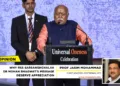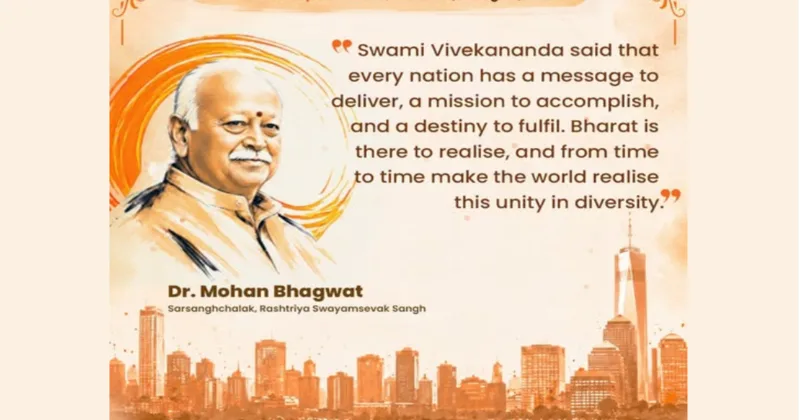
The message delivered to the Western world by Rashtriya Swayamsevak Sangh (RSS) Sarasanghchalak Dr. Mohan Bhagwat is significant for many reasons. At its core, it reminds the world of the inclusive character of Hindutva and challenges several misconceptions that have been deliberately or casually associated with it. At a time when attempts are often made to construct a narrative around phrases such as “Hindutva terror”, it becomes important to understand what Hindutva actually represents and, more importantly, how its civilisational philosophy has manifested itself in practice.
The essence of this message is not new. More than 130 years ago, Swami Vivekananda articulated a remarkably similar idea before the Western world. On September 11, 1893, at the World’s Parliament of Religions in Chicago, Swami Vivekananda introduced the spiritual tradition of Bharat to an international audience. His address became a turning point in the global perception of India and its philosophical traditions. Instead of presenting Hinduism as a faith that sought to establish its superiority by rejecting others, Vivekananda presented it as a civilisation capable of accepting diversity without losing its own identity.
He famously declared:
“I am proud to belong to a religion which has taught the world both tolerance and universal acceptance.”
He went even further:
“We believe not only in universal toleration, but we accept all religions as true.”
These were not merely diplomatic words intended to impress a foreign audience. They reflected a deeply rooted civilisational worldview.
Vivekananda also spoke with pride about India’s historical role in providing refuge to communities facing persecution. In the same address, he said:
“I am proud to belong to a nation which has sheltered the persecuted and the refugees of all religions and all nations of the earth.”
This is an important dimension of understanding Hindutva. It is often interpreted through a narrow political lens, while its civilisational and philosophical foundations are ignored. The Hindu tradition has historically accommodated multiple schools of thought, forms of worship and philosophical interpretations. The existence of diversity within Hindu society itself demonstrates that uniformity has never been the only basis of social cohesion in the Indic civilisation.
The principle is reflected in the ancient Indian idea of Vasudhaiva Kutumbakam—the world is one family. It is not simply a slogan invented for contemporary diplomacy. It represents a worldview in which humanity is understood through interconnectedness rather than permanent conflict between communities and civilisations. This civilisational outlook was also prominently showcased by Bharat during its G20 Presidency. The theme “Vasudhaiva Kutumbakam – One Earth, One Family, One Future” placed an ancient Indian philosophical idea at the centre of a contemporary global platform.
But the real test of any philosophy is not what is written on banners or spoken from podiums. It is how that philosophy is translated into action. The COVID-19 pandemic provided one such opportunity. During one of the most difficult periods in recent global history, Bharat extended medical assistance, medicines and vaccines to numerous countries. Through initiatives involving grants, commercial supplies and vaccine-sharing mechanisms, India provided vaccines and medical assistance to countries across the world. The effort demonstrated that international cooperation, from the Indian perspective, need not always be driven solely by strategic calculations.
Perhaps one of the most striking examples was Pakistan. India and Pakistan have a deeply complicated relationship, marked by wars, terrorism, political hostility and decades of mistrust. Yet even towards a country that has repeatedly been in conflict with India, the Indian approach has not been based on the principle that humanitarian concern should disappear because of political disagreements.
This distinction is important. It demonstrates that compassion and national interest do not necessarily have to be contradictory. A nation can remain firm in defending its sovereignty and security while simultaneously recognising the suffering of ordinary human beings beyond its borders. That is where the broader civilisational idea of Bharat becomes relevant. The Indian worldview does not demand that differences disappear before dialogue or compassion can begin. It recognises plurality as a fact of human civilisation. Different paths, beliefs and practices may exist, yet they need not automatically lead to hatred.
This is also why the idea of Hindutva needs to be understood beyond simplistic political labels. If Hindutva is reduced merely to an electoral slogan, its civilisational dimensions disappear from the discussion. The broader Indic idea associated with Hindutva is rooted in a cultural and civilisational understanding of Bharat—one that recognises the land as a shared home and respects plurality while retaining a distinct civilisational identity.
Swami Vivekananda’s words in Chicago remain relevant precisely because they provide an intellectual framework for understanding this approach. His confidence did not emerge from an inferiority complex. He did not tell the West that India would become modern by abandoning its civilisational roots. Instead, he presented India’s spiritual inheritance with confidence while simultaneously affirming respect for other traditions.
That combination—civilisational self-confidence and universal acceptance—is perhaps one of Bharat’s most important contributions to the contemporary world. Today, when global politics is increasingly marked by polarisation, identity conflicts and competing civilisational narratives, the Indian approach offers another possibility. It suggests that diversity does not necessarily have to become a source of permanent conflict. A society can preserve its cultural identity while respecting the identities and beliefs of others.
The message emerging from the RSS leadership, therefore, deserves to be examined in this larger historical and civilisational context. It is part of a continuing conversation about what Hindutva means and how the idea of Bharat understands society, diversity and humanity. Those who attempt to portray Hindutva exclusively through the prism of violence or “terror” should also engage seriously with this intellectual and historical tradition. Criticism is legitimate in a democracy, but criticism must be accompanied by an honest engagement with the philosophy being criticised.
The Bharat that Vivekananda presented in Chicago in 1893 was confident, inclusive and deeply rooted in its own civilisation. The Bharat that invoked Vasudhaiva Kutumbakam before the world during its G20 Presidency sought to carry that civilisational message into contemporary international relations. And the Bharat that extended medical assistance across borders during a global pandemic demonstrated that these ideas can also find expression through action.
The question before the world, therefore, is not simply what Hindutva is called by its critics. The more important question is: what does the civilisational tradition of Bharat actually teach?
Its answer, articulated by Vivekananda more than a century ago, remains remarkably clear—respect for diversity, acceptance of different paths, compassion for humanity and confidence in one’s own civilisational identity. That is the India the world heard in Chicago in 1893. And that is the India that Bharat continues to present to the world today.