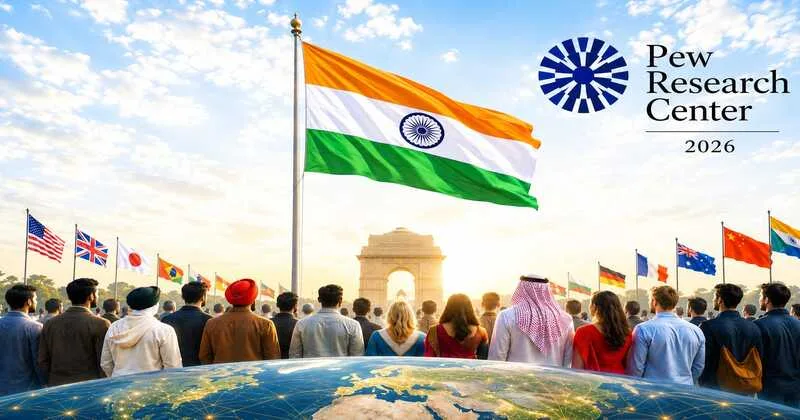
As Bharat celebrates 80th Independence Day, a new international survey points to a broadly positive global image of the country. The Pew Research Centre’s 2026 Global Attitudes Survey conducted across 36 countries between February 8 and May 13, 2026, found a global median of 45 per cent holding a favourable opinion of India, compared with 41 per cent expressing an unfavourable view. The findings, published by the Pew Research Centre in 2026, show that Bharat commands substantial goodwill across strategically important parts of Asia, Africa and Europe, even as perceptions remain sharply divided in some countries.
The overall picture is therefore far from one of global rejection. Rather, the survey indicates that India has become a country about which people increasingly hold definite views, reflecting its growing economic weight, diplomatic reach, strategic partnerships and expanding role in world affairs. The strongest positive assessments come from countries with which India has developed deep economic, cultural or strategic relationships, while the most hostile views are concentrated in countries where geopolitical rivalry, political tensions or competing narratives strongly influence public opinion.
Bharat’s neighbourhood and Asian partners reflect strong goodwill
Sri Lanka stands out as the country with the most favourable perception of India, with 79 per cent of adults expressing a positive opinion and only 11 per cent holding an unfavourable view. Around 63 per cent of Sri Lankan respondents also identified India as their country’s key ally. The result represents a substantial improvement from 2024, when 65 per cent of Sri Lankans surveyed viewed India favourably.
The improvement comes against the backdrop of a significant reset in India-Sri Lanka relations. During Sri Lanka’s severe economic crisis and political unrest in 2022, India extended extensive assistance, including credit lines and financial support exceeding USD 7.5 billion. The goodwill reflected in the Pew findings therefore comes amid a period in which India’s role as a close and dependable neighbour has become particularly visible.
PM Modi from Red fort:
India's profile has grown globally. With 40 countries we are having FTA. These trade agreements are a big opportunity. India's products should reach global markets – from textile to seafood. pic.twitter.com/uTPzuycsux
— Sidhant Sibal (@sidhant) August 15, 2026
Kenya and the United Kingdom are also among the countries most positive towards India, with 71 per cent in each expressing favourable views. Germany follows at 63 per cent, while Israel records 60 per cent, Italy 56 per cent and Sweden 55 per cent. Majorities in Japan and Thailand also view India favourably, with 55 per cent in each country, while 51per cent of respondents in Singapore and 50% in Indonesia express positive opinions. The Philippines records 49 per cent favourable views.
These figures underline the breadth of India’s international appeal. The positive assessments are not confined to one geographical region or political grouping. They extend from South Asia and Southeast Asia to Africa, Western Europe and the West Asia, suggesting that India’s rise is being recognised across diverse parts of the international community.
Pakistan, Bangladesh and Turkey stand out as outliers
India’s immediate neighbourhood presents the sharpest contrast in the survey. Sri Lanka’s 79 per cent favourable rating stands at one end, while Pakistan occupies the opposite extreme. Only 7 per cent of Pakistanis express a favourable opinion of India, while 91 per cent hold an unfavourable view.
The result reflects the long history of conflict and rivalry between the two neighbours. Relations deteriorated further following the May 2025 hostilities and India’s suspension of the Indus Waters Treaty. The survey was also conducted after the Pahalgam terror attack and India’s Operation Sindoor in 2025, during which India struck terror infrastructure and Pakistani military targets in response to the attack.
Bangladesh has also witnessed a marked deterioration in perceptions. Only 42 per cent of respondents now express a favourable view of India, while 51 per cent hold an unfavourable opinion. Compared with Pew’s 2024 survey, favourability has fallen by 15 percentage points. At the same time, the share expressing no opinion has dropped sharply from 24 per cent to 7 per cent, indicating that more Bangladeshis now hold a defined view of India, and that the balance of those views has become less favourable.
Turkey is another major outlier, with only 15 per cent of respondents holding a favourable opinion of India. In the West Bank and East Jerusalem, the corresponding figure is 18 per cent. Malaysia, which witnessed an “India Out” campaign in 2024, records 58% unfavourable views. Australia also records a predominantly negative assessment, with around 55% viewing India unfavourably.
Europe and Africa reflect growing goodwill
One of the more encouraging features of the findings is the improvement in India’s image across important European countries. Germany’s favourable rating has risen from 47% in 2023 to 63% in 2026. France has similarly moved from 39% in 2023 to 50% today. Britain’s favourable assessment has increased by 11 percentage points since 2025, while Germany’s has risen by six points. Sri Lanka has recorded an even stronger 14-point increase since 2024.
#WATCH | South Africa | Prime Minister Narendra Modi witnesses a spiritual performance as he arrives at a hotel in Johannesburg.
PM Modi will attend the 20th G20 Leaders’ Summit
(Source: ANI/DD) pic.twitter.com/gS3pHGTdz7
— ANI (@ANI) November 21, 2025
These improvements suggest that India’s expanding engagement with Europe is translating into a more favourable public perception. Strategic partnerships, trade, technology cooperation and India’s increasingly prominent role in global affairs have created a wider international visibility that goes beyond traditional diplomatic relations.
Africa also remains an important source of goodwill. Kenya’s 71% favourable rating places it among the strongest supporters of India in the survey. The broader positive perception in parts of Africa reinforces the importance of India’s longstanding development partnerships, people-to-people connections and engagement with the Global South.
The picture is less favourable in Latin America, where public opinion tends to be mixed to negative and substantial shares of respondents do not express an opinion. This indicates that India’s global image is not uniform and that its growing influence has yet to translate into the same level of public familiarity everywhere.
Asia presents a similarly mixed but generally significant picture. Japan records 55 per cent favourable views, Thailand 55 per cent, Singapore 51 per cent, Indonesia 50 per cent and the Philippines 49 per cent. South Korea, however, has moved in the opposite direction: 44% now view India favourably, compared with 59 per cent in 2023.
Bharat’s growing global influence wins wider recognition
The United States offers perhaps the clearest example of an increasingly divided perception. Forty-five per cent of Americans have a favourable opinion of India, while 50% express an unfavourable view. Pew notes that the favourable rating has fallen from 51% in 2023 to 45% in 2026, placing current sentiment among the lower levels recorded since 2008.
Yet the American assessment is also politically differentiated. Around 50% of Democrats express a favourable opinion of India, compared with 42 per cent of Republicans. In Canada, the ideological divide is even more pronounced, with 58 per cent on the left holding favourable views compared with 45% on the right. Israel shows almost the reverse pattern: 68 per cent of those on the political right view India favourably, compared with 46 per cent on the left.
Delhi: The NDA Parliamentary Party's 'Mangal Milan' meeting at the Parliament Library Building began with chants of 'Vande Mataram'.
Prime Minister Narendra Modi, Union Home Minister Amit Shah, BJP National President Nitin Nabin, and other NDA leaders are attending the meeting. pic.twitter.com/OYEs51SjT9
— IANS (@ians_india) August 11, 2026
The findings demonstrate that India’s image is increasingly intertwined with the domestic political debates of other countries. Perceptions of Bharat are shaped not merely by bilateral relations but also by how different political constituencies understand its civilisational identity, foreign policy and emerging role in global affairs.
As Bharat enters its 80th year of Independence, the Pew findings offer an important measure of its changing global stature. From Sri Lanka and Kenya to Britain, Germany, Israel, Japan and Thailand, substantial sections of the world see India positively.
The central message of the 2026 survey is clear that India’s global image is becoming more consequential because India itself is becoming more consequential. On the eve of its 80th Independence Day, Bharat stands as a country increasingly seen, discussed and judged across the world, with considerable goodwill already established and a larger global role still taking shape.