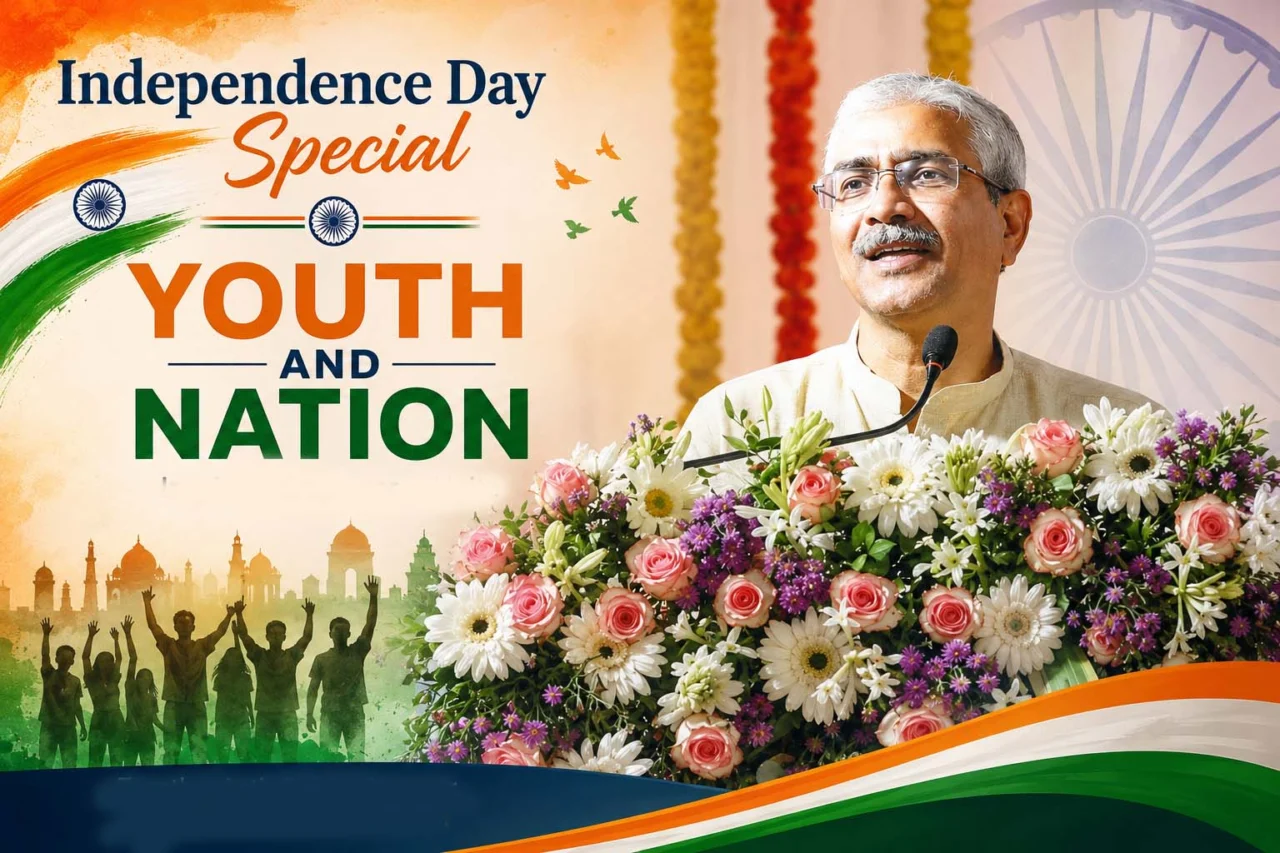
Youth represents energy, courage, adventure, bravery and a willingness to sacrifice everything. That is why it is often observed that the songs on the lips of the youth indicate the future of a country. These are not merely songs; they represent the dreams and aspirations of young people, the values in which they believe, their ideals and their outlook. If these songs are of patriotism, courage, innovation and unity, the dreams that the country has for its youth and the country’s future would be positive. But if these songs are of rebellion, hatred, selfishness, disappointment and indifference, the country’s future cannot remain secure. In this context, the relevance and importance of organisations working amongst the youth with a national outlook become increasingly evident.
The recently concluded CJP agitation needs to be properly studied by everyone as a case study. Although the CJP agitation has come prominently into public view only recently, it has actually been a phenomenon continuing for several years. To study it, we need to examine its chronology, methodology, support system and innovative experiments, along with the ideology behind them. We must understand how the nature of the agitation changed, which organisations became associated with it, how it developed from a student movement into a political movement, and how coordination was established across the country and even abroad. We also need to decode the philosophy behind the agitation and understand what happened to it after it began. There is much that can be learnt from this entire process.
Chronology & The Support Network
If we look at its chronology, Abhijit Dipke, who is from Marathwada, launched the CJP movement and received a large following in its first two or three days. He then came to Bharat and, after arriving on the sixth, an agitation was held on the seventh. At that stage, it did not receive the expected response. From June 7 to 19, it travelled through different cities across the country and attempts were made to organise agitations there as well. Even there, it did not receive much response. From June 20, however, a sit-in agitation began at Jantar Mantar, after which the nature of the agitation gradually changed.
We need to ask what led to this change and what kind of support system became attached to the agitation. To understand this, we need to look at the organisations that joined it. This will give us an idea of its support system.
Since this was essentially a youth and student movement, several student organisations became associated with it. Among the prominent organisations that played a major role on the platform were the All India Students’ Association (AISA) and the Students’ Federation of India (SFI). Several human rights organisations became associated with the movement, including Amnesty International, Human Rights Watch, People’s Union for Civil Liberties and Citizens for Justice and Peace. Several Janajatiya organisations also joined the agitation, including the All India Union of Forest Working People (AIUFWP), Birsa Ambedkar Phule Students Association (BAPSA) and All Assam Tribal Students’ Union (AATSU).
We need to ask why opposition to Hindus emerged from the platform, why people raising and supporting slogans such as “Bharat tere tukde honge” appeared there, and how the platform came under the complete control of the Left
Several women’s organisations also became associated with it. The Pinjra Tod Collective was among them. We should remember that the Pinjra Tod movement had taken place in around 50 universities over the preceding years and a forum had been created under the name Pinjra Tod Collective. The National Federation of Indian Women, Men Against Sexual Violence and State Repression, and the Gender Justice Collective were also associated with it. Several Muslim and Christian organisations also became associated with the agitation, including the Students Islamic Organisation, the Muslim Students Organisation Collective, Minority and Bahujan Rights Forum, the United Christian Forum, All India Catholic Union and the National Council of Churches in India (NCC-I).
Organisations working on legal issues, environmental issues and journalism also participated. The Editors Guild of India and Reporters Without Borders were among them. Farmers’ organisations that had played a role in organising the farmers’ agitation had also joined, including the Samyukta Kisan Morcha and Bharatiya Kisan Union.
Several labour organisations were also associated with the agitation, including the All India Trade Union Congress (AITUC). International organisations had also joined, including the International Federation for Human Rights.
The Network Behind The Agitation
After seeing such a wide range of organisations come together, we need to ask: who brought them together? To understand the methodology and support system of the agitation, we need to examine who brought these organisations together.
A clearer picture will emerge if we examine what was said from the platform of the agitation, what slogans were raised and which individuals appeared there. We need to ask why opposition to Hindus emerged from the platform, why people raising and supporting slogans such as “Bharat tere tukde honge” appeared there, and how the platform came under the complete control of the Left.
What is alternative politics? A theory has been formulated around the concept of “subversion of democracy through democratic means”
We also need to examine how different political parties came together on the platform and how the agitation was transformed from a student movement into a political movement. This was not limited to Delhi. A structure was created to organise similar agitations across different States and districts of the country.
We also need to ask who coordinated these activities and how foreign organisations and agitations abroad became part of the process. In this context, the statement made by Yogendra Yadav after the agitation needs to be decoded and properly understood. He said: “Democracy ka future ab iske aage Sansad tay nahi karegi, sadkon se tay hoga. Election tay nahi karenge, resistance se tay hoga.”
We need to understand this statement carefully, because the philosophy behind it will help explain the agitation. The cause behind the agitation may have been genuine, but we need to understand how the agitation became derailed and who eventually took control of it. Only then can we properly understand its meaning.
Decoding ‘Alternative Politics’
There is much to learn from this agitation. If we come towards its larger conclusion, Left groups view such an agitation as a successful experiment in “alternative politics”. What is alternative politics? A theory has been formulated around the concept of “subversion of democracy through democratic means”. To understand this properly, we need to understand what democratic means are and how they are being used.
This entire framework is systematically documented and taught. The Italian philosopher Antonio Gramsci formulated the theory of “cultural hegemony”. According to this theory, revolution cannot be brought about in a country merely on an economic basis. If a revolution is to be achieved, the cultural hegemony that binds society together has to be destroyed. Therefore, attempts have to be made to destroy that sanskriti.
If we look at the theory of “deconstruction”, we see the deconstruction of Ram and of different Bharatiya ideals. Under such an approach, questions are raised about how Ram can be considered an ideal when he is portrayed as being against women and as someone who abandoned his wife. Similarly, the killing of Shambuka is cited to portray Ram as anti-Dalit. We need to properly understand this method of working.
When we speak of alternative politics, two things are stated. The existing system is parliamentary democracy, which we have accepted. If one remains within this system, it is argued that revolution cannot be achieved. Therefore, Parliament and all institutions associated with the system, including the judiciary, police and administration, have to be challenged.
There are two ways of doing this. One is to enter the electoral process, gain control through elections and then change the system. People holding this view have attempted such experiments. But when electoral success did not prove possible, another option was pursued. That option is described as “subversion of democracy through democratic means”. The rights provided by democracy are to be used for this purpose. Democracy gives us freedom of expression and the freedom to protest. These rights are to be used to carry out further work.
Within this framework, five steps have been identified. The first is “infiltration and tactical participation”. This means infiltration into different systems, including the judiciary, education system and bureaucracy. New theories are introduced into education and critical theory is taught. Diversity, Equity and Inclusion (DEI) also comes into the corporate sector and is described as another form of subversion.
The next step is to weaken institutions, challenge them and cause people to lose faith in them. Trust in the judiciary, Election Commission, police and administration has to be eroded by raising different questions against them. While any system is functioning, mistakes inevitably occur. Those mistakes can be turned into an issue. This is described as a “war of position” and an ideological “war of narrative”.
Films, literature and universities can then be used to establish a different kind of sanskriti. We can see the consequences of this by looking at Bharat’s sanskritik view of women. Bharatiya sanskriti teaches us to look upon another man’s wife as a mother. When this agitation took place, I spoke to some police officers who had been deployed there. They referred to the manner in which some girls behaved, the clothes they wore and the language they used. They said that it was difficult for them to tolerate this. This represents an attempt to degrade sanskriti. The concept of live-in relationships has also become acceptable. This is another example of sanskritik degradation.
Finally, street agitation is used as a weapon. These different methods are employed for what the theory describes as the subversion of democracy.
Ambedkar’s Three Warnings
Babasaheb Dr B R Ambedkar had made us aware of these dangers much earlier. We are not properly following the message of our great leaders, and this leads to confusion. In his concluding speech in the Constituent Assembly on November 25, 1949, which is known as the “three warnings” speech, Ambedkar issued three warnings.
There was a period when we were under foreign rule and the British were in power. At that time, we did not have our own judicial system and parliamentary avenues were also not available to us to present our views. Therefore, various agitations, satyagrahas and revolutionary activities could be justified at that time.
We have accepted the Constitution. Once we accept the Constitution, revolutionary and violent movements must be abandoned
But the situation has changed. We have accepted the Constitution. Once we accept the Constitution, revolutionary and violent movements must be abandoned. If we continue to accept such methods, democracy will not survive.
Babasaheb used the expression “Grammar of Anarchy” for this process. We must completely reject this “Grammar of Anarchy”. In the Constituent Assembly, he also cautioned us about two forces: communists and socialists. Regarding the communists, he said that they did not have faith in the Constitution or parliamentary democracy and believed in the path of violence. Therefore, whenever they got an opportunity, they would attempt to overthrow the Constitution through violence or by any other means. Regarding the socialists, he said that they would resort to different forms of agitation and wanted unlimited rights. In his words, they wanted the right even to overthrow the State and to agitate for that purpose. Babasaheb Ambedkar thus made us aware of these
forces in very clear terms.
Youth and Nation Building
This brings us back to the importance of work among youth. If Bharat is to become a developed country, the contribution of the country’s youth is essential. But what kind of youth do we need? What values should they possess? What dreams should they have? What songs should be on their lips? We must determine these things carefully.
Therefore, we should not look at this agitation merely from a political perspective. We should not look at it only through an “anti-BJP” lens. We should look at it as an agitation used as a weapon against the Constitution and, in that sense, as a movement against the nation.
We need to properly understand the forces about which Babasaheb Ambedkar warned us. We need to recognise the “Grammar of Anarchy” and decode it. But merely decoding it will not be enough. We will also have to find the answer. For that, we have to make our positive line of work much larger. We have to establish extensive contact with young men and women.
The youth have the willingness to dedicate themselves to a larger cause. If we have to make Bharat a developed nation, this youth power must become a constructive force for nation-building. We must ensure that the dreams of our youth, the values they believe in and the songs on their lips reflect patriotism, service, unity and the spirit of innovation. There is a tremendous attraction among young people towards patriotism and service even today. We have to awaken that attraction, strengthen the feeling of patriotism in their minds and connect them with the larger national purpose. If our youth are inspired by these values and work with a clear national vision, they can become a powerful force in building a strong, organised and developed Bharat.
(This article is based on ABVP event at Chhatrapati Sambhajinagar in Maharashtra on August 2)