“If we wish to maintain democracy not merely in form, but also in fact, what must we do? The first thing in my judgement we must do is to hold fast to constitutional methods of achieving our social and economic objectives. It means we must abandon the bloody methods of revolution. It means that we must abandon the method of civil disobedience, non-cooperation and satyagraha. When there was no way left for constitutional methods for achieving economic and social objectives, there was a great deal of justification for unconstitutional methods. But where constitutional methods are open, there can be no justification for these unconstitutional methods. These methods are nothing but the Grammar of Anarchy and the sooner they are abandoned, the better for us”
– Dr Babasaheb B R Ambedkar, Constituent Assembly Debates, Volume 11, November 25, 1949
Another session of Parliament has begun, and so has another wave of protest to disrupt the proceedings. Earlier disturbances, ranging from Pegasus to Hindenburg, had a clear origin on foreign soil. This round of protest had the foundation laid here in Bharat with the unfortunate paper leak incident. The National Eligibility cum Entrance Test (NEET), a gateway to prestigious medical institutions like the All India Institute of Medical Sciences (AIIMS), witnessed another paper leak on May 3, 2026, involving a paper setter, a few coaching centres, and some parents. By May 12, the Union Education Minister Dharmendra Pradhan, who himself has come from a student movement took moral responsibility and ensured swift action against the culprits. The reforms process was also rolled out to conduct the next year’s exam, only to minimise the possibility of leakage. The re-examination was announced. This entire episode was certainly traumatic for the medical aspirants, numbering more than 20 lakhs, competing for around 1.36 lakh seats for MBBS course. Some came under tremendous mental pressure.
Around the same time, on May 15, in a separate incident, the Chief Justice of Bharat remarked while rejecting a petition that certain youth are like ‘parasites’ and ‘cockroaches’, who are unemployable with bogus degrees and resort to some activism to attack the system. Chief Justice clarified that his comments were intended specifically for individuals who sneak into legal, media or NGO professions using fake degrees, and not general unemployed youth. Despite the clarification, an old social media handler of Aam Aadmi Party (AAP), who was unemployed in the USA after completing a course, latched on to the opportunity and started an online platform called Cockroach Janta Party (CJP). The same CJP is now agitating in the name of students. The differentiating factor is that, like Arvind Kejriwal using Anna Hazare for the hunger strike meant to fight corruption, the CJP founder, Abhijeet Dipke, established Sonam Wangchuk’s face to exploit the sentiments of NEET aspirants.
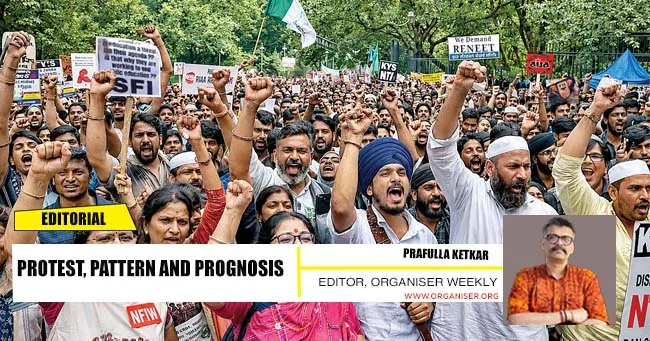
The paper-leak issue is genuine. Protesting against this failure is a democratic right that everyone should perform as a duty. Yet there is a problem with this CJP-led protest, and that is the pattern. The usual members of the protest industry ganged up. They missed no opportunity in abusing the nation and Hindu Dharma, bringing in anti-CAA types and Islamist Supremacist sloganeering. The Communists mobilised a few students, but the rest were political activists. Yogendra Yadav–type preachers, who take pride in resolving issues on the streets and not in Parliament and don’t believe in elections but in resistance to what they call ‘reclaiming republic’, did everything to incite the mob. Violence and abuses were normalised, so was the provocation against the security forces, just to expect one mishap to sustain the movement.
Political parties, who have been eagerly waiting to target the resurgence of Hindutva thought, and PM Narendra Modi could not have wasted this chance. From the Congress and the Samajwadi Party to the US-returned Chandrashekhar Ravan of Bhim Army, they flexed their muscles on various counts to mobilise the cadre. AAP, which had tested the strategy during the anti-CAA protest and anti-Hindu Delhi riots of 2020, occupied the centrestage to control the movement. In the process, the real issues related to educational and examination reforms were relegated to the periphery, and the politics of regime change that started with the Bharat Jodo Abhiyan of 2023-24 made a comeback.
This subversive pattern is not new. A tactical alliance of Opposition parties supported by external forces has tried this during the anti-CAA and anti-farm law protests. Globally, such operations have been conducted in Arab countries, Ukraine, and recently in Bangladesh and Nepal. Hence, the repeated reference was made to a Nepal-like situation in the march to Parliament on July 20, invoking the burning of the Parliament and Prime Minister House in the erstwhile Himalayan kingdom. This pattern of democratic subversion needs an urgent decoding.
The alternative politics model that is rooted in Communist ideology seeks to subvert democracy with democratic means. Conveniently using Gandhi ji and Babasaheb Ambedkar to justify the means and ends of Marx and Mao has become a fashion. Islamists, who always ride on their radical agenda are used in this process to exert street power and violence. Youth, farmers, labour, certain caste groups or regional identities are targeted to use them as what Babasaheb Ambedkar once called ‘cannon fodder’ in this game. The ultimate objective is to destabilise and weaken Bharat, not just a party, leader or Government. Discrediting all democratic institutions, including the Election Commission, Judiciary and Armed Forces, is the primary requirement to facilitate this process. Amidst global instability and uncertainty, Bharat is standing up as a shining star with consistent economic growth and cultural resurgence. This very awakening is not acceptable to many domestically and internationally. The repeated attempts to destabilise democracy, inciting some group or the other, are part of this technique called ‘alternative politics’.
Dr Ambedkar, in his last speech in the Constituent Assembly, warned against the use of undemocratic means when constitutional methods are available. Gandhiji had a complete preparatory programme for a Satyagrahi where mental, spiritual, physical and tactical preparation was mandatory. Moral conviction and discipline are the pre-conditions of Gandhian Satyagraha, which amateurs like Dipke cannot follow. A satyagrahi in well-defined circumstances can resist Government laws but should not resort to social structure, or violence was the clear principle in the Gandhian method. The entry of Marx and Mao, along with Islamists, will never allow Gandhi and Ambedkar to succeed.
The examination system needs an overhaul. The education system needs to be affordable and accessible and reconnected with Bharatiya roots. The National Education Policy 2020 has a framework to move forward in this direction. Every Bharatiya is a direct or indirect stakeholder in the education system. As NEP 2020 did a comprehensive consultation process, the implementation process also requires similar engagement. Unfortunately, the CJP kind of protests will never allow that to happen. It can create a few political leaders but they will not secure the future of youth. While initiating the fast-track educational reforms process, we need to sensitise the masses about the subversive agenda of anti-Bharat forces. Prognosis should not be related to formal education but to the political and national sensitisation of everyone about our national ethos and objectives. Otherwise, forget about the reforms in education and examination; what we will face is repeated protests leading to anarchy.