Inside the Constituent Assembly: Unsung architects of Constitution
June 24, 2026
  • Read Ecopy
  • Circulation
  • Advertise
  • Careers
  • About Us
  • Contact Us
Android AppiPhone AppArattai
Organiser
  • ‌
  • Bharat
    • Assam
    • Bihar
    • Chhattisgarh
    • Jharkhand
    • Maharashtra
    • View All States
  • World
    • Asia
    • Europe
    • North America
    • South America
    • Africa
    • Australia
  • Editorial
  • International
  • Opinion
  • RSS @ 100
  • More
    • Op Sindoor
    • Analysis
    • Sports
    • Defence
    • Politics
    • Business
    • Economy
    • Culture
    • Special Report
    • Sci & Tech
    • Entertainment
    • G20
    • Azadi Ka Amrit Mahotsav
    • Vocal4Local
    • Web Stories
    • Education
    • Employment
    • Books
    • Interviews
    • Travel
    • Law
    • Health
    • Obituary
  • Subscribe
    • Subscribe Print Edition
    • Subscribe Ecopy
    • Read Ecopy
  • ‌
  • Bharat
    • Assam
    • Bihar
    • Chhattisgarh
    • Jharkhand
    • Maharashtra
    • View All States
  • World
    • Asia
    • Europe
    • North America
    • South America
    • Africa
    • Australia
  • Editorial
  • International
  • Opinion
  • RSS @ 100
  • More
    • Op Sindoor
    • Analysis
    • Sports
    • Defence
    • Politics
    • Business
    • Economy
    • Culture
    • Special Report
    • Sci & Tech
    • Entertainment
    • G20
    • Azadi Ka Amrit Mahotsav
    • Vocal4Local
    • Web Stories
    • Education
    • Employment
    • Books
    • Interviews
    • Travel
    • Law
    • Health
    • Obituary
  • Subscribe
    • Subscribe Print Edition
    • Subscribe Ecopy
    • Read Ecopy
Organiser
  • Home
  • Bharat
  • World
  • Operation Sindoor
  • Editorial
  • Analysis
  • Opinion
  • Culture
  • Defence
  • International Edition
  • RSS @ 100
  • Magazine
  • Read Ecopy
Home Politics

Inside the Constituent Assembly: The committees, minds and milestones

All the persons who were members of the Constituent Assembly of India were tall leaders in their own rights who rose through ranks. Dr Rajendra Prasad, who later became first President of independent Bharat, headed four important committees of that august House

Sant Kumar SharmaSant Kumar Sharma
Dec 12, 2025, 12:30 pm IST
in Politics, Bharat, Delhi
Follow on Google News
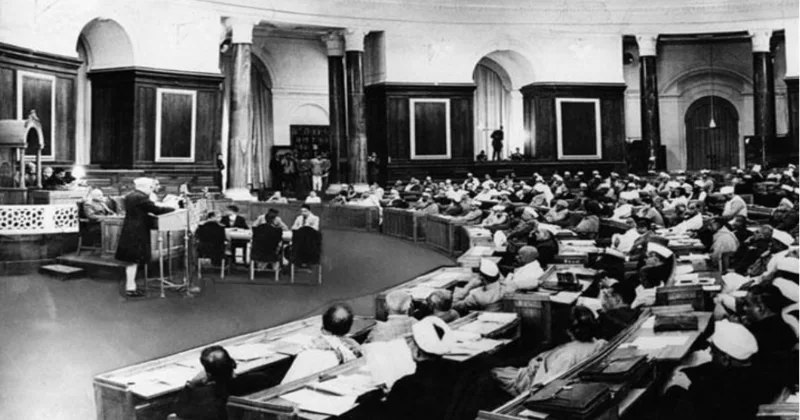
Constituent Assembly (File Image)

Constituent Assembly (File Image)

FacebookTwitterWhatsAppTelegramEmail

The Constitution of India was drafted by the Constituent Assembly, and its genesis can be traced back to the Congress session held in Lucknow in April 1936. At this session, which was presided over by Jawaharlal Nehru, the demand for a Constituent Assembly was raised for the first time. Simultaneously, the Government of India Act, 1935, was rejected as an imposition by the British government on the people of India. Three and a half years later, the demand for a Constituent Assembly was raised again on November 15, 1939. This time it was raised by C Rajagopalachari and he said that it should be based on adult franchise, a demand that was accepted by the British in August 1940.

Incidentally, the Constituent Assembly that came into being years later held its first session on December 9, 1946, over a decade after it was conceived and demanded by those fighting for Bharat’s complete independence from the British. According to official documents pertaining to the Constituent Assembly in public domain, it took three years (two years, 11 months, and 17 days to be exact) to draft the Constitution for Independent India. During this period, it held 11 sessions with at least 165 working days.

In between any two sessions of the Constituent Assembly, the members deliberated on issues that had been taken up already. They also made drafts of the many articles etc during each intervening period and made steady progress. Out of a total of 165 days in all, 114 days were spent on the consideration of the Draft Constitution. Regarding the composition of this august House, it needs to be stated that the members were chosen by indirect elections by the members of the Provincial Legislative Assemblies. This was done according to a scheme envisaged and recommended by the Cabinet Mission Plan of 1946.

Cabinet Mission

The Cabinet Mission, which aimed to discuss India’s transfer of power, was headed by Lord Pethick-Lawrence, the Secretary of State for India, along with two other British Cabinet Ministers, Sir Stafford Cripps and A V Alexander. The chief position in the Cabinet Mission was held by Pethick-Lawrence and he presided over the mission’s efforts to find a constitutional framework for an undivided India.

Initially, when the Constituent Assembly started functioning, there were 389 members in all of which no less than 292 were those elected through the Provincial Legislative Assemblies; 93 members represented the Indian Princely States and four members represented the Chief Commissioners’ Provinces of Delhi, Ajmer-Merwara, Coorg and British Baluchistan. However, as a result of the partition of the country under the Mountbatten Plan of June 3, 1947, a separate Constituent Assembly was set up for Pakistan. As a result, representatives of some provinces stopped being members of the Constituent Assembly. This resulted in the membership getting reduced by 90, to 299 from 389.

All earlier elections under the British Raj were those in which voting rights were provided to very few Indians by imposing restrictions based on property owned by individuals and their educational qualifications. However, in the 1946 elections for electing representatives to the Constituent Assembly, a much larger portion of the Indian adult population was allowed vote. However, this was very far from the universal adult franchise that is considered a cornerstone of true democracies and a fundamental right.

Important Committees

There were eight important committees of the Constituent Assembly and each had a designated Chairman. Of these committees, no less than four were headed by Dr Rajendra Prasad who later became first President of the country.
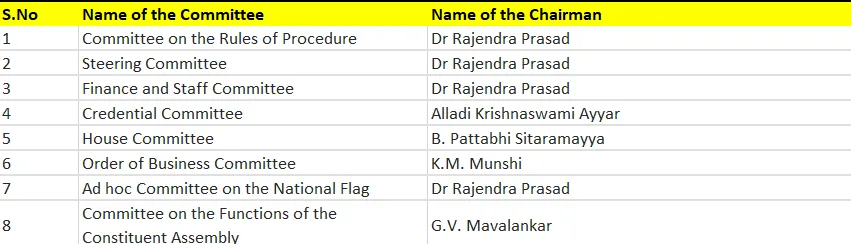
Important Committees of Constituent Assembly and Their Chairmen

Chairmen of Committees

The Chairman of each committee were stalwarts in their own rights and went on to occupy important constitutional positions in free India after August 15, 1947. G V Mavlankar was the Speaker of the Constituent Assembly of India who later became the first Speaker of the Lok Sabha. His son Purushottam Mavlankar was later elected to the Lok Sabha twice from Gujarat.

K M Munshi, who headed Order of Business Committee, also hailed from Gujarat (like Mavlankar). He also held positions of the Minister of Agriculture and Food of India and Governor of Uttar Pradesh. In his later life, he parted company with the Congress and was one of the founding members of Vishwa Hindu Parishad (VHP). At Junagadh, Sardar Patel had declared that the historically important Somnath Temple would be reconstructed. Patel died before the reconstruction was completed and Munshi became the main driving force behind the temple renovation. For reasons best known to him, and taking his false sense of secularism to extremes, Jawaharlal Nehru opposed the reconstruction of Somnath temple. However, Munshi stood up firmly against all these attempts and this was his basic reason for developing aversion of Nehruvian politics.

The main architect of the Indian Constitution, Dr B R Ambedkar, who also chaired the constitution’s drafting committee, credited Alladi Iyer’s contribution in glowing words: “There were in the drafting committee men bigger, better and more competent than myself such as my friend Sir Alladi Krishnaswamy Iyer.” When the principle of universal adult franchise was adopted, Iyer remarked that this was done, “with an abundant faith in the common man and the ultimate success of democratic rule’’.

At the Lucknow session of the Congress in 1916, B P Sitaramayya demanded the formation of separate Congress circle for Andhra. The demand was opposed by Mahatma Gandhi, but as Gangadhar Tilak supported Pattabhi, the Andhra Congress Committee came into existence in 1918. Sitaramayya was a member of the Working Committee of the Congress for a number of years and the President of Andhra Provincial Congress Committee in 1937–40. He had a very illustrious career and decades of experience before becoming a member of an important committee of the Constituent Assembly.

Topics: LucknowConstituent AssemblyDr Rajendra PrasadCabinet Mission
ShareTweetSendShareSend
✮ Subscribe Organiser YouTube Channel. ✮
✮ Join Organiser's WhatsApp channel for Nationalist views beyond the news. ✮
Previous News

Indian Railways overhauls ticketing system with robust cybersecurity, Aadhaar verification to curb misuse

Next News

Jharkhand: NIA conducts search at terror suspect Alam’s house in Hazaribagh

Related News

Uttar Pradesh: Digital democracy dialogue ‘Triveni’ concludes; Focused on inclusive growth & cultural discourses

Six mazars on the KGMU campus in Lucknow have been declared illegal and unclaimed after an inquiry found them on encroached university land

UP: 6 mazars at KGMU declared illegal after probe finds encroachment on University land; Demolition action planned

NIA court awards life term to three for UP terror plot linked to Ansar Ghazwat-ul-Hind

Pakistan-linked terror plot targeting Ayodhya, Lucknow foiled: NIA court awards life sentence to 3 Al-Qaeda operatives

Dr Ambedkar: The architect who prevented India from becoming a communist state

Uttar Pradesh: Two-day National Conclave ‘Savishkar Startup Sangam 2026’ commences at AKTU Lucknow

Rashtriya Swayamsevak Sangh Sarsanghchalak Dr Mohan Bhagwat addressing a Samajik Samrasta Baithak at Saraswati Shishu Mandir in Nirala Nagar, Lucknow

Hindu society must be organised: RSS Sarsanghchalak Dr Mohan Bhagwat

Load More

Latest News

President Droupadi Murmu confers the Padma Shri on former civil servant R.V.S. Mani on June 23, 2026.

Former MHA official RVS Mani honoured with Padma Shri for contributions to internal security

Tamil Nadu: Temple funds only for temple property; TVK govt concedes before Madras High Court

Keralam’s former Industries Secretary, Mohammed Haneesh IAS (Right Side)

Keralam Cashew Scam: Former Industries Secretary Md Haneesh apologises before High Court after contempt proceedings

Tamil Nadu: Assembly Speaker directs all bureaucrats to strictly follow warrant of precedence after Mayor-MLA row

Kamakhya Mandir

Kamakhya Mandir’s Ambubachi Mela: The ancient tradition that honours the menstruation of mother Earth

Amazon in dock for mocking Hindu Gods

Amazon File: From Ganesha to Aryabhata-Has Amazon India become a platform for Anti-Hindu narratives?

The West Bengal Budget 2026–27 aims to drive growth through infrastructure, industry, innovation and welfare

Reimagining Bengal: How the West Bengal Budget 2026–27 seeks to balance growth, welfare & economic transformation

Pratiraksha is Gujarat Police's Aadhaar-based verification platform designed to identify illegal workers and prevent identity fraud in industrial sectors

Pratiraksha: How Gujarat police uses Aadhaar verification to secure industrial workforce against identity fraud

Israel-Iran crisis has highlighted not only shifting dynamics of West Asia but also growing confidence of India's foreign policy

India, Israel and the rise of strategic autonomy in an era of global geopolitical realignment

Saleem and Jaleel arrested in forced religious conversion case

Karnataka Conversion Case: Forced conversion of Hindu woman and minor son sparks outrage; Saleem and Jaleel arrested

Load More
  • Privacy
  • Terms
  • Cookie Policy
  • Refund and Cancellation
  • Delivery and Shipping

© Bharat Prakashan (Delhi) Limited.
Tech-enabled by Ananthapuri Technologies

  • Home
  • Search Organiser
  • Bharat
    • Assam
    • Bihar
    • Chhattisgarh
    • Jharkhand
    • Maharashtra
    • View All States
  • World
    • Asia
    • Africa
    • North America
    • South America
    • Europe
    • Australia
  • Editorial
  • Operation Sindoor
  • Opinion
  • Analysis
  • Defence
  • Culture
  • Sports
  • Business
  • RSS @ 100
  • Entertainment
  • More ..
    • Sci & Tech
    • Vocal4Local
    • Special Report
    • Education
    • Employment
    • Books
    • Interviews
    • Travel
    • Health
    • Politics
    • Law
    • Economy
    • Obituary
  • Subscribe Magazine
  • Read Ecopy
  • Advertise
  • Circulation
  • Careers
  • About Us
  • Contact Us
  • Policies & Terms
    • Privacy Policy
    • Cookie Policy
    • Refund and Cancellation
    • Terms of Use

© Bharat Prakashan (Delhi) Limited.
Tech-enabled by Ananthapuri Technologies