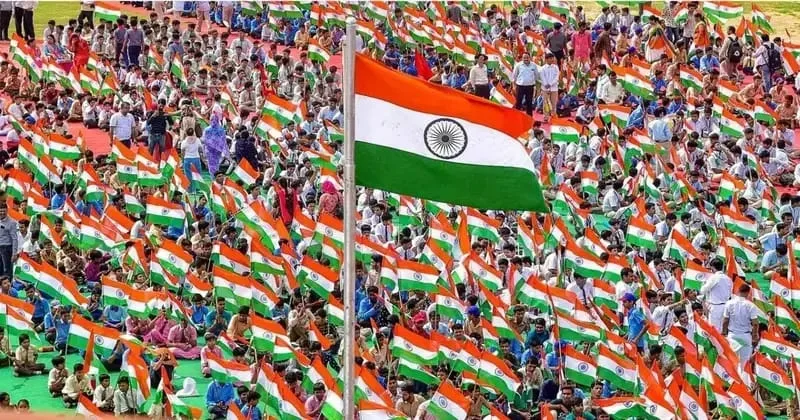
New Delhi: It is essential for every Indian to understand that the Tiranga is not merely a national flag made up of three colours; it is a living symbol of India’s freedom, sovereignty, unity and integrity, democratic consciousness, and national identity. Each of its colours and symbols embodies a profound national philosophy. It reflects the sacrifices of countless known and unknown freedom fighters, the democratic aspirations of the makers of the Constitution, and the dream of a just, equitable, and prosperous India.
Therefore, respect for the Tiranga should not be limited merely to holding it in our hands, hoisting it at home, bowing before it, or saluting it on national occasions. The true respect for the national flag will be reflected only when our reverence for it becomes visible in our conduct and the ideals it represents become an integral part of our thoughts, behaviour, and daily lives. “Tiranga in Every Home” will become truly meaningful only when it is accompanied by “Tiranga in Every Heart.”
The three colours of the Indian national flag carry profound messages. The saffron colour at the top inspires courage, sacrifice, and selfless service. It reminds us that nation-building is not achieved merely by demanding rights; it also requires the fulfilment of duties, discipline, and, when necessary, the willingness to sacrifice personal interests. During the freedom movement, countless people gave up their personal comforts and placed the nation above themselves. The same spirit is needed for nation-building even today.
The white colour of the flag conveys the message of truth, peace, and transparency. In a democratic society, integrity, tolerance, dialogue, and peaceful coexistence are not merely idealistic expressions; they are essential conditions for social stability. When truth and transparency weaken in public life, and disagreement begins to be perceived as hostility, democratic values suffer. The white colour therefore inspires us to embrace truth and restraint in both thought and conduct.
The green colour is regarded as a symbol of life, growth, prosperity, and harmony with nature. Its message is particularly significant for a country like India, which is predominantly agricultural and richly endowed with biodiversity. Economic development is essential, but development based on reckless exploitation of natural resources and disregard for the interests of future generations cannot be considered genuine progress. The green colour therefore reminds us that development must go hand in hand with environmental protection and the responsibility to pursue sustainable development.
The Ashoka Chakra in blue at the centre of the Tiranga deepens its philosophical essence. The Ashoka Chakra evokes the ancient Indian tradition of the Dharma Chakra, associated with righteousness, justice, and moral order. Its 24 spokes inspire continuous movement and action. Its broader message is that there must be no stagnation in life, society, or the nation; continuous progress is essential. Freedom does not mean inactivity; it means responsible action. Rights are accompanied by duties, and freedom is inseparable from responsibility.
Today, India is establishing a strong presence among the world’s rapidly emerging economies. The country has achieved significant progress in areas such as space science, digital technology, biotechnology, manufacturing, startups, defence production, and innovation. From the Chandrayaan missions to digital public infrastructure, and from indigenous technological capabilities to a growing spirit of entrepreneurship at the global level, India’s capabilities have expanded considerably. Yet the true strength of a nation is determined not merely by its gross domestic product, military capability, or technological achievements. Its enduring strength lies in the character of its citizens, social harmony, respect for institutions, adherence to the rule of law, and ethical standards in public life.
This is the essence of the concept of “Tiranga in Every Heart.” It means that the Tiranga should be visible not only in our hands but also in our thoughts and actions. Patriotism is not merely the display of national pride on special occasions. It is a continuous commitment to performing our daily responsibilities with honesty, dedication, and competence. A teacher teaching sincerely, a student embracing discipline and hard work, a doctor adhering to professional ethics, a businessperson conducting honest transactions, an employee demonstrating commitment to duty, a farmer working diligently, and a scientist dedicating himself or herself to the creation of new knowledge, i.e., all are contributing to nation-building.
Patriotism cannot be confined to displaying the image of the Tiranga on social media, raising patriotic slogans, or singing patriotic songs and distributing sweets on national occasions. True patriotism is reflected in our small, everyday acts of citizenship. Following traffic rules, protecting public property, maintaining cleanliness, using water and energy judiciously, paying taxes honestly, respecting women and disadvantaged sections of society, and translating the constitutional values of justice, liberty, equality, and fraternity into practice are all integral to our responsibilities towards the nation.
India’s identity does not lie in uniformity but in its unique capacity to sustain unity in diversity. Its many languages, cultures, traditions, ways of life, and schools of thought enrich the country’s social fabric. Therefore, placing the Tiranga in our hearts does not mean generating hatred towards any religion, caste, language, region, or political ideology. On the contrary, it means recognising our shared identity as “Indians” as the highest common bond of citizenship, despite our differences, and respecting the dignity of every citizen.
The nation is not protected only by soldiers stationed at its borders. While soldiers safeguard the external frontiers, citizens strengthen the nation’s internal resilience, social stability, and global reputation through their conduct. The courage of a soldier at the border is as important as the hard work of a farmer in the field, the research of a scientist in the laboratory, the labour of a worker in a factory, the knowledge imparted by a teacher in the classroom, the innovation of an entrepreneur, and the honesty of a citizen in public life. Nation-building is, in reality, the outcome of the collective actions of millions of citizens.
Therefore, when we hoist the Tiranga at our homes this year, let us pause for a moment and ask ourselves: Is our respect for the Tiranga limited merely to the flag, or are its ideals also visible in our lives? Do we carry within us the courage and sacrifice represented by saffron, the truth and peace symbolised by white, the spirit of development and sensitivity towards nature represented by green, and the continuous commitment to action embodied in the Ashoka Chakra? Do we take our duties as seriously as we take our rights? If the answers to these questions are affirmative, only then can “Tiranga in Every Home” achieve its broader national purpose and give rise to the spirit of “Tiranga in Every Heart.”
The Tiranga should be visible not only on the rooftops of our homes but also in our character. It should exist not merely in our hands but in our thoughts; not only on national occasions but in our everyday conduct. When the colours of the national flag become the colours of our behaviour, and the movement of the Ashoka Chakra becomes an inspiration for our actions, our reverence for the Tiranga will truly be transformed into patriotism.
“Tiranga in Every Home” is a celebration of national pride, but “Tiranga in Every Heart” is a commitment to translate that pride into our lives. This is true patriotism, true service to the nation, and our greatest civic responsibility towards independent India.