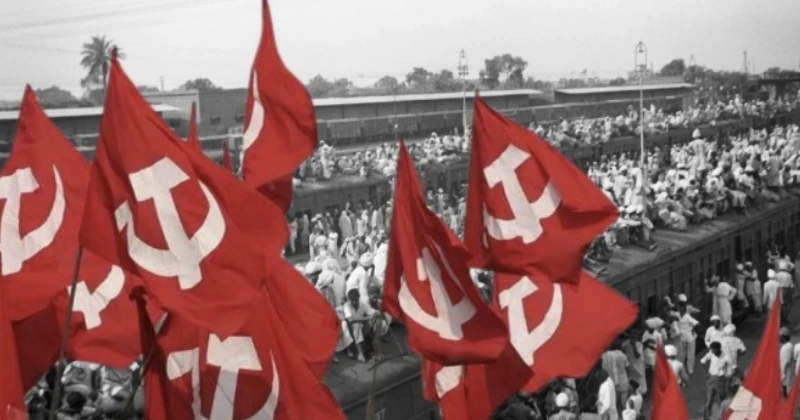
When we speak of the Partition of 1947, it is always believed that it was driven only by religious conflict between the Congress and the Muslim League. However, there is another factor that has not been talked about much. On the occasion of Partition Horrors Remembrance Day, we need to be aware of the fact of the role of the Communist Party of India (CPI), too, which also backed the partition on a religious basis.
Rather than prioritising India’s unity, it had aligned itself with Moscow’s geopolitical interests. At that time, Moscow saw the creation of Pakistan as strategically useful against British imperialism, and the CPI adopted that line. This meant the CPI publicly endorsed the Muslim League’s demand for Pakistan, presenting it as a “progressive” or anti-imperialist cause, even though in reality it was based on religious separatism. By doing so, the CPI gave the Pakistan movement intellectual and ideological cover, making it appear as something more than just a sectarian Muslim demand. Instead of being an insignificant fringe party, the CPI in the 1940s was active in trade unions, student movements, and cultural circles. Therefore, its support lent legitimacy and strength to the League’s domestic and international case.
The CPI’s adoption of the Muslim League’s claim was the outcome of Marxist theory and the then prevailing global politics with reference to the Second World War. In other words, CPI’s policy was not born out of national interests but was shaped by ideology and forces outside India. The CPI’s eventual stance gave ideological legitimacy to the League’s separatist movement.
CPI’s pre-1942 “National Line”
When the Communist Party of India was founded in 1925, its ideological compass pointed firmly toward two goals: the anti-colonial struggle against British imperialism and solidarity with the global communist movement led by Moscow. In practice, this meant supporting India’s freedom struggle while maintaining a Marxist critique of its leadership.
In its early years, the CPI saw the Indian National Congress as a “bourgeois” party — a movement that represented the aspirations of the Indian capitalist class rather than the proletariat. Yet, despite this criticism, the party recognised the Congress as the central vehicle of mass anti-colonial mobilisation and participated in campaigns for national independence. Before the 1940s, the CPI’s ideological position on national unity was straightforward: India was a single nation oppressed by colonialism. Communal divisions were seen as the artificial creation of the British policy of “divide and rule.” The party rejected the Muslim League’s separatist claims, regarding them as a diversion from the class struggle and a threat to the integrity of the anti-imperialist movement.
However, a shift began in the late 1930s. Influenced by the Comintern’s evolving analysis, CPI leaders started to reconsider whether India truly constituted a single, unified nation in the Marxist-Leninist sense. A major ideological turn came with World War II, particularly after June 1941, when Nazi Germany invaded the Soviet Union. The USSR, which was then seen as the ideological motherland for communists worldwide, had now aligned itself with Britain and other Western powers in the fight against fascism. This episode demonstrates how the communist movement in India was steered by external directives. The Comintern instructed communist parties in colonial territories to suspend confrontational struggles against imperial governments and instead back the Allied war effort against fascism. In India, this meant a dramatic reversal.
In August 1942, when the Congress launched the Quit India Movement to force the British to leave immediately, the Communist Party of India refused to support it. The CPI was following Moscow’s line at the time — the Soviet Union was fighting Nazi Germany in the Second World War and wanted Britain to remain strong against fascism. Because of this, the CPI’s policy treated the war as an “anti-fascist” struggle in which India should cooperate with Britain rather than rebel against it.
By rejecting the Quit India Movement, the CPI distanced itself from the Congress and the broader nationalist movement, losing political common ground with them. This isolation pushed the CPI to look for other allies. The Muslim League — which also opposed Quit India, but for different reasons became one of the few major parties the CPI could work with without clashing over the war issue.
Acceptance of the “Two-Nation Theory” in Practice
In this period, the CPI underwent a profound shift in its understanding of the Indian nation. In 1942, the Gangadhar Adhikari thesis articulated a new position: India was not a single nation but a “multi-national” state composed of various nationalities, each at different stages of socio-political development. Within this framework, Muslims were recognized as a distinct “nation” under Marxist–Leninist definitions. And as Marxist theory upheld the right of nations to self-determination, including secession, the CPI concluded that the Muslim League’s demand for Pakistan was a legitimate democratic claim.
The party justified this stance by arguing that denying Muslims the right to self-determination would perpetuate national oppression even within a post-colonial India. In effect, the CPI had moved from opposing the idea of partition to accepting it as a valid expression of anti-imperialist will, provided it emerged through democratic means.
Legitimising Pakistan as a democratic right
The CPI’s recognition of the Muslim League’s position gave the separatist demand a powerful ideological endorsement. The League could now claim support not just from Muslim constituencies, but from a party that styled itself as the vanguard of secular, working-class internationalism. The CPI described partition as a progressive application of the principle of national self-determination. Muslim League’s demand for Pakistan, the CPI insisted, was not a communal reaction but an anti-imperialist movement representing the aspirations of Muslim masses. CPI leaders such as P. C. Joshi and Sajjad Zaheer openly endorsed the Muslim League: Joshi described Jinnah as “the freedom-loving League masses’ leader” akin to Gandhi.
Sajjad Zaheer called the League a “great progressive liberationist force.”
The Communist Party of India not only supported the Muslim League but gave its own people like Sajjad Zaheer, Abdullah Malik and Daniyal Latifi, to the League. The Muslim League argued that the demand of Pakistan was recognised by secular leftists, not just by “communal” Muslim politicians. This bolstered the League’s negotiating power in its dealings with both the British and the Congress.
Tactical cooperation in Bengal and Punjab
On the ground, CPI cadres occasionally worked alongside League activists, especially in provinces like Bengal and Punjab, where the League enjoyed significant Muslim support. In rural struggles, where landlords were Hindu and peasants were Muslim, CPI campaigns framed these conflicts in class terms. Yet, the political benefit often flowed to the League, which positioned itself as the defender of Muslim interests.
This overlap was particularly visible in Punjab, where the CPI lent not only ideological support but also personnel to the League’s electioneering machinery. Sajjad Zaheer, Abdullah Malik, and Daniyal Latifi — all communists — played significant roles in shaping and promoting the League’s political messaging. Latifi even authored the Punjab Muslim League’s 1945–46 election manifesto.
CPI–Muslim League partnership in leaders’ own words
The CPI’s support for the League was not hidden. PC Joshi, one of the party’s most prominent leaders, openly defended the alliance. In his pamphlet Congress and the Communists, Joshi argued: “We were the first to see and admit a change in its character when the League accepted complete independence as its aim… We concluded… that it had become an anti-imperialist organisation expressing the freedom urge of the Muslim people… Mr. Jinnah is to the freedom-loving League masses what Gandhiji is to the Congress masses.”
Sajjad Zaheer went further, describing the Muslim League as a “great progressive liberationist force” whose growth every patriot should support. Such statements illustrate how, by the mid-1940s, the CPI leadership saw the League not as a communal body serving elite Muslim interests, but as a mass nationalist organisation akin in its constituency and function to the Congress.
From other freedom fighters
The CPI’s stance was sharply criticised by other nationalist forces. The Congress accused the communists of betraying the cause of Indian unity for the sake of foreign ideological directives. The Hindu Mahasabha condemned the CPI for aiding what it saw as a communal and divisive project. Even some socialist groups viewed the policy as a capitulation to both imperialist strategy and communal separatism.
In the post-independence political landscape, the CPI’s wartime record became a liability. Many nationalists — especially in North India remembered the communists as collaborators with the British and allies of the League during the crucial years leading to partition. This memory damaged the CPI’s ability to position itself as a credible national party in the early decades after independence. Its electoral performance in much of North India remained poor, even as it found stronger bases in states like Kerala and West Bengal.
Strengthening the Partition Outcome
By supporting the Muslim League, CPI continues to be seen as a ploy in the hands of the British and other countries. Its ideological endorsement made Pakistan more respectable in certain circles. By presenting partition as compatible with progressive politics, the CPI helped normalise an outcome that many anti-partition leaders were still fighting to prevent.
The CPI’s alignment with the Muslim League in the 1940s illustrates the complex interplay between ideology, international politics, and domestic strategy. At the theoretical level, the party’s position flowed logically from Marxist–Leninist principles of national self-determination. At the practical level, however, it also reflected the geopolitical reality of being tied to Moscow’s wartime priorities. By framing the League’s separatism as progressive, the CPI humiliated or disregarded the nationalist sentiments.
The Communist Party of India’s support for the Muslim League during the 1940s remains one of the most shameful aspects of modern Indian political history. The effect was to legitimise a separatist project that fundamentally reshaped the subcontinent. The CPI’s stance weakened the united nationalist front, gave the League valuable ideological cover, and left the communists with a political legacy that would haunt them long after independence.
Communists have hardly learnt any lesson from their historic blunder. During the fight for independence, they used to interpret the Muslim League through Marxist/Russian lenses. But their habit of appeasing Muslims even after independence still continues. This is the reason why communist ideology is shrinking every day. Communists might not have learnt the lesson, but Indians have.