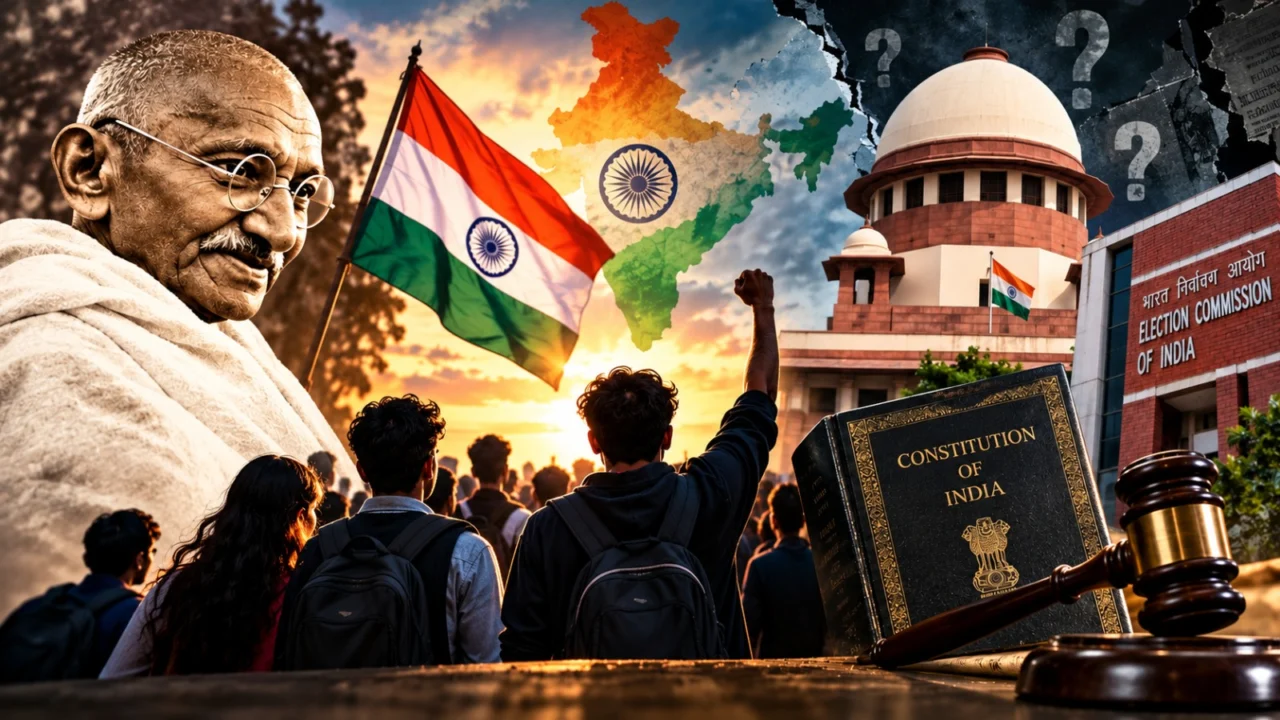
India has a proud history of protest movements based on ethical values. In these movements, protesters showed the courage to question those in power while also fulfilling their responsibility towards the country’s democratic system. A protest becomes a matter of concern when it leads citizens to believe that every institution is dishonest and every constitutional means of seeking justice is useless. This concern becomes more serious when political messages reach young people through repeated allegations without evidence or the necessary context.
According to Akashvani’s report of 8 October 2026, the open letter written by 42 former judges brings this concern into public discussion. The signatories expressed concern over attempts to weaken the Election Commission, the judiciary and other institutions. The letter also called on institutions to remain transparent and work above party politics. Both aspects require attention. A worrying situation arises when disagreement with a decision turns into an allegation against the entire institution. An unfavourable court judgment is treated as proof that the judiciary has lost its impartiality, while an electoral dispute leads to the conclusion that the entire election process is meaningless. When unverified allegations are repeatedly presented as established facts, people may begin to believe that there is no hope of obtaining justice through the constitutional system. Political leaders who encourage this belief must also consider its possible consequences, as it can lead any country towards anarchy.
Several such incidents have been discussed in recent times. This issue also arose in the debates surrounding Operation Sindoor, launched in May 2025. Citizens have the right to question the government’s strategic decisions, diplomatic claims and public explanations. This is part of democratic accountability. However, allegations against the professional integrity of the armed forces require solid evidence. The same standard should apply to allegations against constitutional institutions such as the judiciary and the Election Commission. These institutions play an important role in maintaining the country’s democratic system. Protests held in the name of protecting the Constitution must also ensure that political disagreement does not become a means of spreading distrust in the constitutional system. The distinction between criticising government decisions and questioning the impartiality of institutions must remain clear. It is inappropriate to erase this distinction in party political debates and place all institutions under the same cloud of suspicion.
In the age of social media, this is a serious concern, especially for young people who understand political disputes through short video clips, slogans and shared messages. Anger can bring people together quickly, but responsible leadership must explain what the allegations are, what facts have been verified and what solution is being sought. Leaders should also have the courage to acknowledge and correct a claim when it is proved wrong. Creating the belief among young people that every constitutional institution is dishonest can weaken their faith in peaceful democratic change. Their energy must be directed towards positive change and concrete reforms. Events in neighbouring countries show the need to give young people’s anger a responsible direction. During these movements, violent clashes and government responses deepened the crises and created serious challenges for democratic processes and public order. These events warn us that when protest turns into violence and destruction, a demand for change can take the form of anarchy. Such instability can also give foreign forces acting against the country’s interests an opportunity to carry out their plans.
Mahatma Gandhi’s individual Satyagraha provides a useful historical example. In October 1940, while Britain was involved in the Second World War, he chose a limited movement involving selected individuals. Vinoba Bhave became the first individual satyagrahi on 17 October. The movement emphasised the freedom to oppose India’s involvement in the war without the consent of its people. Gandhi continued the resistance while considering the movement’s scale, discipline and possible consequences. His recorded conversations with Nehru that month reveal his concern that mass civil disobedience could lead to violence. This did not mean accepting colonial injustice. Gandhi continued to resist and was prepared to face repression. His leadership role in the Quit India Movement of 1942 also makes it clear that the strategy adopted in 1940 was suited to the circumstances of that time; it was not a permanent rejection of mass movements. The lesson is that leaders must carefully consider the methods of their movements and their consequences.
In an independent democracy, this responsibility becomes even more important. Political parties claiming to protect the Constitution should explain how their demands will strengthen the constitutional system. They must support their allegations with evidence, suggest practical solutions and oppose violence and intimidation. Institutions must also respond to public concerns through reasoned explanations, accessible grievance procedures and impartial investigations. Constitutional rights must be accompanied by responsible conduct; a claim of protecting democracy cannot justify violence. Governments also share the responsibility for preventing unrest. To maintain trust in democratic institutions, they must listen to citizens, address their grievances and correct shortcomings. Failure to resolve grievances raised peacefully in a timely manner, or the use of unnecessary force, can deepen public distrust.
The purpose of a protest movement should be to bring improvements in the public interest and strengthen the democratic system. Leaders must consider what people will gain after the movement: solutions to their problems and greater trust in institutions, or deeper distrust and damage to the system. Gandhi insisted that both the goal and the methods used to achieve it should be ethical and non-violent. This lesson remains relevant today. The responsibility of leaders who encourage people to protest is not merely to generate anger, but also to direct it towards positive and responsible change.