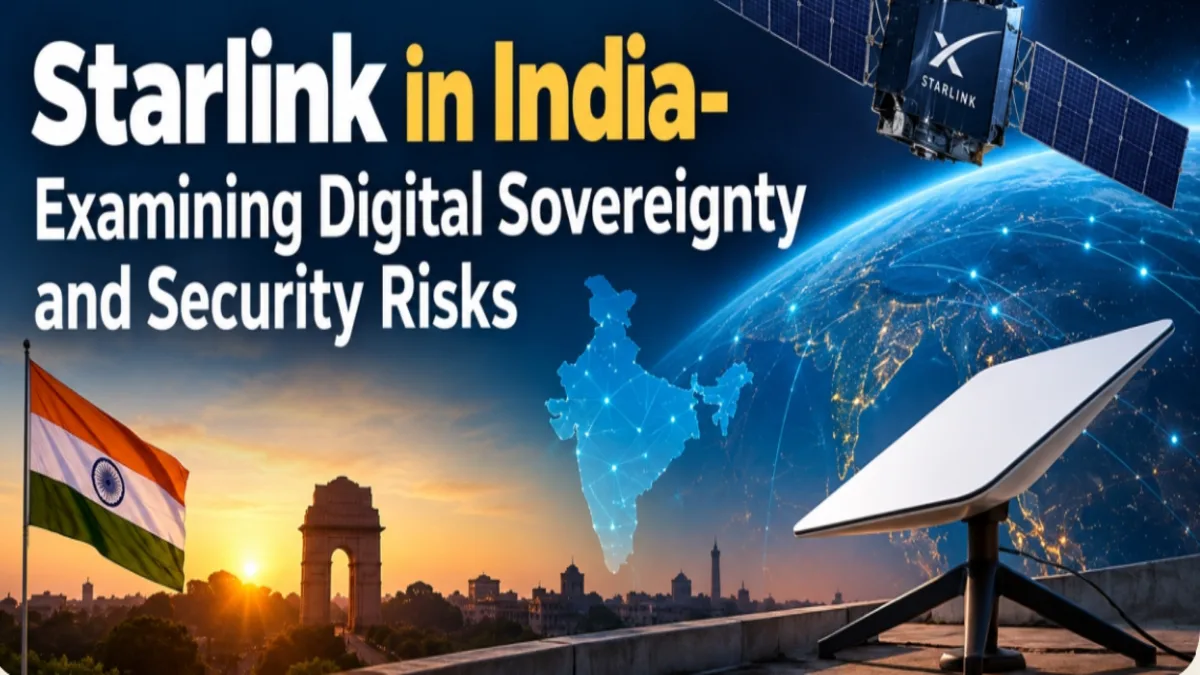
On October 13, the Swadeshi Jagran Manch wrote a letter to the Central Government urging that Starlink’s petition for commercial satellite broadband in India be denied. The group’s National Co-Convener, Ashwani Mahajan, noted three key concerns in his letter, viz. data being routed between satellites, the concern over whether the services could be blocked by the government as a crisis management strategy, and the fact that illegal Starlink terminals had been found on Indian soil.
The timing was deliberate. Delhi is witnessing sustained protests against the Chief Election Commissioner. “Currently, India is grappling with various law-and-order challenges,” Mahajan said. “In such situations, internet-based social media often fuels rumours and anti-national narratives.”
Starlink is not merely an internet provider. It is a strategic asset of a foreign power, and the terms on which India admits it will shape India’s digital sovereignty for decades.
The architecture of risk
Starlink’s satellites talk to one another through optical inter-satellite laser links. A data packet can hop across the constellation in space before it touches the ground. That is an engineering marvel and a regulatory problem.
India’s satellite licensing framework requires every operator to set up an earth-station gateway in India and to route Indian traffic through it. The gateway is where the law lives. It is what makes lawful interception possible, and what allows the state to suspend services under the Telecommunications (Temporary Suspension of Services) Rules, 2024. “Government wants Indian traffic routed through gateways within India,” Mahajan reminded the country.
The difficulty is verification. A written assurance that traffic stays in India is not the same as a regulator’s ability to audit routing decisions made inside an orbital mesh controlled from abroad. Starlink’s Vice-President, Lauren Dreyer, told India Mobile Congress on 7 October that the company had built 20 gateway sites and India-specific safeguards. “We stand ready to serve India,” she said. India’s answer must be simple: prove it, under Indian testing and Indian audit.
Weaponised interdependence
A paper by the Delhi-based Kutniti Foundation, “An appraisal of technology for geopolitical control”, frames the larger danger. Whoever controls critical communications infrastructure can monitor activity on it, or switch it off. This is “weaponised interdependence”.
Starlink is a textbook dual-use system. SpaceX holds contracts with the US Department of Defense, the US Space Force and the National Reconnaissance Office. American law, from FISA to the CLOUD Act, can compel American companies to hand over data. Business Standard has flagged that Starlink’s privacy policy permits the use of customer data to train artificial intelligence models.
Ukraine shows what dependence costs. In 2022, Musk personally refused to enable coverage for a Ukrainian drone strike on Russia’s fleet off Crimea. As the Kutniti paper concludes: “For India, any satellite network whose terminal-level control sits outside Indian jurisdiction is a standing lever over Indian security decisions.”
Lessons from abroad
In Iran, during the January 2026 protests, the state deployed what researcher Amir Rashidi described as “highly sophisticated and military-grade” jamming. Disruption of Starlink traffic rose from roughly 30 per cent to over 80 per cent in a single evening. The lesson is that a state which fails to regulate a satellite network at the gate ends up fighting it in the sky.
Taiwan amended its Telecommunications Management Act in July 2026 to let low-earth-orbit operators bypass its 49 per cent foreign ownership cap. A sovereign legislature rewrote its own law to suit a single vendor. In Africa, the resistance has been firmer. Namibia refused a licence in March 2026 over its 51 per cent local participation rule. South Africa, Musk’s birthplace, has not approved Starlink because it requires 30 per cent local ownership. In Gambia, the US Embassy pressed the government to grant a licence that it had initially refused.
Closer home, the threat is already operational. Reuters reported that Indian authorities recovered Starlink equipment from drug smugglers in the Andaman and Nicobar Islands and from an Army search in Manipur in late 2024. In Sudan, smuggled terminals have sustained armed groups. Starlink reportedly declined to share user data with Indian police, citing American privacy law.
Two futures
Project these cases forward and two trajectories emerge. Nations that integrate deeply with a foreign constellation will, within a decade, find rural fibre bypassed and domestic satellite ambitions shelved. Within a generation, their citizens’ data will have trained foreign AI models, leaving them consumers of artificial intelligence, not its creators.
The sovereign path is harder at first. Costs are higher and rollout slower. But the gateways, the data and the courts stay Indian. Over time, a country that owns its connectivity builds an industry, trains its own AI on its own data and acquires something to export. The choice is between renting from a foreign landlord who can change the locks and owning the house.
The regulatory standoff
Starlink has secured real approvals: a GMPCS licence in June 2025, IN-SPACe authorisation for 4,408 satellites in July 2025 and Aadhaar authentication integration in August 2025. It does not yet have the final clearances. Security agencies under the Home Ministry reportedly froze them in June 2026. Spectrum pricing, the direct-to-device framework and FDI approval remain pending.
He accused unnamed “oligarchs” of keeping a “monopolistic chokehold” on Indians and asked whether Mukesh Ambani was “the real boss of India”. Mahajan’s reply was measured: “It is unfortunate that instead of responding to clarifications sought from his company, on national security grounds, Elon Musk has chosen to make allegations on Indian businesses and the government indirectly.”
The Ministry of Communications has rejected the charge of discrimination. It said the government has “a fair and non-discriminatory authorisation framework”, and that Starlink, Eutelsat OneWeb and Jio Satellite Communications are “at broadly the same regulatory stage”. BJP MP Nishikant Dubey was blunter: India “does not change its security policy under pressure from social media or external figures.”
The indigenous path
India has been here before. The SJM’s opposition to Huawei and ZTE during the 5G rollout created space for Indian scientists to develop the indigenous 5Gi standard.
Reliance Jio is building a low-earth-orbit constellation of around 1,600 satellites at an estimated cost of 10 to 15 billion dollars. Bharti is a major shareholder in Eutelsat OneWeb. Indian terminals can be built from the outset to work with NavIC, India’s own navigation constellation, and with Aadhaar-based verification. “Even if there is a slight delay in launching indigenous satellite-based internet services,” Mahajan argued, “we would still be able to offer services far cheaper than Starlink while ensuring national security.”
None of this requires a closed door, only that any operator, foreign or Indian, meet the same test: Indian gateways, demonstrated lawful interception, rehearsed emergency shutdowns, and data that stays within Indian law.
The sovereignty imperative
The question, as former intelligence officer Yashovardhan Jha Azad put it, is simple: “Who retains effective control over an essential communications service during a crisis?” If the answer lies in Hawthorne or Washington, India is a user. If it lies in New Delhi, India is an owner.
Data is the raw material of this century, and connectivity is its railway. A civilisation that once watched its cotton shipped away to foreign mills should not repeat the bargain with its data. Atmanirbhar Bharat in space is not protectionism. It is the precondition of a free India in the digital age.