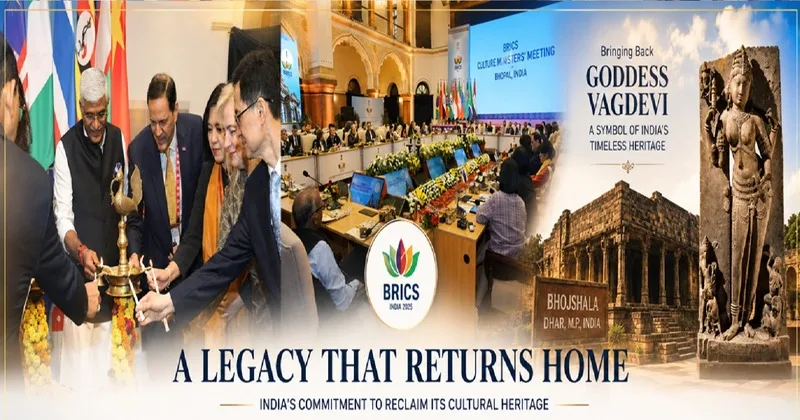
Dhar: After remaining in the British Museum in London for more than a century, the 11th-century idol of Maa Vagdevi is now raising hopes of returning to its original home in Dhar, Madhya Pradesh. Carved in white marble, the statue symbolises the rich knowledge tradition and civilisational memory of central India and is associated with the historic Bhojshala. Following a request from the Madhya Pradesh government, the Union government has stepped up diplomatic and institutional efforts to facilitate the statue’s return.
The BRICS Culture Working Group and the meeting of Culture Ministers held in Bhopal have given the effort a wider international context. The matter has now moved beyond the courts and political debate to the global platform of cultural diplomacy.
Vagdevi’s Journey from Bhojshala to London
The statue of Maa Vagdevi, believed to be associated with the historic Bhojshala in Dhar, is a heritage object dating back to the Paramara period. Made of white marble, the statue is approximately 1.28 metres tall and weighs around 250 kilograms. An inscription on the statue points to its connection with Dhar in the 11th century. According to records of the British Museum, the statue was acquired from Major-General William Kincaid and was formally incorporated into the museum’s collection in 1909.
Over time, the statue travelled thousands of kilometres away from India to Britain, but its significance in Dhar and its associated cultural memory remained intact. The Indian government is now seeking to create a pathway for the return of this historic heritage through diplomatic dialogue, institutional engagement and international cooperation.
Centre Steps Up Efforts Following Madhya Pradesh’s Request
The Madhya Pradesh government has formally requested the Modi government at the Centre to bring the statue of Maa Vagdevi back to India from the British Museum. Following this, the Ministry of Culture has taken the matter forward at the diplomatic level. According to Union Culture Secretary Vivek Agrawal, after receiving the letter from the Madhya Pradesh government, the ministry initiated contact through Indian diplomatic channels in Britain as well as at the museum level.
According to Agrawal, several written communications have been sent through Indian diplomatic channels in Britain by the Ministry of Culture. This makes it clear that the effort to secure the statue’s return is no longer confined to a local demand, but has become part of the Government of India’s broader campaign to recover cultural heritage.
Issue Moves from Courtroom to International Diplomacy
The return of the Vagdevi statue has long remained a sensitive issue amid the dispute surrounding the Bhojshala-Kamal Maula complex in Dhar. The Madhya Pradesh High Court’s 15 May judgment gave the matter a new direction. The court considered claims relating to the declaration of a part of the disputed complex as a temple dedicated to Goddess Saraswati or Vagdevi and asked the Central Government to consider the requests made for the return of the statue currently kept in London.
Following this judicial development, the demand for the statue’s return received an institutional basis. However, the process of bringing the statue back to India is also linked to British laws, museum policies and international arrangements concerning cultural property. In this context, diplomatic dialogue has become the most important channel available to India.
Cultural Heritage Question Raised at BRICS Forum in Bhopal
The most significant international context for the effort to bring back the statue emerged from the BRICS Culture Working Group, and the meeting of Culture Ministers held in Bhopal. During the four-day deliberations, emphasis was placed on making the return of cultural property a subject of broader multilateral cooperation. Union Minister for Culture and Tourism Gajendra Singh Shekhawat said that the BRICS partnership is not limited to economic and political cooperation. Culture, peace, mutual respect and inclusive development also connect the member countries. The objective of the Bhopal Declaration is to develop institutional arrangements for transforming cultural dialogue into practical cooperation.
It is at this point that the question of the Vagdevi statue from Dhar becomes connected with India’s broader cultural diplomacy. India now seeks to advance the return of its ancient heritage located abroad not merely as individual bilateral cases, but within a broader framework of international cooperation.
‘Bhopal Declaration’ on the Return of Cultural Property
The Bhopal Declaration records an agreement to strengthen cooperation for the identification, research into the provenance, return and restitution of cultural property that has been stolen or illegally taken to other countries. The proposal to explore the potential of artificial intelligence-based tracing tools is also significant. The importance of this initiative increases as numerous museums around the world hold historical heritage from Asia, Africa and other regions, whose countries of origin are now seeking their return. India’s effort is to make the identification and recovery of such objects more effective through technology, shared databases, research and diplomatic dialogue.
Cultural Property Has a Value Beyond Economics
Union Minister Gajendra Singh Shekhawat has described cultural property not merely in terms of its economic value, but as part of civilisation, history and collective memory. This approach appears to be becoming the foundation of India’s current campaign for the return of heritage.
The value of a statue, sculpture or ancient artwork is far greater than its market price. Such objects preserve within them the memories, religious beliefs, artistic achievements and knowledge traditions of a society. The return of such heritage is therefore also being viewed as an exercise in cultural justice and civilisational reconnection. The case of the Vagdevi statue represents this broader sentiment. If the statue returns to India, it would give renewed strength to an important chapter associated with Dhar’s cultural identity.
653 Ancient Heritage Objects Returned Since 2014
Over the past decade and more, India has significantly accelerated its campaign to bring back cultural property located abroad. According to official figures released by the Central Government, more than 700 ancient objects have been brought back to India since 2014. Before this, the number of ancient objects returned to the country stood at just 13. These figures make it clear that the recovery of cultural heritage has now become an important component of India’s foreign policy and cultural diplomacy. The return of several significant statues and artefacts from the United States, Australia and other countries is a result of these efforts.
Important Heritage Objects Return from the US and Australia
Among the objects returned from the United States in recent years are important bronze sculptures from the Chola and Vijayanagara periods. The Smithsonian’s National Museum of Asian Art has returned a 12th-century Somaskanda sculpture and 16th-century sculptures of Saint Sundarar and Paravai. A Chola-period statue of Shiva Nataraja is also to be returned to India after the completion of a temporary exhibition arrangement.
Australia has also agreed to the voluntary return of three ancient artefacts associated with Tamil Nadu. These include a stone statue of Nandi, a metal trident bearing an image of Bhadrakali and a six-faced stone statue of Kartikeya. Their return was welcomed during Prime Minister Narendra Modi’s visit to Australia. These successes have strengthened the credibility of India’s campaign to systematically bring back its cultural heritage by using bilateral and multilateral platforms.
‘Voluntary Artist Registry’ to be Created for Artists
The scope of the Bhopal Declaration was not confined to the return of ancient heritage. On India’s proposal, BRICS partner countries have decided to establish a voluntary ‘Voluntary Artist Registry’. Its objective is to facilitate contact among artists from different countries, cultural exchange and creative opportunities. Shekhawat described this as an important achievement of the BRICS Culture Track. According to him, work has also been undertaken towards preparing a common roadmap for the traditional and contemporary fields of culture and heritage.
Initiative to Secure UNESCO Recognition for Shared Heritage
The Bhopal Declaration also agreed to strengthen cooperation in the multinational nomination process for UNESCO recognition of sites associated with shared civilisational heritage. A direction has been set towards joint efforts for the preservation and international recognition of heritage that has been connected with the historical journeys of more than one country. This strengthens the possibility of viewing cultural heritage beyond political boundaries as a shared civilisational legacy. The process of international heritage recognition was also referred to in the context of important heritage sites such as Sarnath.
Participation of 14 Countries Creates a Broad Cultural Platform
Fourteen countries, including India, participated in the ministerial meeting. The BRICS member countries included Brazil, China, Egypt, Ethiopia, India, Indonesia, Iran, Russia, South Africa and the United Arab Emirates. Belarus, Cuba, Kazakhstan and Thailand participated as partner countries. Egypt participated online. With a total of 55 representatives present, the meeting assumed the character of a broad cultural dialogue. India used the platform to firmly place the return of cultural property on the agenda of international cooperation.
Vagdevi’s Return Now a Test of Cultural Diplomacy
The question of bringing the Vagdevi statue back to Dhar is no longer merely an effort to recover an ancient statue. It is also a test of India’s broader cultural policy, under which the identification, recovery and restitution of Indian heritage that reached foreign countries during and after the colonial period is being given priority.
In this context, the BRICS ‘Bhopal Declaration’ has provided a multilateral platform to the effort. Attention is now focused on the dialogue with Britain and the response of the British Museum. If the Vagdevi statue returns to Dhar, it would mark not only the return of a historic heritage object, but also a significant success for India’s cultural diplomacy.