

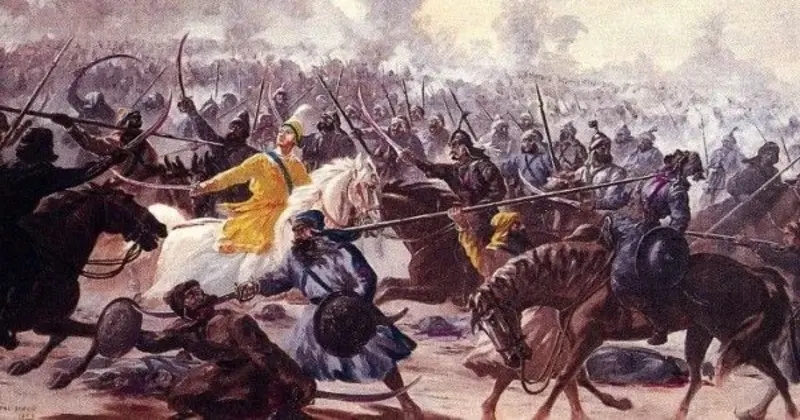
Shatrubodh is about recognizing our own boundaries. This understanding is crucial for identifying when our personal space, beliefs and interests are being threatened, as such intrusions can be detrimental to us. In essence, a deep grasp of both Aatma-Bodh and Shatru-Bodh is vital for our survival, development, humanity and collective well-being as both individuals and as a society. In Hindu philosophy, Shatrubodh underscores the importance of comprehensively understanding and evaluating one’s adversaries to make informed decisions and protect one’s own interests, both strategically and philosophically. A brief story illustrates this concept.
In a village, there was a cobra that would bite and kill the villagers. A Sadhu who passed by learned of this and instructed the cobra not to attack anymore. The cobra complied and refrained from harming the villagers. However, the villagers, noticing the cobra’s newfound calmness, began to throw stones at it, causing serious injuries. The cobra, bewildered by this, reflected on its promise to the Sadhu.
Upon the Sadhu’s return, he found the injured cobra and asked what had occurred. The cobra explained, “You told me not to attack and kill, yet they threw stones at me”. The Sadhu then replied, “My child, I instructed you not to bite, but did I tell you to refrain from hissing in self-defense?”
This story reflects the confusion that has characterized Hindus over the past century regarding the distinction between attack and defense. Sanatana Dharma does not oppose war; rather, it views it as a last resort when all else fails. This is embodied in the Fourfold Strategy of Dharma: Sama (conciliation), which seeks to win hearts through dialogue; Dam (concessions), which offers incentives for cooperation; Bheda (differentiation), which involves creating strategic divides to weaken the opposition; and finally Dhanda (force), which should be applied only when other methods have failed.
These concepts are reflected in the Mahabharata, Arthashastra, and Vidura Neeti, where Krishna illustrates this progression in the Kuru Sabha — starting with reasoning, then proposing compromise, followed by revealing internal conflicts, and ultimately warning of war. War is portrayed neither as glorious nor avoided; it is a means to an end, not an objective. Dharma requires restraint before retaliation but never capitulation to adharma. This approach ensures that violence is a last resort, only invoked when righteousness is threatened.
The history of Bharat encompasses not just invasions and defeats but also remarkable assimilation, resistance and victory by a robust civilization. Over the last two and a half millennia, Bharat has faced numerous invasions, which can be categorized into two distinct phases based on the nature of the invaders and Bharat’s response.
First Phase: Assimilation of the Greeks, Shakas, Kushans and Huns
From BC to the fifth or sixth century AD, Bharat experienced many invasions from the northwest, including those from the Greeks (Yavanas), Shakas, Kushans, and the fierce Huns. Despite being militarily powerful, these invaders lacked a profound philosophy or structured theology. Remarkably, Bharat’s response was cultural rather than military; these invaders, coming with weapons, ultimately yielded to the deep philosophical traditions of Bharat.
Examples of this harmony include:
- Greek ambassador Heliodorus, who embraced Vaishnav Sect and erected a Garuda pillar in Madhya Pradesh
- Kushan emperor Kanishka becoming a significant patron of Buddhist philosophy
- The Huns and Shakas, once seen as brutal, eventually integrated into Bharatiya society, especially as Rajputs and Kshatriyas.
All these invaders assimilated, adopting local identities, languages and deities, to the point where their distinct identities have vanished in Bharat today.
Second Phase: Monotheistic invaders and the clash of civilizations
The invaders from Europe post-8th century (Arabs, Turks, Afghans, Mughals) and after the 17th century (British, Portuguese) presented a starkly different challenge. This marked the beginning of Bharat’s true struggle for cultural and social survival. These invaders sought not merely wealth but imposed a closed and ‘Exclusive’ ideology, believing that their religion and culture were superior, and viewed the religious conversion of others as divine. The British articulated this ideology through the concept of the ‘White Man’s Burden,’ framing it as a duty to ‘civilize’ Bharatiyas. Their intolerant mindset prevented any meaningful assimilation into Bharatiya society, as they clung to their distinct identity and maintained a sense of superiority until the end.
Bharat’s exceptional resistance(The great resistance)
Bharat’s response during this period is unparalleled in history. Ancient civilizations like Iran (Persia), Egypt and Mesopotamia were obliterated within a few centuries by Islamic incursions, while the Maya and Inca civilizations collapsed under European conquest in mere decades. In contrast, Bhara, despite facing challenges over a millennium, preserved its core identity.
Bharat’s resistance took various forms
Political and military resistance
This was unyielding, demonstrated by figures like Dahir Sen in Sindh, Bappa Rawal and Maharana Pratap in Rajasthan, Harihar and Bukka of the Vijayanagara Empire in the south, Chhatrapati Shivaji Maharaj’s Hindavi Swarajya in Maharashtra and extended part, and the Khalsa Panth of the Sikh Gurus in the north, each providing military opposition to foreign rule.
Cultural and spiritual shield (Bhakti Movement)
During times when temples and universities were under threat, saints across Bharat, such as Namdev, Dhyaneshwar, Eknath, Tukaram, Mirabai, and Guru Nanak, uplifted the spirits of the society by focusing on spirituality accessible to the common person.
Social Resilience
The caste system and self-sufficient village structures offered social stability, rendering society less dependent on centralized power. Even as capitals fell, villages sustained their customs and governance, creating a decentralized resistance that invaders struggled to penetrate.
Bharat’s culture and national spirit have exhibited both adaptability and resilience over time. Those who understood and respected Bharat (such as the Shakas and Huns, as well as the Parsis and Jews who sought refuge) were integrated into its broader narrative. Conversely, invaders who aimed to obliterate Bharat’s identity faced a prolonged and ideological conflict. Today, in the 21st century, the ancient culture of Bharat remains vibrant and alive.