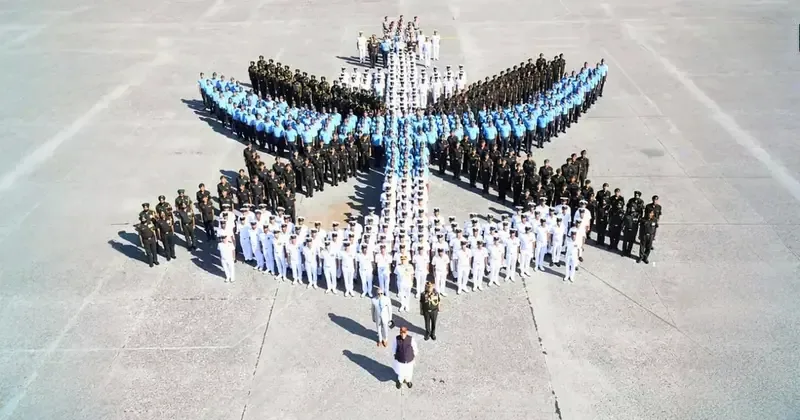
Indian Armed Forces take pride in training for the contemporary and future wars and conflicts. In the spirit of Defence Reforms 2025, the armed forces are transforming for the future, with jointness as the core theme. Towards this holistic aim, the fourth edition of the Tri-Services Future Warfare Training Course commenced on August 3, at the Manekshaw Centre, New Delhi. This four-week training programme is being organised under the aegis of Headquarters Integrated Defence Staff (HQ IDS) and coordinated by Centre for Joint Warfare Studies (CENJOWS).
The training programme is being attended by officers from the three services, participants from the government (Ministry of Defence and other ministries), academia, industry and strategic think tanks.
Chief of Defence Staff (CDS) General N.S. Raja Subramani addressed the inaugural session on August 3 and emphasised the need for the armed forces to adapt to technological change and evolving warfare concepts.
He stressed that future military success will depend not just on advanced weapons, but on leaders who can anticipate disruption, integrate emerging technologies into doctrine and respond quickly to an uncertain security environment. He also highlighted that warfare is expanding beyond conventional battlefields into cyberspace, the electromagnetic spectrum, outer space and the information domain. To achieve a strong joint operational culture across the three Services, the CDS emphasised the need for continuous learning and seamless coordination so that Indian Armed Forces can operate effectively across multiple domains.
Before proceeding any further, it is important to understand why jointness, synergy and integration is critical to operational success in modern warfare. It is a fact that the three Services (Indian Army, Indian Navy, Indian Air Force) largely trained in respective silos earlier, with little bit of cosmetic integration during some specific training courses. Yes, there were structures and organisations that coordinated the joint operations when the need arose. But with quick decision-making needed in complex operations, such adhoc organisations are less likely to succeed.
Once Prime Minister Narendra Modi came to power in 2014, he quickly grasped the essentials of modern warfare. During his interaction with the top brass of the armed forces, he emphasised the need for jointness. His directions led to cross-posting of officers in each other’s establishments. During my military career, I was part of the team in the Army Headquarters that implemented first major step towards jointness by posting high calibre Army officers to Navy and Air Force establishments in the year 2017.
While a lot of preparatory work was going on behind the scenes, PM Modi for the first time publicly highlighted the need for the three Services to work together in a seamless manner from the ramparts of Red Fort on 15 August 2019. It resulted in creating the post of CDS with effect from January 1, 2020 and apporting General Bipin Rawat as the first CDS. By creating the appointment of the CDS, PM Modi fulfilled the key recommendation of Kargil Review Committee, 1999. CDS is the single point advisor to the PM and RM on defence matters and he heads the Department of Military Affairs in the Ministry of Defence.
He is the principal advisor to the RM on all tri-service matters and is responsible for fostering jointness amongst the three Services though HQ IDS. That is why the fourth edition of the Future Warfare Course is being conducted under the aegis of HQ IDS. It is also important to understand the changing nature of wars and conflicts.
The wars have shifted from being one country versus another country with defined geographic frontlines (along borders) to borderless battlefields. Instead of national armies which fought conventional war earlier, the contemporary conflicts have shifted to hybrid warfare, which are increasingly being fought by non-state actors and proxies. The warfare has less kinetic action through boots on ground, by the weapon platforms like tanks, artillery guns and fighter jets but now use more drones, missiles and cyberattacks.
It is best exemplified by the ongoing US & Israel -Iran war, where every shade of a complex modern warfare is visible. The four and half year long Russia-Ukraine war has also its set of military lessons. In the Indian context, the wars and conflicts will be fought on multiple domains against minimum three fronts: Pakistan, China and the hybrid domain.
In fact, it was Russia-Ukraine war which started in February 2022 and it became a ‘live lab’ for the Indian Armed Forces. During the last phase of my military career, I was happy to see that the lessons from Russia-Ukraine war accelerated India’s jointness, indigenisation and drone warfare push. In addition, India worked on a layered air defence and counter-drone systems. India went ahead by integrating S-400, Akash, QRSAM and conventional AD guns into a seamless multi-tier defence. India also improved the artillery guns profile and integrated Precision Guided Munitions like Pinaka and BrahMos for their deadly accuracy.
Indian forces also improved their Electronic Warfare capability and satellite imagery for better intelligence about the enemy. So, it was much superior operational preparedness that facilitated India’s outstanding victory over Pakistan during Operation Sindoor in May last year. India’s retribution to the Pahalgam terror attack on 22 April last year was focused with clear political and military objectives. Indian forces destroyed 9 terror camps inside Pakistan including Jaish-e-Mohammad stronghold at Bahawalpur and Lashkar-e-Toiba main camp at Muridke. India had accurate intelligence about these terror camps and more than 100 terrorists were killed in the precision Indian strikes.
When Pakistan escalated the conflict by targeting India’s border areas, Indian forces destroyed 11 Pakistani airfields and destroyed/damaged 13 Pakistani aircraft. India also destroyed the war-waging capability of Pakistan by destroying their radar centres, AD systems and command & control structures. Pakistan was so severely beaten that it pleaded ceasefire with India in less than four days of conflict on 10 May 25.
Under this backdrop, India’s quest to fight the future wars will be also guided by the lessons learnt during Operation Sindoor and the ongoing US-Iran war. For example, during this war, Iran has perfected the art of asymmetric warfare by successfully taking on the might of the US armed forces. This ongoing war has also highlighted the complexities of naval warfare, with Iran using fast moving small boats against a big target like a naval ship or aircraft carrier. The challenges of keeping the maritime routes open through constricted spaces like Strait of Hormuz also need special attention.
In addition, the limitations of conventional air power against well-protected targets under mountains is also a cause of concern. But at the core of India’s defence preparedness remains being self-reliant (Atma Nirbhar) in most of the military hardware and equipment. The fourth edition of Future Warfare Course is certainly going to deliberate on these issues and many more concerns.
In view of the above, the fourth edition is deliberating a broad set of future-war issues, particularly how emerging technologies and changing geopolitics will shape wars and conflicts. The most obvious one will be to discuss Drone Warfare strategy for India with focus on swarm drone capability. DRDO is actively pushing private industry to build indigenous drone technology. Low-Cost Unmanned Area Swarm Technology (LOCUST) is being developed jointly by DRDO and private defence industry in India.
In addition, India is also refining its counter-drone strategy from the lessons learnt during Operation Sindoor. The future wars need huge quantity of low-cost drones which are AI-enabled, which can work in GPS-denied, jammed environments. In future, most of the weapon platforms have to become AI-enabled for faster reaction in ever changing battle conditions.
Operation Sindoor also taught the importance of Information Operations and Psychological Warfare. Information Operations mean fighting the enemy’s mind and data domain so as to win perception war and gain information dominance over the adversary. On the other hand, Psychological Warfare aims to influence the emotions and behaviour of an adversary so as to break his will to fight, without firing a shot. Another invisible battlefield remains in the cyberspace domain where bytes replace the bullets.
India’s Defence Cyber Agency is a tri-service organisation and a lot of work has to be done as per Joint Doctrine for Cyberspace Operations, 2024. Space is the fourth warfighting domain after land, sea and air. India Defence Space Agency established in 2019 has to prepare for the future threats, particularly from China, with Anti-Satellite (ASAT) capability.
The ongoing US-Iran war has also brought a new reality in global maritime navigation. Keeping the key sea routes free and open at all times has become critical for the global economy. India as the world’s fourth largest Navy has to play a more proactive role in the future. The military leadership has to understand the evolving geopolitics and multi-domain operations even beyond the land and maritime borders.
Towards this, India is now in the final stages of creating three Integrated Theatre Commands. The success in the future wars is incumbent on ‘whole of nation approach’ where warfare is treated as a national effort and not just a military one. The fourth edition of the Future Warfare Course, with participation by the best brains involved in the national security, will be able to synchronise best civil-military integration for a strong and resilient Bharat.