
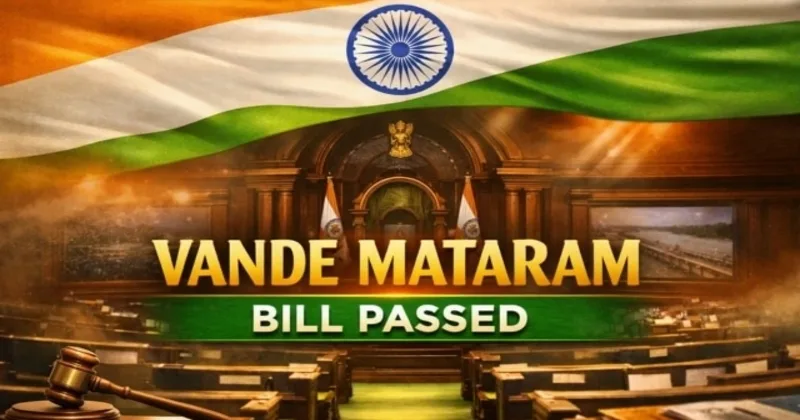
The bill — The Prevention of Insults to National Honour (Amendment) Bill, 2026 — has been passed in the Indian parliament. Now insult to the National song “Vande Mataram” will be a criminal offence. In fact, Vande Mataram is the most precious social capital which will not only inspire Indians for generations but it will instill self respect and confidence among the youth. This patriotic song reminds every Indian of the sacrifices made by the freedom fighters to achieve India’s independence. Now it is the responsibility of every educated Indian to create the right environment so that freedom will remain forever.
The revolutionary poet and writer, Bankim Chandra Chottopodhyaya had written a historical novel, “Ananda Matha” in 1882. The patriotic song was part of the novel which was written in the backdrop of the Indian Sanyasis’(Monks) armed struggle to make India free from the British’s rule. The song was officially adopted by the Indian National Congress in 1905 to serve as a pan-Indian, nationalist salutation to mother India during the Independence struggle. Noted freedom fighter, Lala Lajpat Rai started a journal called “Vande Mataram” from Lahore during that time.
On May 20, 1906, in Barisal of the undivided Bengal, more than ten thousand people, both Hindus and Muslims marched together with Vande Mataram flags in hand. In 1907, Madam Bhikaiji Cama, a Parsi freedom fighter from Mumbai created the first version of India’s national flag with “Vande Mataram” written on it. She also unfurled it on August 22, 1907. The Indian National Congress had chosen “Vande Mataram” as the national song in 1937.
The Constituent Assembly of India had granted it the official status as the National Song in 1950, to be honoured equally with the National Anthem, “Jana Gana Mana …..” Mahatma Gandhi supported adoption and the singing of the Vande Mataram song. In January 1946, while giving a speech in Guwahati, he urged that “Jai Hind should not replace Vande-Mataram”. He reminded everyone present that Vande-Mataram was being sung since the inception of the Congress. He supported the “Jai Hind” greeting, but remanded that this greeting should not be to the exclusion of Vande Mataram.
The Madras High Court in July 2017 ruled that the “Vande Mataram” shall be sung or played at least once a week in all schools, universities and other educational institutions of Tamil Nadu. The Court also ruled that the song should be played or sung in government offices and industrial facilities at least once a month. But, in November 2017, the Madras High Court backtracked and left it to the Tamil Nadu government to take a decision. Unfortunately, this patriotic song which united Indians against the British Raaj and inspired freedom fighters, faces controversy in post-independent India. In fact, not a single word in Vande Mataram is against any religion or group.
Over the last many decades Vande Mataram was close to the hearts of the Indian patriotic organizations and the youth. The activists of the RSS, BJP and the other patriotic organisations used to chant “Vande Mataram” in public meetings, functions and during public protest. In fact, Vande Mataram is an ode to the motherland. The first stanza of Vande Mataram reads: “Vande Mātaram: Sujalāṃ suphalāṃ Malaẏajaśītalām. Śasyaśyāmalāṃ Mātaram. Vande Mātaram”. Oh mother! Accept my prayer. You have water and crops in abundance. You touch us with a cool and gentle breeze. Oh Mother! You have abundant green crops…”.
This powerful patriotic song had not only triggered many mass movements in India, it had inspired people to perform patriotic deeds. Patriotism is an elixir of growth and prosperity; it inspires youth to achieve impossible feats. If the right environment is created in the country, Vande Mataram will achieve great things for the country.
The slogan “Vande Mataram” has a magical effect on people if it is chanted by leaders who live truth, purity and integrity. The social capital, Vande Mataram can build a strong and prosperous country. Let the brave and proud people of this country learn not to bow down before any foreign power but before their own mother land.