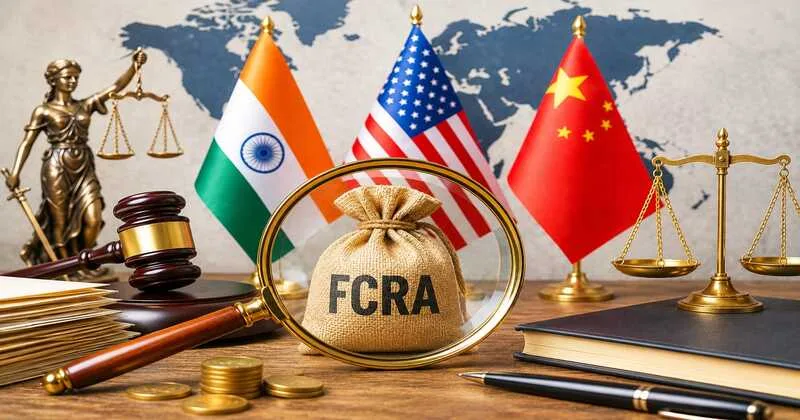
The regulation of foreign funding for non-governmental organisations (NGOs) has become an increasingly important aspect of national security policy across the world. Governments argue that while civil society organisations play a vital role in development, humanitarian work and advocacy, foreign funding can also be used to influence domestic politics, public opinion, policymaking and even national security. Consequently, several countries have enacted laws to ensure transparency and oversight over organisations receiving funds from overseas.
India is among the countries that have adopted a dedicated legal framework to regulate foreign contributions. The Foreign Contribution (Regulation) Act (FCRA), first enacted in 1976 during the Emergency and comprehensively revised in 2010, seeks to ensure that foreign contributions do not adversely affect the country’s sovereignty, democratic processes, public interest or national security. The Act was further strengthened through amendments in 2020, and the Union Government has now introduced the Foreign Contribution (Regulation) Amendment Bill, 2026, proposing additional safeguards.
Critics have often portrayed India’s FCRA regime as unusually restrictive. However, a closer examination of international practices reveals that several major powers have adopted their own legal mechanisms to regulate foreign influence. While the legal structures differ, countries such as China and the United States also maintain stringent oversight over organisations or individuals linked to foreign funding or foreign governments.
Rather than being an exception, India’s approach reflects a broader global trend in which governments increasingly view foreign financial influence through the lens of national security.
India’s New FCRA Amendment: Strengthening oversight
The proposed Foreign Contribution (Regulation) Amendment Bill, 2026 seeks to plug gaps identified during the implementation of the existing law. According to the reports, the amendments are intended to improve transparency, accountability and effective monitoring of foreign-funded organisations.
Among the significant provisions is the proposal for the appointment of a custodian to manage the assets of organisations whose FCRA registration has expired, been cancelled or suspended. This provision aims to prevent misuse or diversion of assets acquired through foreign contributions until the legal status of the organisation is resolved.
Another important amendment proposes that organisations will be permitted to utilise foreign contributions only for the specific objectives and within the States or Union Territories approved during registration. Any substantial deviation would require prior approval from the Central Government. The Government argues that this will improve accountability and ensure that foreign funds are used strictly for the declared purposes.
The FCRA Amendment Bill, 2026 is under Parliament’s consideration after being introduced in the Lok Sabha on March 25.
It proposes tighter oversight of foreign contributions, a designated authority to manage assets of organisations losing FCRA registration, and reduced… pic.twitter.com/1zdDgnZliE
— SansadTV (@sansad_tv) August 6, 2026
The Bill also introduces greater clarity regarding activities that qualify as “religious purposes.” It explicitly states that proselytisation or religious conversion shall not be treated as a permissible religious activity under the Act. According to the reports, this amendment is intended to distinguish legitimate religious and charitable work from activities aimed at religious conversion using foreign funds.
The amendments also seek to streamline compliance requirements, strengthen monitoring mechanisms and reduce opportunities for misuse of foreign contributions.
According to the Government, these measures are intended to safeguard India’s sovereignty while allowing genuine charitable and developmental organisations to continue their work within a transparent regulatory framework.
China’s Foreign NGO Law: A highly centralised model
If India regulates foreign funding through the FCRA, China has adopted an even more centralised system under the Law on the Management of Foreign Non-Governmental Organisations’ Activities, commonly known as the Foreign NGO Law, which came into force in 2017.
Unlike India, where NGOs register with the Ministry of Home Affairs for receiving foreign contributions, China places the administration of foreign NGOs under the supervision of the Ministry of Public Security and provincial public security authorities.
Foreign NGOs wishing to operate in China must either establish a representative office or obtain approval for temporary activities. They cannot function independently. Every foreign NGO must secure the sponsorship of an officially approved Chinese government agency or public institution, commonly referred to as a Professional Supervisory Unit.
The law further requires registration with public security authorities, submission of annual work plans, disclosure of funding sources, reporting of financial accounts and acceptance of regular inspections by government agencies.
Chinese law also prohibits foreign NGOs from engaging in or funding political activities and bars them from activities considered to threaten national unity, ethnic harmony or social stability. Authorities possess extensive powers to inspect offices, examine documents, question personnel, freeze assets in certain situations and suspend operations if violations are detected.
Beijing has consistently defended the legislation as essential for protecting China’s national security, maintaining social stability and preventing foreign interference in domestic affairs.
While India’s FCRA focuses primarily on regulating foreign contributions received by Indian organisations, China’s law exercises direct supervision over foreign NGOs themselves, making it one of the world’s most comprehensive regulatory frameworks governing overseas civil society organisations.
The United States: Transparency through FARA and greater scrutiny of foreign influence
Unlike India and China, the United States does not have a single law regulating all NGOs receiving foreign donations. Instead, it relies on a combination of laws, the most prominent being the Foreign Agents Registration Act (FARA), 1938, which seeks to ensure transparency when individuals or organisations act on behalf of foreign governments, political parties or other foreign principals.
Enacted in 1938 to counter foreign propaganda, FARA requires persons acting as agents of foreign principals to register with the US Department of Justice. Registrants must disclose their relationship with the foreign principal, the nature of their activities, income received and expenditures made while carrying out such work. Failure to register can lead to civil and criminal penalties.
Although FARA does not prohibit foreign funding, it mandates public disclosure so that policymakers and citizens know when advocacy, lobbying or public campaigns are linked to foreign interests. In recent years, enforcement of FARA has increased significantly, with the Department of Justice pursuing more investigations and prosecutions involving undisclosed foreign influence.
Alongside FARA, the United States has tightened oversight of foreign investments, foreign lobbying, sanctions compliance and organisations suspected of acting on behalf of overseas governments. National security agencies increasingly view foreign influence operations as a significant challenge, particularly from strategic competitors.
The second Trump administration has further intensified scrutiny of US foreign assistance programmes. President Donald Trump has repeatedly argued that American taxpayer money should serve US national interests and has questioned overseas spending that, according to his administration, lacks accountability or advances ideological objectives rather than strategic priorities.
Soon after assuming office for his second term, the administration initiated a broad review of foreign assistance programmes, including projects implemented through the United States Agency for International Development (USAID). Funding for numerous overseas programmes was paused or reviewed to determine whether they aligned with the administration’s foreign policy priorities. Officials argued that aid should advance America’s security, economic interests and diplomatic objectives rather than support programmes considered inconsistent with those goals.
Vice President JD Vance has heavily criticised USAID funding and NGO operations, arguing that they act as inefficient “middlemen” who use taxpayer money to promote ideological or “woke” agendas rather than delivering effective aid. Speaking at the International Religious Freedom Summit, he targeted NGOs for ideological overreach, questioning taxpayer support for organisations “dedicated to spreading atheism”.
The administration also emphasised stricter oversight of grants, improved financial accountability and greater scrutiny of organisations receiving US government funding abroad. While these measures relate primarily to American foreign aid rather than domestic NGO regulation, they reflect the broader principle that governments have the authority to examine how foreign funds are utilised and whether such spending advances national interests.
Comparing India, China and the United States
Although India’s FCRA, China’s Foreign NGO Law and America’s FARA differ in structure, they share a common objective of protecting national interests from undue foreign influence.
India regulates the receipt and utilisation of foreign contributions by Indian organisations. China regulates the activities of foreign NGOs operating within its territory through an extensive public security framework. The United States focuses on transparency by requiring disclosure when persons or organisations act on behalf of foreign principals.
The level of government oversight also differs considerably. China’s model is the most stringent, with public security authorities exercising direct supervision over foreign NGOs and possessing extensive enforcement powers. India’s framework requires registration with the Ministry of Home Affairs, periodic reporting, designated banking channels and compliance with conditions attached to foreign contributions. The American model places greater emphasis on disclosure and transparency rather than prior approval of funding.
UP DGP VIKRAM SINGH:
"FCRA Bill is not against any Religion.
In Balrampur, Changur received ₹400 crore in foreign funds to facilitate 2,000 conversions 😳
There have been allegations of religious conversions in Northeast & Punjab"
pic.twitter.com/p2SViseqTF— News Algebra (@NewsAlgebraIND) August 6, 2026
Another significant distinction lies in the scope of regulation. India’s FCRA covers charities, educational institutions, research bodies, religious organisations and voluntary associations receiving foreign contributions. China’s law applies specifically to all foreign and domestic NGOs operating in China. FARA applies only when individuals or entities act on behalf of foreign principals in political or influence-related activities and does not regulate every NGO receiving overseas donations.
Nevertheless, all three countries recognise that foreign funding may, under certain circumstances, be used to influence domestic affairs. Each has therefore adopted legal mechanisms suited to its constitutional framework and national security priorities.
The debate is therefore not whether foreign funding should be regulated, but how such regulation should be designed to balance transparency, security and the legitimate functioning of civil society organisations.
India’s FCRA and the global shift towards greater accountability
The debate surrounding India’s FCRA has often been framed as a conflict between national security and civil society. However, developments across major powers suggest that governments worldwide are becoming increasingly cautious about foreign influence. Whether through India’s FCRA, China’s Foreign NGO Law or the United States’ Foreign Agents Registration Act (FARA), the underlying concern remains the same: ensuring that foreign money does not compromise national sovereignty, democratic institutions or public policy.
The Indian government has consistently maintained that the FCRA is not intended to curb genuine charitable or developmental work. Instead, it seeks to ensure that organisations receiving foreign contributions remain transparent, accountable and compliant with Indian law. Successive governments have argued that foreign funding should not be used to influence elections, public servants, judicial processes, national security or activities that may adversely affect the country’s strategic interests.
BIG BREAKING: FIR registered under UAPA against US-based evangelical group The Timothy Initiative (TTI) & 6 individuals on charges of Christian Conversion and FCRA violations.
ED probe alleges ₹92.55 crore illegally routed via 1,000+ foreign debit cards without FCRA… pic.twitter.com/Ts1wnipGwt
— Megh Updates 🚨™ (@MeghUpdates) June 16, 2026
The proposed Foreign Contribution (Regulation) Amendment Bill, 2026 builds upon this approach. By introducing provisions such as the appointment of custodians for assets of organisations that lose FCRA registration, restricting the use of foreign funds to approved purposes and geographical areas, and clarifying that proselytisation does not qualify as a permissible religious activity under the Act, the Government says it is addressing regulatory gaps identified during implementation.
International comparisons indicate that India is not acting in isolation. China maintains one of the world’s most stringent systems for supervising foreign NGOs, with mandatory registration, official government sponsors, annual work plans and extensive oversight by public security authorities. The United States, while adopting a different legal model, has steadily expanded scrutiny of foreign influence through stricter enforcement of FARA and greater oversight of foreign-funded activities.
\The Trump administration’s review of USAID-funded programmes and emphasis on aligning overseas assistance with American national interests further reflects the growing priority governments place on accountability in the use of public and foreign funds.