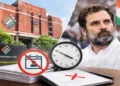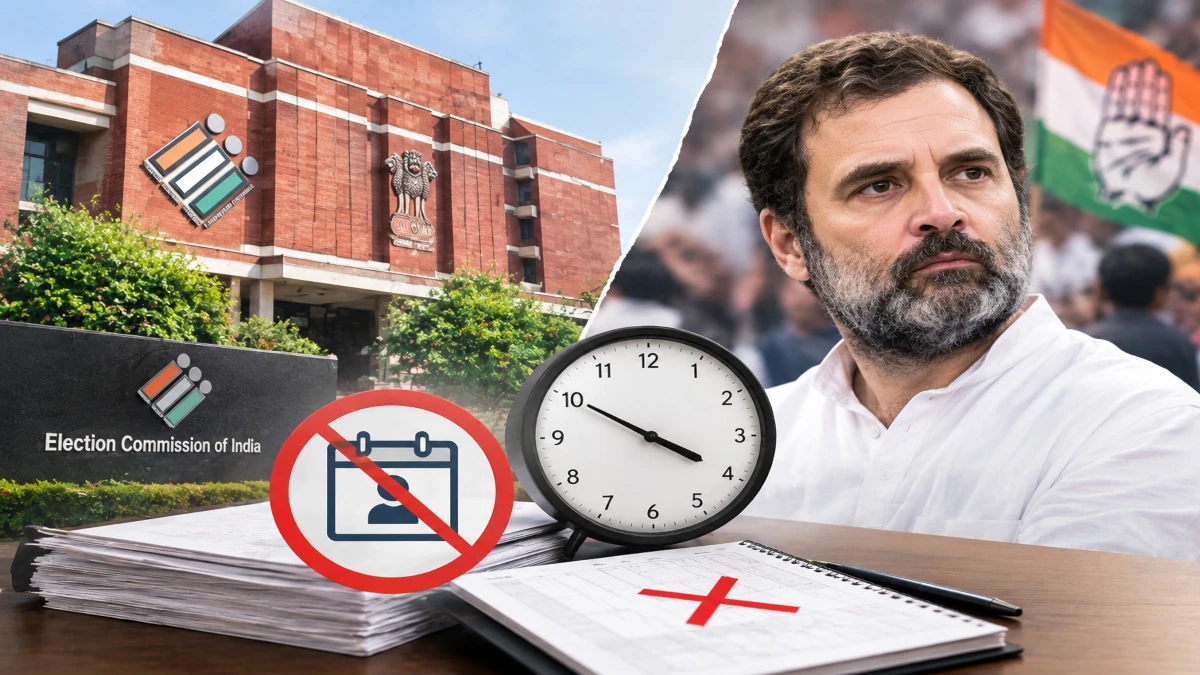
NEW DELHI: The Election Commission of India has pushed back sharply against Leader of Opposition Rahul Gandhi’s allegation that the poll panel was refusing to meet him and a delegation of MPs over issues related to the Special Intensive Revision (SIR) of electoral rolls, saying that no political party had sought an appointment with the Commission through the prescribed procedure until 4 PM on October 6.
The ECI’s detailed clarification came after Rahul Gandhi and opposition MPs marched towards the Election Commission, with the Congress leader accusing the poll panel of avoiding a meeting with the delegation. The Commission’s statement, however, presents a markedly different account of the sequence of events, saying the request reached it only later in the afternoon and was subsequently complicated by a demand to meet with around 240 MPs at the Parliament House Annexe.
The Election Commission said it first learnt through the media that some MPs wanted to meet the Commission along with a delegation. Until 4 PM, however, no political party had formally sought an appointment through its authorised representative, as required under the procedure laid down by the ECI in 2025.
According to the Commission, at around 4 PM, Delhi Police informed it that a delegation led by Rahul Gandhi wanted to meet the poll panel and submit a memorandum.
‘The @RahulGandhi Doctrine’: When you fail to score a goal, or the only goals you score are self-goals, you shift the goalpost…
Making a spectacle of himself Rahul Gandhi claims ECI is refusing to meet him and his cohorts over SIR-related issues.
But the Truth, as always, is… pic.twitter.com/kiLeDXSAKk
— Kanchan Gupta 🇮🇳 (@KanchanGupta) October 6, 2026
ECI: Opposition did not follow established procedure
The Commission said that political parties had already been informed of the procedure governing such meetings.
Under the system laid down in 2025, whenever a political party or a joint delegation of several parties wants to meet the ECI, it is expected to seek an appointment through its duly authorised representative. The meeting is then scheduled at a mutually agreed date and time.
The ECI’s statement therefore directly challenges the political narrative that it simply refused to grant Rahul Gandhi an audience.
Rather, according to the poll panel, the initial requirement for seeking an appointment through the authorised channel had not been followed before the delegation attempted to meet the Commission.
The situation became even more unusual, the ECI said, when Delhi Police subsequently informed it that the proposed delegation comprised around 240 MPs and that the meeting was being sought at the Parliament House Annexe.
‘Unusual request’: ECI says meeting venue was Parliament Annexe
The Commission said it considered the request unusual because, under its established protocol, meetings with political delegations are held on the premises of the Election Commission of India. Consequently, the ECI said it could not accept the proposal for a meeting at Parliament House Annexe.
But the Commission did not simply close the door on the delegation.
In what it described as an “unprecedented step”, the ECI proposed sending its senior-most officer on duty to the Parliament House Annexe to receive the memorandum from the MPs. That offer, too, was declined by the MPs, according to the Commission.
This detail significantly undercuts the claim that the Election Commission categorically refused to engage with the opposition delegation. The ECI maintains that while it could not agree to an unusually large delegation meeting it at a location outside its premises, it nevertheless offered an alternative mechanism to receive the memorandum.
Rahul Gandhi’s ‘refusal’ charge faces ECI counter
Rahul Gandhi and opposition parties have sought to portray the development as evidence that the Election Commission is unwilling to hear their concerns over SIR-related issues.
The ECI, however, has put the focus on procedure, timing and venue, arguing that political parties cannot bypass established protocols and then portray the Commission’s adherence to those protocols as a refusal to engage.
The Commission reiterated that political parties are free to seek meetings with it at any time, with the date and time to be mutually scheduled. It also stressed that it respects parliamentary and democratic processes, while maintaining that its own protocols and conventions are equally important.
A political confrontation over SIR
The clash comes amid an increasingly charged political debate over the Special Intensive Revision of electoral rolls, with opposition parties raising questions over the exercise and demanding greater engagement from the poll authorities.
Rahul Gandhi’s decision to lead a large group of MPs to the Election Commission was clearly intended to put political pressure on the poll panel and dramatise the opposition’s objections.
But the ECI’s October 6 statement has shifted the focus from the substance of the opposition’s SIR concerns to whether the delegation itself followed the Commission’s established procedure for seeking an appointment.
The Commission’s account is unequivocal, there was no formal appointment request through the prescribed channel before 4 PM; the subsequent request involved around 240 MPs; the proposed venue was the Parliament House Annexe rather than the ECI premises; and even the Commission’s offer to send its senior-most officer to receive the memorandum was rejected.
‘Goalpost politics’ takes centre stage
The controversy has provided fresh ammunition to critics of Rahul Gandhi, who argue that the Congress leader’s political strategy increasingly involves turning procedural or institutional disagreements into allegations of institutional obstruction.
While Rahul Gandhi has sought to project the episode as the Election Commission refusing to meet the Opposition, the ECI’s own account says the issue was not a refusal to meet political parties but the failure to seek an appointment through the established mechanism, followed by an unusual demand involving a 240-MP delegation at Parliament House Annexe.
The Commission has also made clear that its doors remain open: any political party can request a meeting, and the ECI will schedule one through the regular process.