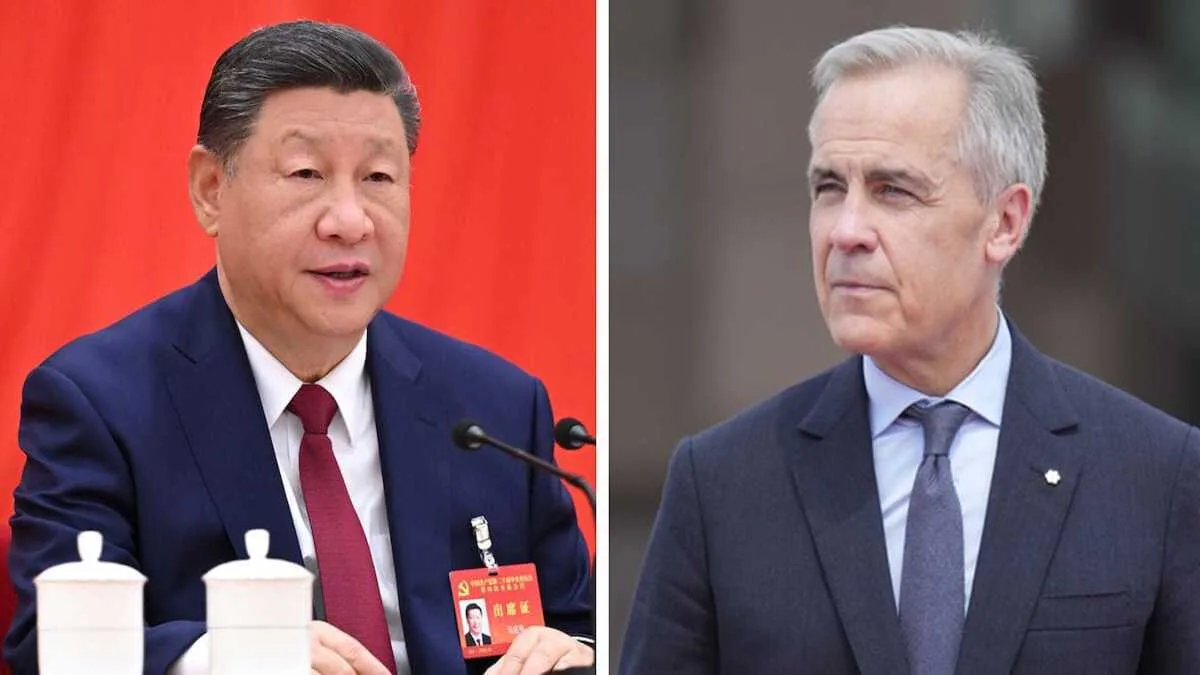
New Delhi: Canada’s intelligence agency has identified China as the most active foreign state conducting interference activities in Canada, warning that Beijing is likely to continue targeting Canadian democratic institutions, political actors and Chinese Canadian communities.
In its foreign interference report released on September 3, 2026, the Canadian Security Intelligence Service (CSIS) said the People’s Republic of China (PRC) remains the leading foreign interference actor in Canada in both the scale and scope of its activities. The report also examined foreign interference threats linked to India, Russia, Pakistan and Iran.
CSIS said PRC officials and their proxies are involved in planning, organising and executing interference operations. The agency identified Canadian government institutions, political leaders and staff, academics, businesses, community organisations and members of the Chinese diaspora among the targets.
According to CSIS, Beijing is likely to attempt electoral interference during the next year, potentially during the next federal election. The agency also assessed that China will “almost certainly” continue transnational repression against Chinese Canadian communities.
Beijing’s expanding network of influence
CSIS defines foreign interference as clandestine, deceptive or threatening activities undertaken by foreign states or their proxies within or against Canada or Canadian interests. Such activities can include cultivating individuals, attempting to influence politicians and decision-makers, spreading disinformation and intimidating or coercing members of diaspora communities.
The agency said PRC officials operating in Canada and China are primarily responsible for planning and organising political interference, while proxies, including individuals and groups connected to the Chinese Communist Party’s United Front system, are primarily involved in implementing such activities. CSIS has previously described the United Front Work Department as the CCP’s primary foreign-interference administrative arm.
The intelligence service described Beijing’s approach as a sophisticated system of incentives and disincentives. Financial and status-related rewards can be used as incentives, while visa restrictions, surveillance, harassment, intimidation and pressure involving relatives or friends can serve as forms of punishment.
CSIS said China’s principal objectives include exercising influence over Chinese Canadian communities, suppressing dissent and encouraging Canadian politicians and decision-makers to adopt positions favourable to Beijing. The agency assessed that the PRC almost certainly regards its foreign interference operations as “low-risk, high-reward” activities and is likely to employ new tools and capabilities to target Canadian democratic institutions.
The assessment follows CSIS’s previous public reporting in June 2025, when the agency described China as posing the “greatest counter-intelligence threat” to Canada and said Chinese intelligence and United Front organisations were targeting governments, citizens, diaspora communities, media, academia and other institutions through foreign interference, espionage and clandestine activities.
Intelligence warning amid closer Canada-China ties
The latest warning comes as Prime Minister Mark Carney has pursued a significant recalibration of Canada-China relations. During his visit to China in January 2026, Carney and Chinese President Xi Jinping outlined a new strategic partnership covering areas including trade, energy, finance, public security, people-to-people relations and multilateralism. The visit also produced several memoranda of understanding.
The approach represented a change from Carney’s position during the April 2025 federal election campaign, when he described China as “the biggest security threat” to Canada.
The tension between security concerns and diplomatic engagement became more visible in September 2026. On September 4, military-to-military talks between Canada and China were held in Canada. China’s Defence Ministry described the meeting as a candid and in-depth exchange and said both sides expressed willingness to strengthen military cooperation. Canada’s Defence Department confirmed the meeting as part of ongoing functional-level military-to-military communications.
The talks drew criticism from Conservative defence critic James Bezan and foreign affairs critic Eric Duncan. They also objected to government documents showing that Canadian Armed Forces personnel had helped train the Chinese military during Exercise Khaan Quest in 2023 in Mongolia, a United Nations preparation mission.
Bezan said on September 15, 2026, that the Conservative Party would introduce a parliamentary committee motion calling for Canadian defence officials to testify about the military training and the resumption of military talks with Beijing.
Concerns over Chinese interference are also reflected in the findings of the public inquiry led by Justice Marie-Josee Hogue. In its final report in January 2025, the inquiry described China as the “most active perpetrator” of foreign interference in Canada and concluded that Ottawa had not been sufficiently transparent with Canadians about the threat posed by Beijing.
The report stated that the Canadian government had “proven to be a poor communicator and insufficiently transparent” on foreign interference, underscoring the continuing challenge of balancing engagement with China against concerns over Canadian democratic institutions and national security.