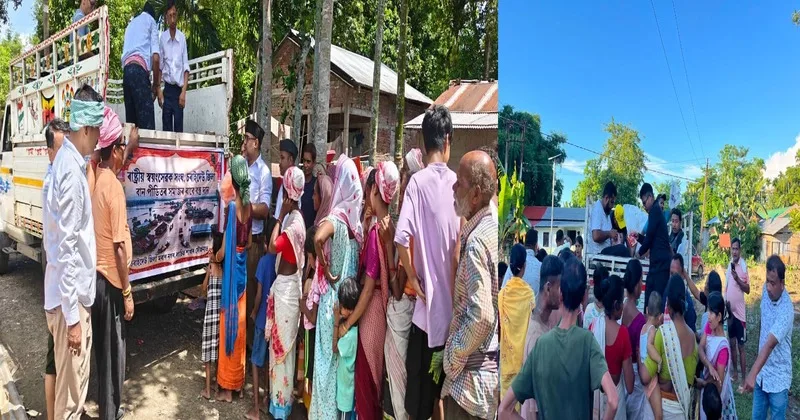
Guwahati: Floods have brought misery to large parts of Upper Assam with over 89 people having lost their lives. Lakhs of people have been affected in 4 districts. Thousands of cattle and 59,000 hectares of crops were also ruined by the flood. In this crisis time the Swamsevaks of Rashtriya Swayamsevak Sangh (RSS) along with several other wings of the organisation, are working tirelessly round the clock to help those affected. Sivasagar, Charaideo, Golaghat and Jorhat districts have been the worst hit, with thousands of families left homeless and struggling to find food, clean water, shelter and medical care.
Since July 20, 1,912 Swayamsevaks of RSS have been carrying out rescue and relief work across 378 flood-affected villages in these three districts. So far, they have reached 40,168 flood affected families. The Swayamsevaks have been helping people in mud cleaning, temporary house construction etc besides regular relief and rescue missions. The flood flurry has been decreasing to some extent but the rehabilitation process has not been so easy in the affected areas as thick lairs of mud have buried many villages. Many of these volunteers travelled to Sivasagar, Charaideo, Jorha and Golaghat from Dibrugarh, Lakhimpur and other parts of the state to lend a hand to the affected people.
In the worst-hit places like Sundar Pokhuri, Bamun Pokhuri, Geleki and Rajabari small boats have become a lifeline. Swayamsevaks have used them to ferry cooked food, clean drinking water, medicines, clothes and other essentials to families stranded by rising water. Not only the relief, Swayamsevaks have rescued over 200 people from worst affected villages like Betbari, Kakati Gaon, Nepali Khuti, Bihubor etc and shifted them to safe places.
The relief supplies cover the basics people need to survive: rice, sugar, porridge, baby food, salt, potatoes, clothing, bedding, utensils, candles, dry rations, biscuits, soap and clean drinking water, among other items.
Alongside the relief work, Sangh partnered with the National Medicos Organisation to run more than 50 medical camps in the flood-hit areas, offering treatment to those who need it most.
In the early days of the floods, when many homes were still submerged, volunteers focused on getting people out safely. Using small boats, they evacuated the elderly, women, children and the sick, moving them to safer ground and arranging emergency medical care along the way.
Now, as flood waters recede in some areas, the focus is shifting. Volunteers are helping families repair homes damaged by the floods and are also distributing feed for livestock, since many families depend on their animals for a living. Attention is also turning to the fields, with efforts underway to help farmers get back to planting once the land is ready.
For the Rashtriya Swayamsevak Sangh, this kind of response is nothing new but a part of selfless service to the nation. Sangh describes it as part of a long-standing tradition of service, one they trace back to the idea of “Nar Seva Narayan Seva” serving people as an act of serving the divine. In the middle of a disaster that has upended thousands of lives, volunteers say their aim has been simple: to stand by the affected families and give them hope, support and the means to rebuild.