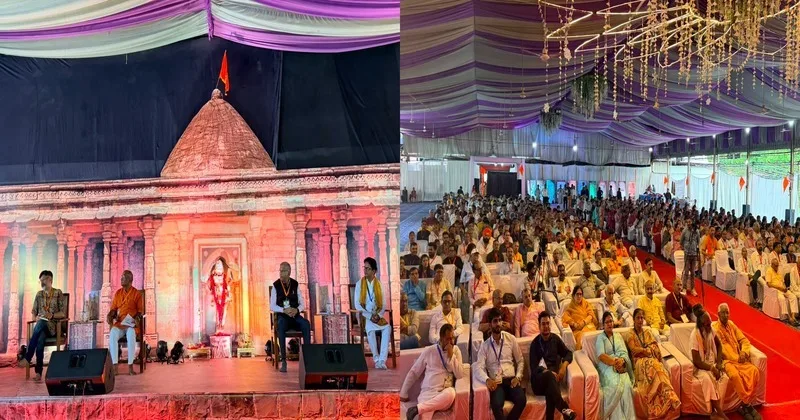
Dhar: The Rajabhoj Memorial Lecture Series Organising Committee, Dhar, hosted a distinguished lecture on “Bhojshala: India’s Cultural Renaissance – Direction, Vision, and Responsibility” at Milan Mahal on Friday. The four-hour event witnessed the participation of more than two thousand attentive listeners, who remained deeply engaged throughout the proceedings. The lecture series evolved into a profound forum for reflection on India’s civilisational consciousness, knowledge traditions, historical legacy, cultural self-respect, and national responsibility.
Revisiting Indian History Through an Indian Perspective
Delivering the keynote address, Dr Balamukund Pandey, National Organising Secretary of the Akhil Bharatiya Itihas Sankalan Yojana and a renowned historian, observed that the history taught in India has often failed to accord due recognition to the nation’s civilisational wisdom, intellectual traditions, and cultural grandeur. He remarked that glorious chapters such as Raja Bhoj, the historic city of Dhar, and India’s vast knowledge systems remained neglected for decades.
He noted that during successive invasions, temples, libraries, and centres of learning were systematically destroyed, and later, the very evidence of their existence was demanded. Stressing the need for scholarly and evidence-based historical research, he called upon society to preserve and rediscover India’s authentic historical narrative and cultural heritage.
Dr Pandey further emphasised that history is not merely a chronicle of changing political powers; it is the living record of a nation’s cultural consciousness and intellectual legacy. He urged that younger generations must be introduced to India’s glorious past through authentic and well-researched historical sources.
Bhojshala Continues to Bear Witness to Faith and Resistance
Speaking on the historical significance of Bhojshala, Dr Pandey stated that the surviving temple structure itself stands as testimony that its original identity could never be completely erased. He observed that even today, the handprints of the courageous women who embraced jauhar within the complex silently narrate stories of sacrifice, resistance, and unwavering cultural devotion.
He also advocated incorporating the contributions of Raja Bhoj into the National Education Policy and university curricula so that future generations may appreciate his enduring contribution to Indian civilisation.
‘Samarangana Sutradhara’: A Remarkable Testament to Ancient Indian Science
Distinguished thinker, author, and social commentator Shri Prashant Pol highlighted that Ujjayini and Avanti were among the foremost centres of learning in ancient India. Continuing this illustrious tradition, Raja Bhoj established Bhojshala in Dhar as a premier institution dedicated to Sanskrit, mathematics, astronomy, architecture, and scientific studies.
He explained that Raja Bhoj’s celebrated treatise, Samarangana Sutradhara, is far more than a work on architecture. It is an extraordinary document of ancient Indian science and engineering, containing detailed descriptions of mechanical devices, hydraulic systems, and automated technologies that display remarkable similarities with modern engineering principles. Shri Pol further noted that while this monumental work has attracted considerable scholarly attention abroad, it has yet to receive the level of academic study it deserves within India.
Bhojshala: A Great Centre of Knowledge, Culture, and Education
Editor of the weekly Organiser and senior journalist, Prafulla Ketkar, described Bhojshala as much more than a physical monument. According to him, it represented one of the greatest centres of learning, culture, and education during the reign of Raja Bhoj.
Referring to various reports of the Archaeological Survey of India (ASI), he stated that Bhojshala has been identified as a site originally associated with a temple and the worship of Goddess Saraswati. He emphasised that India’s history must be understood through an Indian civilisational perspective, supported by indigenous traditions, archaeological evidence, and historical research. He also advocated comprehensive scientific study of the Bhojshala complex and wider dissemination of verified historical findings.
Lecture Series Continuing Since 2015
Dr Dinesh Karma, President of the Rajabhoj Memorial Lecture Series, and Advocate Siddharth Jain, Secretary, informed the gathering that the lecture series has been organised annually since 2015 under the auspices of the Dattaji Unnagaonkar Memorial Trust.
The Trust was established in memory of the late Dattaji Unnagaonkar, a dedicated pracharak of the Rashtriya Swayamsevak Sangh and an eminent lyricist. Through service initiatives, value-based educational centres, and intellectual programmes, the Trust continues to work towards social awakening and cultural enrichment. Each year, the Rajabhoj Memorial Lecture Series brings together eminent scholars and public intellectuals to deliberate on issues of contemporary national and civilisational significance.