In a major milestone, marking the growing indigenous defence capabilities of India, the Defence Research and Development Organisation(DRDO), country’s premier defence think-tank has successfully tested the long-range surface-to-air missile under project Kusha, off the coast of Odisha at Dr. APJ Abdul Kalam Island. The indigenous three-tier missile defence shield successfully intercepted a high-speed, high-altitude simulated target. Project Kusha aims to develop three variants of surface-to-air missiles as a part of the ambitious Sudarshana Chakra mission.
The successful test of the air defence system by DRDO, thus signifies a giant leap in the indigenous defence prowess of India and a reduced dependence on defence imports to seal national security. Hailing the milestone of DRDO, Defence Minister Rajnath Singh said, “Kusha missile system is capable of neutralising a wide variety of aerial threats including fighter jets, missiles, UAVs and large enemy aircrafts within a wide range and altitude envelope”.
“Today’s successful test flight of Kusha marks an important milestone in Indian defence R&D. The capability in developing long range surface-to-air missile systems is possessed only by a handful of nations. This will also eliminate the import dependency for such systems and signifies a giant leap in air defence capability of the nation. I congratulate DRDO and other stakeholders for this achievement”, the Defence Minister further added.
The @DRDO_India has successfully conducted the maiden flight test of Long-Range Surface-to-Air Missile Kusha today from the APJ Abdul Kalam Island off the coast of Odisha.
Kusha missile system is capable of neutralising wide variety of aerial threats including fighter jets,… pic.twitter.com/EceUgGM1HR
— Rajnath Singh (@rajnathsingh) July 23, 2026
The Project Kusha imbibes three-tier indigenous missile system, which forms the core component and a key to craft Sudarshana Chakra, a home-grown defence technology, conceptualised as a multi-layered air defence system, aimed to consolidate the national security architecture from emerging geopolitical threats and unforeseen misadventures by the enemy camps from the neighbouring regions.
Project Kusha is also dubbed as an indigenous equivalent to Russia’s S-400 which proved stellar performance during Operation Sindoor and is considered as a game-changer that aided to foster a strategic edge against Pakistan. India’s relentless ambition to equip the indigenous defence basket with cutting-edge military technologies, is also an impact of the evolving precarious geopolitical landscape and strategic compulsions.
The ongoing Russia-Ukraine war or the West Asia conflict has acted as a testament to realise the importance of having an advanced & robust air defence system and the contemporary wars are increasingly evolving as airborne. Nations have to be equipped with the ability to neutralise the intruding aerial threats and protect critical military infrastructure or civilian spaces. In this direction, India is fast-tracking its indigenous offensive and defensive capabilities and Project Kusha is deemed as a giant leap in this path.
Sudarshana Chakra is a complex indigenous multi-layered, integrated air defence system, envisioned by Prime Minister Narendra Modi during his previous year Independence Day speech. The Sudarshana Chakra will be ready to be deployed by 2035, as it is a long-gestation defence project with multiple elements. However, the successful testing of the surface-to-air missile system, under Project Kusha, adds great momentum to this journey.
Project Kusha
- Long-range surface-to-air missile
- Fully developed by DRDO including advanced long-range radars, Artificial Intelligence(AI) capabilities, multi-tier interceptors, command and control centre etc.
- Has a range of more than 200-400 kms
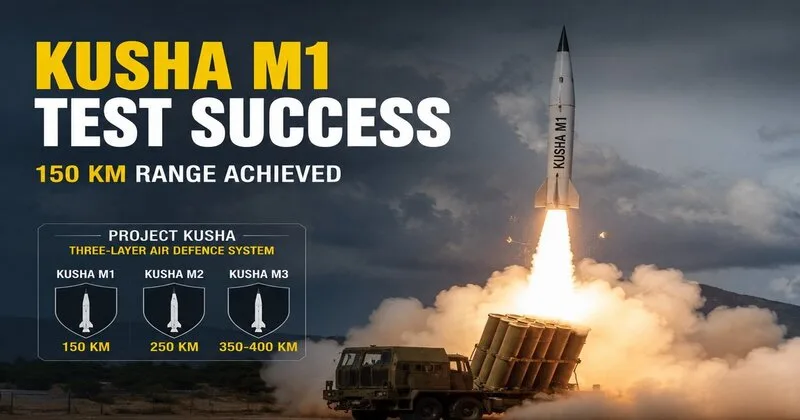
- The system will have three interceptor variants, M1 with around 150 km range, M2 with around 250 km range and M3 with around 350–400 km range, thus enabling a multi-tier interception against enemy threats, intruding at all ranges or altitudes.
- Capable of neutralising all kinds of aerial threats, including fighter jets, stealth platforms, precision-guided munitions, missiles, drones, Unmanned Aerial Vehicles(UAVs) and large enemy aircrafts
- Project Kusha is also called the Extended Range Air Defence System (ERADS) and forms the backbone of India’s future, state-of-the-art indigenous long-range air defence systems.
The successful testing of Project Kusha, thus adds fuel to India’s quest of indigenous defence systems and indeed consolidates the country’s offensive and defensive capabilities. It establishes a clear strategic deterrence amidst escalating geopolitical upheavals and enemy atrocities.