Every modern representative democracy has adopted the same foundational compact: the lower house exists to mirror the governed, with seats for citizens, not just taxpayers. James Madison codified that compact into the American Constitution; Ambedkar wrote it into ours, insisting that the Lok Sabha’s only currency would be the citizen, not the coffer. Praveen Chakravarty, in his article “The delimitation debate is a fight over the wrong number”, wants to renegotiate this compact, opening with a line masquerading as a settled fact: “Parliament’s first power is the power of the purse.” It is not — Parliament’s first power is to speak for the people; scrutinising finances is only a derived function.
Chakravarty posits that a state’s weight in parliament ought to track its tax collections, inverting another American doctrine to mandate ”representation only with taxation”, in other words, representation only for the taxed. This is tax-based enfranchisement window-dressed as ”federalism”. If Tamil Nadu, Karnataka and Telangana’s 20% share of national taxes against 13% of the population is a cheque to purchase additional seats, such seats only pillage voters elsewhere of the value of their vote. Further, between exemptions, business formalisation, corporate structuring, and regulatory norms on identification of tax incidence, tax collection does not correspond one-to-one to economic activity in a state, and this further weakens Chakravarty’s case.
The Finance Commission has been misleadingly invoked by Chakravarty. The Commission’s devolution occurs from the divisible pool, i.e., does not impinge on many taxes that the state levies and collects. Thereafter, devolution exists not as largesse, but to ensure that citizens in all states can receive critical public services. The citizen is the ends of the Republic of India; the states are only the means. Further, devolution is much starker within states – a fact that is conspicuously absent in Chakravarty’s analysis. Chennai alone generates close to a third of Tamil Nadu’s GSDP; Greater Hyderabad produces over half of Telangana’s GSDP; 7 of Maharashtra’s 36 districts, mostly Mumbai, Pune and Nagpur, account for 54% of that state’s GSDP. Notably, all of these industrial states have been gerrymandered against their urban, productive, and manufacturing or services-oriented people to artificially inflate the representation of landed dominant castes who belong to overrepresented rural areas; 54% of Tamil Nadu’s population, for example, lives in urban areas, yet they hold only about 17% of assembly seats; India’s least represented Lok Sabha seat is Maharashtra’s Thane.
If fiscal parsimony is truly the yardstick, why stop at taxes? Why not dock Andhra Pradesh, Himachal Pradesh and Punjab for the country’s steepest fiscal deficits outside the Northeast, or strip Punjab, Himachal, West Bengal and Kerala for India’s highest debt-to-GSDP ratios?
India already has the Rajya Sabha, designed to let states, not just citizens, speak. Our Upper House has been hollowed out by every ruling formation to accommodate assorted unelectable or convenient faces in Parliament, with little to show for any genuine state representation. Replicating this dysfunction in the Lok Sabha will only atrophy the parliament further.
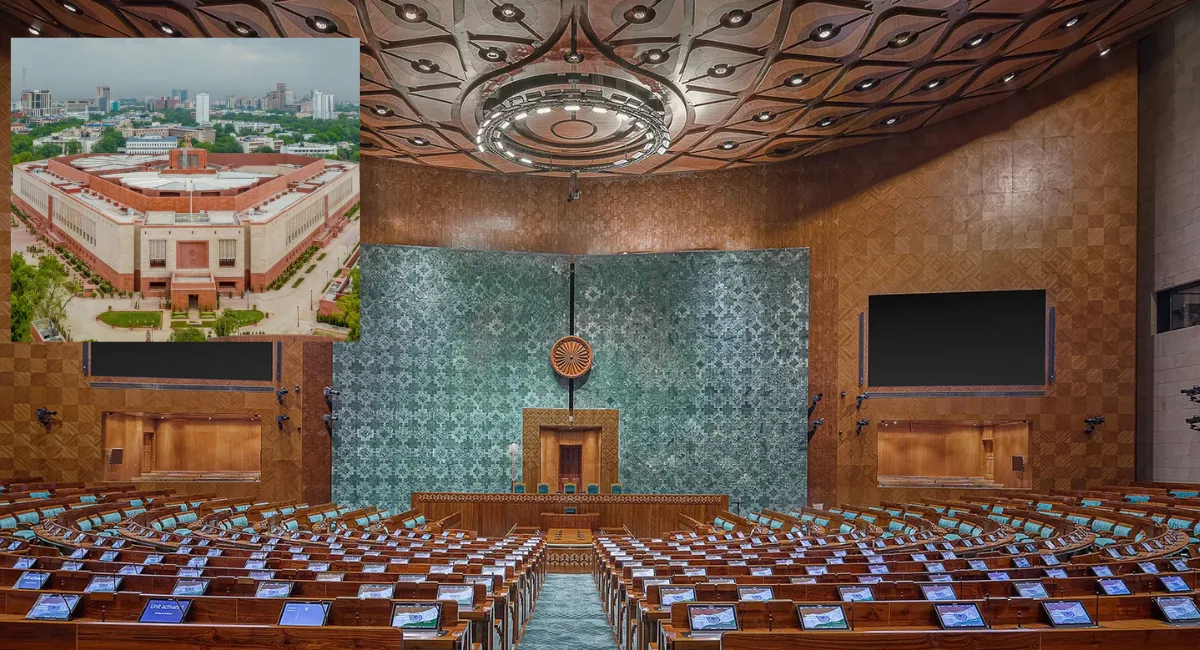
The actual crisis is one of raw, ungovernable scale. India’s Lok Sabha already carries the most crowded seats of any major democracy — roughly 17.9 lakh voters per constituency, against 5.9 lakh in the United States, 2.3 lakh in Japan, and under a lakh apiece in Germany, France, Britain and Canada. Even an expanded House of 888 seats only brings that down to about 10.9 lakh. No representative, however technologically savvy, can answer to a constituency that size. This is the burden Chakravarty claims technology has “dissolved” with elected representatives ‘talking’ to the people via social media. How many of these people can understand what is being ‘said’ to them on social media? A broadcast can reach a million people; it cannot manufacture the relationship or the accountability that true representation requires.
Chakravarty is right that state representation sits badly askew now. The predicament was crystallised in 1956, when the states Reorganisation Commission drew a colonial reproduction of India’s linguistic map and, in Ambedkar’s own words, balkanised the South even as it consolidated the North — the precise asymmetry now animating this fight. Ambedkar wanted no state’s population to exceed roughly 2 crore, reasoning that only states that size could sustain a working link to their citizens. That is why the authors of this piece have proposed, in their recent book, that delimitation and states reorganisation ought to be done together: some 75 states of comparable size, each carrying equal weight. We have proposed two tenets for delimitation, namely Each State Same Heft, Each Vote Same Value — that resolves the imbalance Chakravarty points at, without despoiling equality between citizens.
Chakravarty opines that “delimitation is not about the individual vote”. Then, one might ask what delimitation is all about, or is Chakravarty asking for a new meaning of this word? This word has had only one meaning in any electoral democracy in modern times. He also maintains repeatedly that India is a federation. This is simply untrue. India is not a federation, unless again we seek a new meaning for the word ”federation”. Our country never was a federation, and it was set up so as not to be one. This needs saying repeatedly and without qualification, especially when so many politicians invoke this word. Some have even gone as far as saying that our states are sovereign entities. India is not a federation of states that convened and confabulated together, lending Delhi a portion of their sovereignty, as happened in the USA, Germany, Switzerland and other true federations; Ambedkar was unambiguous in that the Union was not an agreement among states; he said that the country was one integral whole, and the nation a single people living under a single imperium. It is, in his own phrase, an indestructible Union of destructible states. The only states’ rights worth defending are the rights of the citizens who live there, and that right cannot survive a formula that prices a vote based on taxes.
We have conducted Chakravarty’s experiment before, to disastrous effect. The 1976 freeze on Lok Sabha seats was justified on an identical instinct: that population-based delimitation would “punish” southern states for successfully controlling population growth. That did not survive scrutiny then, and does not now: rising income and urbanisation drag fertility down, not government mandate. Every part of northern India barring Bihar is already below replacement fertility; Uttar Pradesh stood at the threshold in 2011 and has likely crossed it since. A high birth-rate North swamping a virtuous South is close to a red herring, exactly as the fear behind the original freeze was in 1976. It need not be gainsaid that when citizens did not meaningfully respond to politicians’ calls on population control, it is even less likely that they will increase their fertility upon platitudes.
Chakravarty notes, correctly, that a chunk of Karnataka and Tamil Nadu’s tax revenue is generated by workers from Bihar and Uttar Pradesh, still counted in the population of the states they left. Likewise, Maharashtra keeps losing seat share to its own falling fertility even as it absorbs the country’s largest inward migration, and the votes of the workers powering its economy stay registered back home. This is a genuine gap, worth closing with clearer rules on welfare and voter rolls for migrants — not an excuse to gerrymander because citizens migrate for work. The remittances flowing back are fair wages for labour Karnataka and Maharashtra need. They cannot source locally, not charity entitling the host state to a share of the worker’s vote too.
Chakravarty diagnoses a genuine ailment, yet his prescription may be problematic and lead to further problems downstream. As Don Norman observed, “a brilliant solution to the wrong problem can be worse than no solution at all — solve the correct problem”. The correct problem is that some of India’s citizens already count for less than others, purely on account of where they were born. The remedy is smaller constituencies carved out of states of equal size, not a Lok Sabha whose seats are priced in rupees taxed.