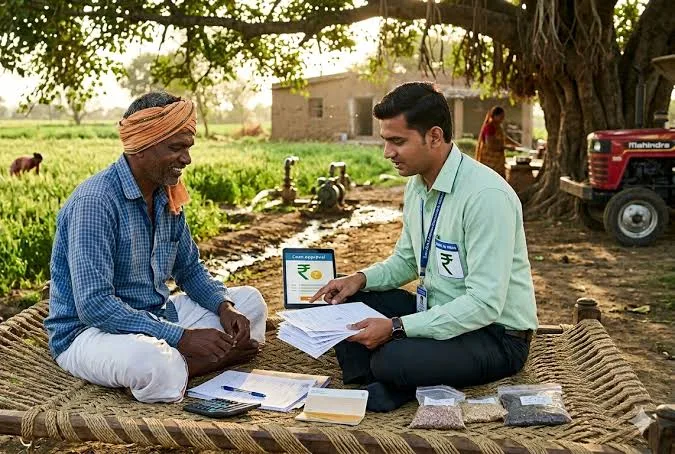
Access to affordable credit has become one of the biggest drivers of rural development in India. Over the years, the country’s rural credit system has evolved from one that relied heavily on local moneylenders to a large institutional network of banks, cooperative societies and digital platforms. This transformation has helped millions of farmers, small entrepreneurs and rural households access formal loans at lower interest rates while supporting agriculture, rural businesses and livelihoods.
The latest government data shows that financial inclusion has continued to improve, with more rural families now depending on banks and other formal institutions instead of informal lenders.
Rural Economy Shows Signs of Improvement
According to NABARD’s Rural Economic Conditions and Sentiments Survey for May 2026, rural consumption has remained strong. Around 77.2 per cent of rural households reported an increase in household consumption, indicating higher purchasing power and improving economic conditions.
The survey also found that 51 per cent of rural households now depend entirely on formal financial institutions such as banks and cooperatives for loans. Another 27 per cent use both formal and informal sources of credit. This suggests that while informal borrowing still exists, institutional lending is steadily becoming the preferred option for rural families.
A Journey That Began More Than 70 Years Ago
India’s rural credit system did not develop overnight. It has been built gradually through policy reforms and new institutions introduced over the last seven decades.
The foundation was laid in 1955 with the creation of the National Agricultural Credit (Long-Term Operations) Fund and the establishment of the State Bank of India. Another major step came in 1969, when the government nationalised 14 major commercial banks. This brought agriculture and priority sectors into the mainstream banking system and increased lending to small and marginal farmers.
A major milestone came in 1982 with the establishment of the National Bank for Agriculture and Rural Development (NABARD). The institution was created to support agriculture and rural development through refinancing, policy support and supervision of rural financial institutions. NABARD completed 45 years in July 2026.
Over the years, several other initiatives strengthened the rural credit ecosystem. The Self-Help Group (SHG)-Bank Linkage Programme began in 1992 to connect women’s groups with banks. The Kisan Credit Card (KCC) scheme was launched in 1998 to provide farmers with easy access to short-term agricultural loans. In 2014, the government introduced the Pradhan Mantri Jan Dhan Yojana (PMJDY) to expand banking services to every household, followed by the MUDRA scheme in 2015 to support small businesses with collateral-free loans.
More recently, digital initiatives such as the Jan Samarth Portal and e-Kisan Credit Card have simplified loan applications and improved transparency in credit delivery.
Banks have Expanded Their Presence Across Rural India
Institutional banking has expanded significantly over the past decade, bringing financial services closer to villages.
Scheduled Commercial Banks have increased their rural branch network from 41,464 branches in 2014 to 56,193 branches by July 2025, reflecting an increase of more than 35 per cent.
Regional Rural Banks (RRBs), created under the Regional Rural Banks Act of 1976, have also played an important role. Today, 28 RRBs operate more than 22,000 branches across nearly 700 districts, focusing mainly on small and marginal farmers, agricultural labourers, artisans and rural entrepreneurs.
The cooperative banking system continues to be another important pillar of rural finance. It includes 34 State Cooperative Banks, 352 District Central Cooperative Banks, 1,458 Urban Cooperative Banks and thousands of Primary Agricultural Credit Societies (PACS) operating at the village level.
Modernising Cooperative Credit
The government has also launched an ambitious programme to strengthen the cooperative sector.
Since 2023, efforts have been underway to establish two lakh new multipurpose Primary Agricultural Credit Societies (PACS), dairy cooperatives and fisheries cooperatives across every panchayat over five years.
As of January 2026, 32,836 new cooperative societies had already been registered, while 15,793 existing dairy and fisheries cooperatives had been strengthened.
Digitisation has also become a major focus. More than 61,800 PACS have already been integrated into a common ERP-based software platform, allowing better record management, transparency and faster delivery of services.
Apart from commercial and cooperative banks, 11 Small Finance Banks are also serving rural and underserved communities through technology-driven banking services.
Government Policies Encourage Agricultural Lending
The Reserve Bank of India has introduced several policy measures to ensure adequate flow of credit to agriculture.
Under the Priority Sector Lending (PSL) guidelines, banks are required to allocate at least 18 per cent of their lending towards agriculture. Specific targets have also been fixed for non-corporate farmers and small and marginal farmers to ensure they receive adequate financial support.
Every year, the government also fixes a Ground Level Credit (GLC) target for agriculture and allied sectors. For FY 2025-26, the target has been increased to Rs 32.5 lakh crore, including Rs 5 lakh crore specifically for animal husbandry, dairying and fisheries.
The growth has been significant. The annual agricultural credit target has increased more than four times from Rs 8 lakh crore in 2014-15 to Rs 32.5 lakh crore today.
Affordable Loans Through Interest Subsidy
To make borrowing cheaper for farmers, the government continues to operate the Modified Interest Subvention Scheme (MISS).
Under this scheme, farmers can avail short-term Kisan Credit Card loans at 7 per cent interest. Those who repay their loans on time receive an additional interest incentive, reducing the effective interest rate to 4 per cent.
The Union Budget 2025-26 further expanded the scheme by increasing the loan limit under MISS from Rs 3 lakh to Rs 5 lakh. The loan ceiling for fisheries and allied activities was also raised to Rs 5 lakh, while the collateral-free agricultural loan limit increased from Rs 1.6 lakh to Rs 2 lakh from January 2025.
Financial Inclusion Has Reached Millions
Government-backed financial inclusion programmes have expanded banking services to rural India on an unprecedented scale.
Under the Deendayal Antyodaya Yojana-National Rural Livelihoods Mission (DAY-NRLM), more than 10 crore rural women have been organised into over 90 lakh Self-Help Groups. These SHGs have collectively received loans worth more than Rs 13 lakh crore since the programme began.
A network of over 50,000 Bank Sakhis has also played a crucial role by helping rural women connect with banks, complete paperwork and access credit. Since 2013-14, they have facilitated bank credit worth over Rs 12 lakh crore for SHGs.
Kisan Credit Card Continues to Support Farmers
The Kisan Credit Card remains one of India’s largest agricultural credit programmes.
As of July 2026, commercial banks had received around 739 lakh KCC applications, Regional Rural Banks over 365 lakh applications, while cooperative banks accounted for the highest share with more than 1,178 lakh applications.
The scheme provides farmers with quick and flexible access to working capital for crop cultivation and allied activities.
Jan Dhan Has Strengthened Rural Banking
The Pradhan Mantri Jan Dhan Yojana has become the backbone of financial inclusion.
By June 2026, more than 58.63 crore Jan Dhan accounts had been opened across the country, with deposits exceeding Rs 3 lakh crore.
Women account for 55.7 per cent of all Jan Dhan account holders, while nearly 78 per cent of these accounts are located in rural and semi-urban areas.
According to the Jan Dhan Darshak App, nearly 99.92 per cent of villages now have a banking outlet within five kilometres, significantly improving access to financial services.
New focus on low-performing agricultural districts
The government has also introduced targeted interventions for districts that continue to lag behind in agricultural development.
The PM Dhan Dhanya Krishi Yojana, approved in 2025, seeks to improve agricultural productivity and rural incomes in 100 low-performing districts by bringing together 36 central schemes implemented by 11 ministries.
Based on performance until May 2026, districts such as Banka (Bihar), Mahoba (Uttar Pradesh), Charaideo (Assam), Kishanganj (Bihar) and Tikamgarh (Madhya Pradesh) have emerged among the best performers under the programme.
India’s rural credit system has undergone a remarkable transformation over the last seven decades. What was once largely dependent on informal moneylenders has evolved into an extensive network of commercial banks, Regional Rural Banks, cooperative institutions, Self-Help Groups and digital platforms.
Government initiatives such as Kisan Credit Cards, Jan Dhan accounts, interest subsidy schemes, digitisation of cooperatives and targeted agricultural programmes have expanded access to affordable finance across rural India. While challenges remain, the growing reach of institutional credit is helping farmers, women, artisans and rural entrepreneurs invest in agriculture, start businesses and improve their livelihoods, making rural finance a key pillar of India’s economic development.