New Delhi: India has firmly rejected Pakistan’s allegations at the United Nations over the Indus Waters Treaty (IWT), asserting that cooperation under the decades-old water-sharing agreement cannot be expected when “cross-border terrorism” is employed as an “instrument of state policy.” New Delhi also reiterated that J&K “has always been, is, and will remain” an integral and inalienable part of India.
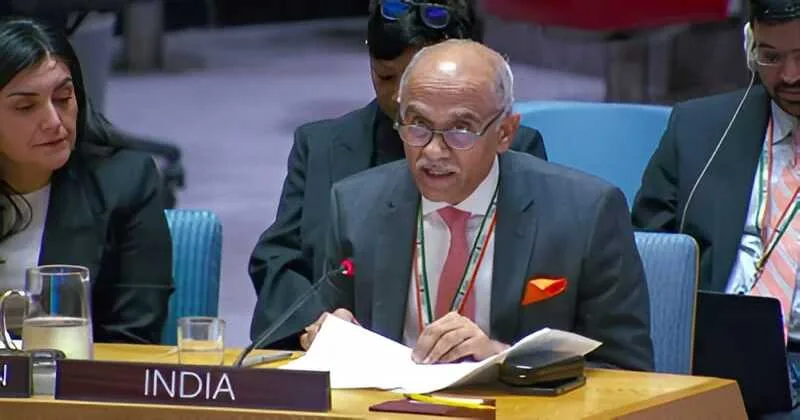
The remarks were made on July 22 by India’s Permanent Representative to the United Nations, Ambassador Parvathaneni Harish, during the High-Level Open Debate of the UN Security Council on “Natural Resources Governance: the Foundation of Peace, Security and Prosperity.” Exercising India’s right of reply, the envoy said he was compelled to respond after Pakistan “misused” the discussion to advance what he described as a “false narrative.”
Responding directly to Pakistan’s allegations, Harish said India’s position on the Indus Waters Treaty remains “clear and consistent.” “Our position on the Indus Water Treaty remains clear and consistent. Cooperation on the basis of mutual trust and goodwill cannot be expected when cross-border terrorism is regularly deployed as an instrument of state policy,” he said.
His remarks came after Pakistan’s Permanent Representative to the United Nations, Ambassador Asim Iftikhar Ahmad, accused India of “weaponising water” by placing the Indus Waters Treaty in abeyance. Pakistan described India’s decision as “illegal” and argued that suspending the treaty threatened the livelihoods of more than 240 million Pakistanis who depend on the Indus river system.
#IndiaAtUN | It was not our intention to bring other issues in this forum, but my delegation is compelled to respond to Pakistan, as it has chosen to misuse today’s discussion to peddle its false narrative. Our position on the Indus Water Treaty remains clear and consistent.… pic.twitter.com/h7KRGky4Km
— DD News (@DDNewslive) July 23, 2026
The Indus Waters Treaty, signed in 1960 and brokered by the World Bank, governs the sharing of the waters of the six rivers of the Indus basin between the two countries. Under the agreement, the three eastern rivers were allocated to India, while the three western rivers were largely reserved for Pakistan.
India placed the treaty in abeyance following the April 22, 2025, Pahalgam terror attack, maintaining that the spirit of cooperation envisaged under the agreement cannot continue while Pakistan-sponsored cross-border terrorism persists.
India reaffirms position on J&K
India also delivered a strong rebuttal to Pakistan’s repeated references to J&K during the debate. Harish stated that the Union Territory of J&K is an inseparable part of India and dismissed Pakistan’s claims as contrary to constitutional and legal realities. “As for the Union Territory of J&K, it has always been, is, and will remain an integral and inalienable part of India. This is the constitutional and legal reality that Pakistan deliberately chooses to ignore,” he said.
The Indian envoy further asserted that the only unresolved issue relating to J&K concerns what he described as Pakistan’s “naked aggression and illegal occupation” of Indian territory. “The only outstanding issue with regard to J&K is the naked aggression and illegal occupation of India’s sovereign territory by Pakistan. Instead of pointing fingers at India, Pakistan would serve itself and its people far better by putting its own house in order,” he added.
During his broader intervention at the Security Council debate, Harish emphasised that natural resources should primarily serve as instruments of development, peace and prosperity for sovereign states. He cautioned that the illicit exploitation and trafficking of natural resources can, in certain situations, finance armed groups and prolong conflicts.
He stressed that the governance and management of natural resources remain the primary responsibility of sovereign states and called for transparent, accountable and nationally owned governance mechanisms. He also advocated responsible supply chains, greater transparency and stronger international cooperation to combat the illegal exploitation and trafficking of natural resources, describing these measures as essential for promoting sustainable development, peace and long-term security.