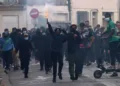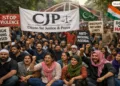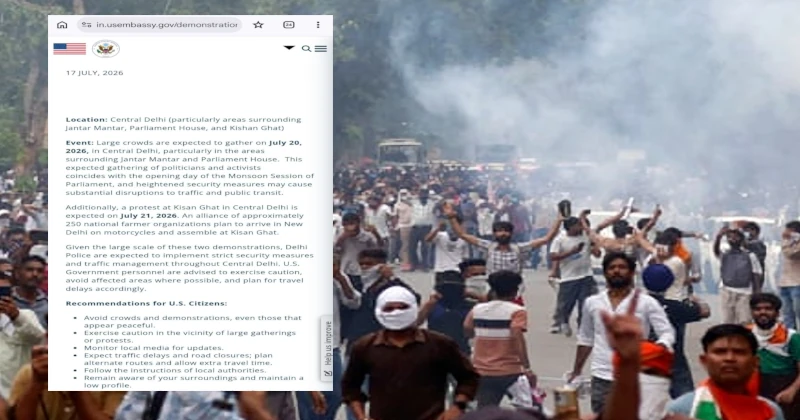
Cockroach Janata Party (CJP) has turned a serious education crisis into its personal political theatre. What began as legitimate outrage over the NEET paper leak has been cleverly hijacked into a high-voltage drama of road blockades, police clashes, and deliberate disruptions during Parliament’s Monsoon Session.
Behind the student facade, non-student elements, certain left-leaning groups, and vested political interests appear to be driving the agitation — with growing suspicions of deep-state funding and external orchestration.
The suspiciously precise US Embassy advisory issued days in advance has only strengthened questions about whether this so-called “people’s movement” is being remotely steered to destabilise the government rather than solve the education crisis.
Deep State Links, US Training & Hidden Agendas?
On July 17, three days ahead of the July 20 Parliament march coinciding with the opening of the Monsoon Session, the US Embassy issued a “Demonstration Alert” advising American citizens to avoid central Delhi due to anticipated protests and heightened security arrangements.
While embassies across the world routinely issue travel and security advisories for their nationals, the level of detail contained in the US Embassy’s alert has prompted questions in some quarters over how it obtained advance information regarding the demonstrations.
The advisory warned that large crowds were expected to gather around Jantar Mantar and Parliament House on July 20, coinciding with the commencement of Parliament’s Monsoon Session.
It further cautioned that the demonstrations could result in significant disruptions to traffic and public transport due to extensive security arrangements expected to be put in place by the Delhi Police.
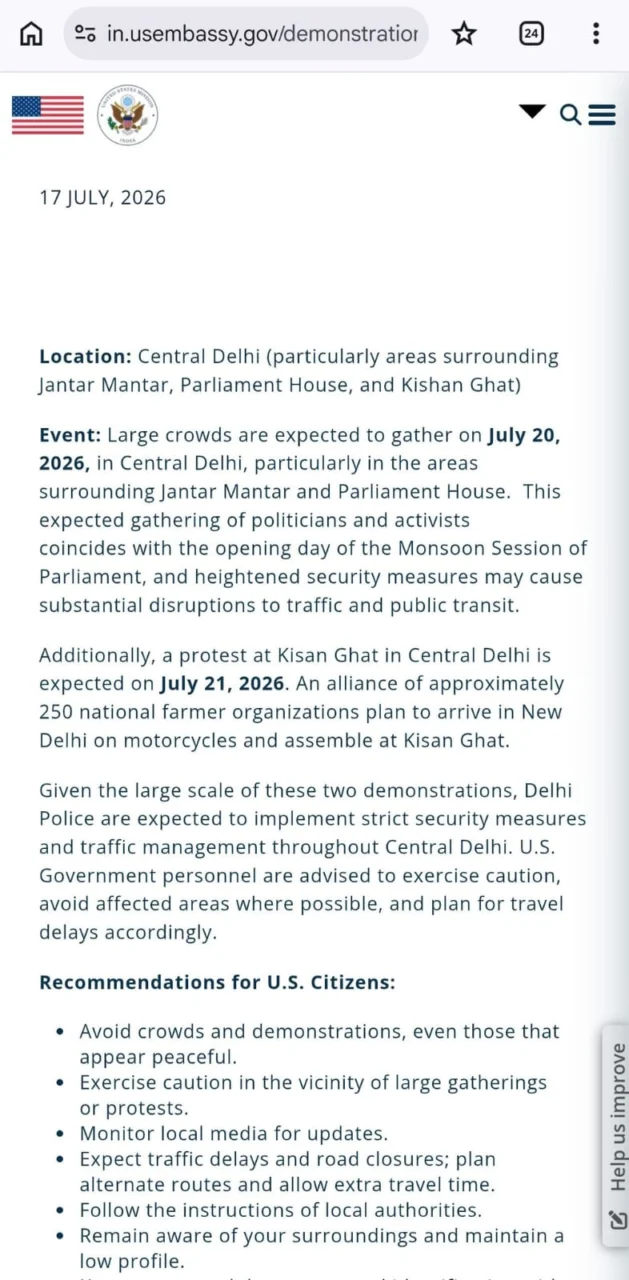
The embassy also highlighted a separate protest scheduled for July 21 at Kisan Ghat, stating that an alliance of approximately 250 national farmer organisations planned to ride motorcycles into New Delhi before assembling at the protest site.
The advisory warned US citizens to expect traffic diversions, road closures and increased security deployment across central Delhi. In its public notice, the US Embassy advised American citizens to:
- Avoid crowds and demonstrations, even if they appear peaceful.
- Exercise caution around large public gatherings.
- Follow local media for updates.
- Prepare for traffic delays and road closures.
- Follow the instructions of local authorities.
- Remain aware of their surroundings.
- Carry identification and travel documents at all times.
- Register under the Smart Traveler Enrollment Program (STEP) to receive security updates.
The embassy also cautioned that the protests could significantly affect transportation across parts of the national capital. The Delhi Police issued a traffic advisory on July 18, outlining expected diversions and restrictions in view of the Monsoon Session and anticipated public gatherings.
Authorities had reportedly denied permission for the Parliament march proposed by the political outfit referred to as the Cockroach Janata Party, which claims to have been formed in the name of student welfare.
Despite the denial, security agencies remained on alert in anticipation of possible demonstrations. The controversy stems not from the issuance of the advisory itself which is standard diplomatic practice but from the specificity of the information it contained.
The embassy’s alert not only identified the dates and locations of the demonstrations but also mentioned that nearly 250 farmer organisations were expected to participate in the July 21 mobilisation at Kisan Ghat.
Some commentators have questioned how the embassy was able to project the scale of the planned protests several days in advance, particularly before official traffic advisories were publicly released.
Diplomatic missions routinely monitor local media, maintain contact with host government agencies, assess publicly available information and prepare security assessments for their citizens. However, the detailed nature of this advisory has become a subject of political debate.
Among the claims being circulated are references to the so-called “Deep State” and allegations involving billionaire investor George Soros, who has frequently been accused of supporting organisations involved in political activism across various countries. However, no evidence has been publicly presented linking the US Embassy’s advisory to any such network or establishing any connection between the advisory and these allegations.
Similarly, attention has been drawn to Abhijit Dipke, identified as a leader associated with the Cockroach Janata Party. Dipke is reported to have previously been associated with the Aam Aadmi Party before pursuing studies in mass communication at Boston University in the United States. No official agency has suggested that Dipke’s educational background or past political association has any connection with the US Embassy’s advisory.