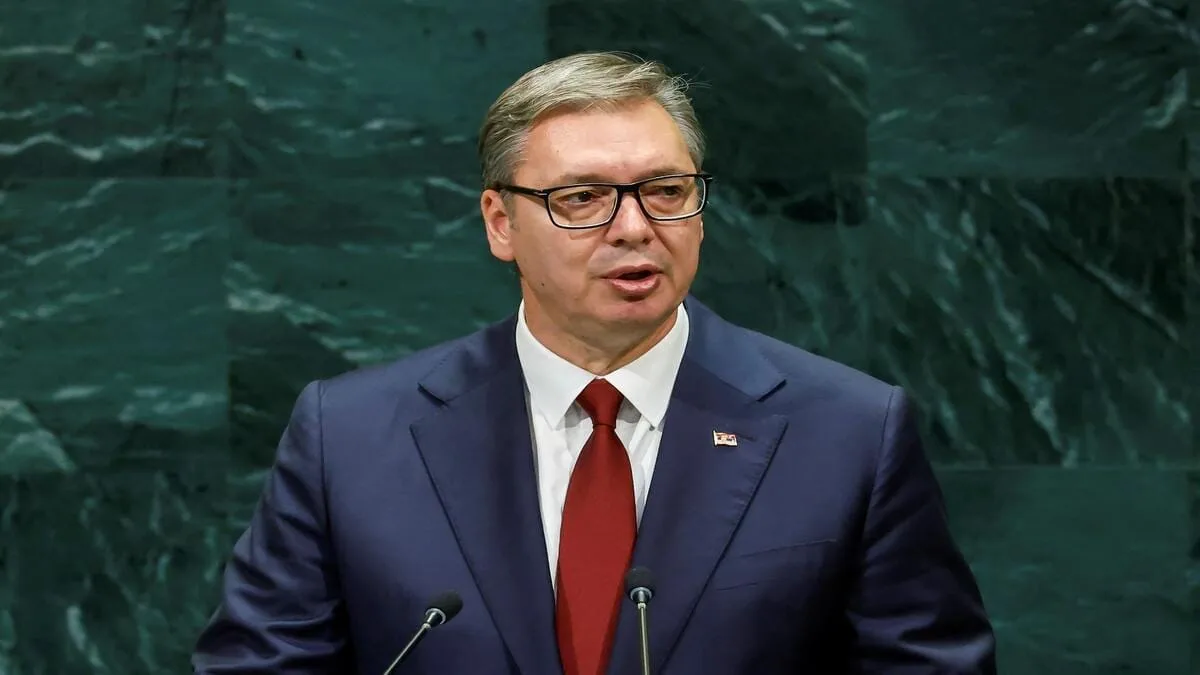
“…you have a leader like Narendra Modi. And now there’s an effort to undermine him.” A striking observation from a foreign political leader in the middle of his own electoral battle has put India’s current political confrontation in an international perspective.
Aleksandar Vučić, who stepped down as Serbia’s President on September 27 after reaching the constitutional limit on presidential terms and is now campaigning to return as Prime Minister in the October 25 parliamentary election, has said that attempts to undermine leaders who have delivered major achievements have become a pattern. And the leader he chose as an example was Prime Minister Narendra Modi.
"IT HAS BECOME A PATTERN…"
Serbian President talks about how there are forces at work to destablise and stall India's rise by undermining PM Narendra Modi's mandate. pic.twitter.com/m0HK0FKPqG— Rahul Shivshankar (@RShivshankar) October 7, 2026
In a pre-election programme in Serbia, Vučić said: “Let me tell you, for example, you have a leader like Narendra Modi. And now there’s an effort to undermine him. The man who raised India to the heavens. He tries to follow the main teachings of Mahatma Gandhi. India became so important on the world stage because of him. He has done tremendous things, yet they try to tear him down by claiming he failed. I want to tell you, it has become a pattern.”
Vučić did not identify who he believed was behind the alleged effort to undermine Modi. But his remarks acquired particular resonance in India on October 7, as opposition parties and political groups continue a street campaign centred on trumped up allegations against the Election Commission and its Special Intensive Revision of electoral rolls.
A Serbian leader speaking from his own political battlefield
Vučić’s intervention is noteworthy precisely because he is not a detached foreign observer. After nearly two years of anti-government protests in Serbia, sparked by the 2024 Novi Sad railway-station disaster, Vučić resigned as President and entered the parliamentary contest as the leader of the Aleksandar Vučić–United Serbia electoral list. The October 25 election is effectively his bid to continue exercising political power from the Prime Minister’s office.
His campaign comes after prolonged street protests and a sustained political challenge from a student-led movement. In other words, Vučić is himself operating in an environment in which street mobilisation over a clearly unrelated issue or jurisdiction, competing narratives and attempts to define a government’s record have become central to political contestation.
The Serbian episode illustrates how a political movement can expand an issue far beyond its original trigger and turn it into a vehicle for challenging an elected government. What began with demands for accountability over the November 2024 railway-station canopy collapse, in which 16 people died, developed over nearly two years into a nationwide protest movement and ultimately an electoral challenge to Aleksandar Vučić’s government.
Associated Press (AP) notes that the student-led movement has now entered the parliamentary contest itself. The broader political lesson, as critics of such movements would frame it, is that sustained mobilisation around a single grievance can become a means of delegitimising an entire government, even when the original issue is narrower than the question of who should govern.
It is against that backdrop that his description of what he sees as a recurring pattern in attempts to discredit political leaders becomes particularly significant. He did not merely praise Modi. He specifically contrasted Modi’s achievements with what he described as efforts to portray those achievements as failure.
From Belgrade to Delhi: The politics of the street
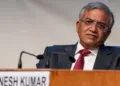
That observation comes as the political temperature rises in India over the Election Commission. The Cockroach Janta Party, or CJP, staged a protest at Mumbai’s Shivaji Park on October 2, demanding the resignation of Chief Election Commissioner Gyanesh Kumar. At the same time, AAP leaders and Left-linked student organisations led protests in Delhi, where hundreds of demonstrators were detained while attempting to reach Jantar Mantar.
AAP leaders Atishi and Sanjay Singh had publicly mobilised supporters for the October 2 protest, alleging irregularities in the electoral-roll revision.
The political dispute has subsequently widened. Congress, AAP and CJP have traded accusations over influence, leadership and ownership of the protest movement, with reports specifically highlighting tensions over whether ostensibly student-led mobilisation is being influenced by political organisations. That is the larger backdrop against which screenshots now circulating on social media purport to show discussions inside WhatsApp groups associated with the protest mobilisation.
https://twitter.com/VijayGajeraO/status/2107703327664562235/photo/2
The screenshots shared with this report contain messages attributed to Aam Aadmi Party known leaders Raj (Rajesh) Redij-Gill and Ajinkya Shinde, including instructions concerning proposed protest activities and a message stating that “all CJP groups are currently under surveillance” and asking members to exercise caution in sharing material relating to the protest. Raj or Rajesh Gill is said to be the head of the AAP Support Network’s global fundraising initiative. Ajinkya Shinde is brain behind the CJP formation and campaigns and the mentor of Abhijeet Dipke the supposed founder of the CJP.
The Organiser cannot verify the authenticity of those screenshots – which should, however, be treated as material circulating on social media rather than independently authenticated evidence of who organised or directed the protests.
The Organiser cannot vouch for the authenticity of these messages or purported communications, but after joining the dots of how every key member of the CJP turned out to be an AAP prop – it cannot be dismissed as too farfetched.
Congress has accused AAP of attempting to influence the CJP movement, while CJP representatives have rejected attempts by political parties to claim ownership of it. AAP has separately organised its own mobilisation against the Election Commission.
‘India is blessed to have you’
Vučić’s remarks were followed by an unusually warm public exchange with Modi.
Congratulations, @NarendraModi, on completing 25 years of public service at the highest level.
Few people can say they have devoted a quarter of a century to serving their country, first as Chief Minister of Gujarat and then as Prime Minister of India. I know how deeply you care…— Александар Вучић (@avucic) October 7, 2026
On October 7, Vučić congratulated Modi on completing 25 years in public service at the highest level, writing:
“Few people can say they have devoted a quarter of a century to serving their country, first as Chief Minister of Gujarat and then as Prime Minister of India.” He added that the world could see “how high you have raised India” and concluded: “India is blessed to have you.”
Modi responded by thanking Vučić for his “warm words and friendship” and, in turn, highlighted what he described as Serbia’s “extraordinary transformation” under Vučić’s leadership. “I deeply appreciate your personal contribution to strengthening the India-Serbia partnership. Under your leadership, Serbia has undergone an extraordinary transformation. You have served Serbia with determination and dedication.”
The exchange is particularly interesting because Vučić’s praise came while he himself was preparing for an election that could determine whether he moves from the Serbian presidency back into the premiership.
To Prime Minister @narendramodi,
An avatar of our times pic.twitter.com/84RDOEfELm— Tshering Tobgay (@tsheringtobgay) October 7, 2026
And then came Bhutan’s ‘avatar’ tribute
The Serbian leader’s comments were not the only striking international tribute to Modi on his 25-year milestone. Bhutanese Prime Minister Tshering Tobgay recalled meeting Modi in New Delhi on July 27, 2019, when Tobgay was no longer Bhutan’s Prime Minister or an MP. He wrote that he had then told Modi that he saw him as “an avatar of Vishnu” and as an elder brother.
Tobgay said that, after subsequently reflecting on Modi’s record, he concluded that he had been right.
He went further, saying he now knew which avatar he had in mind: Kalki, the Vishnu avatar traditionally associated with overcoming disorder, restoring dharma and ushering in renewal.
The Bhutanese Prime Minister linked his assessment to what he described as Modi’s emphasis on wisdom, compassion, courage, infrastructure, development, execution and national confidence.
The Prime Minister’s Office itself highlighted Tobgay’s tribute as part of the messages from world leaders marking Modi’s completion of 25 years as head of government.
The contrast is striking
On one side of the political picture are international leaders publicly speaking of Modi’s impact on India’s global standing, his longevity in public life and, in Bhutan’s case, even invoking the civilisational language of Vishnu and dharma.
On the other is a domestic political campaign in which opposition parties and protest groups are attempting to make the Election Commission and electoral-roll revision a major political confrontation.
Vučić’s phrase, “it has become a pattern”, therefore provides the most striking frame for the day’s events. He was speaking about Modi and did not name India’s Opposition, AAP, CJP or any other domestic political organisation. Nor did he provide evidence for the forces he said were trying to undermine the Indian Prime Minister. But his remarks arrive at a moment when India’s political opposition is increasingly taking its contest with the government and constitutional institutions to the streets, while allegations over the organisation and political influence behind some of the protests are themselves becoming part of the political battle.
And that is perhaps what makes the Serbian leader’s intervention unusually timely: a politician fighting his own election, after facing years of street mobilisation at home, looking at India and describing what he sees as a familiar political pattern, first undermining the leader, then turning achievements into alleged failures.
Vučić’s words have added an unexpected foreign voice to a debate that is increasingly being fought not merely inside Parliament, but on India’s streets and across its social-media networks.
While Opposition parties have repeatedly demanded Chief Election Commissioner (CEC) Gyanesh Kumar’s impeachment, the Supreme Court has so far neither ordered nor endorsed his removal. In its latest intervention, the Court declined to suspend him, saying it could not act on media reports or assumptions and would first examine the Election Commission’s records. It nevertheless made clear that any decisions found to have violated the statutory requirements could subsequently be annulled.
Incidentally, electoral-roll revision is not a BJP-era invention. The Election Commission has routinely revised and updated voter lists across governments, including throughout the Congress-led UPA years. During the UPA itself, the ECI conducted special and intensive revisions, while Congress leaders also demanded revision of electoral rolls when they alleged bogus or irregular voters.