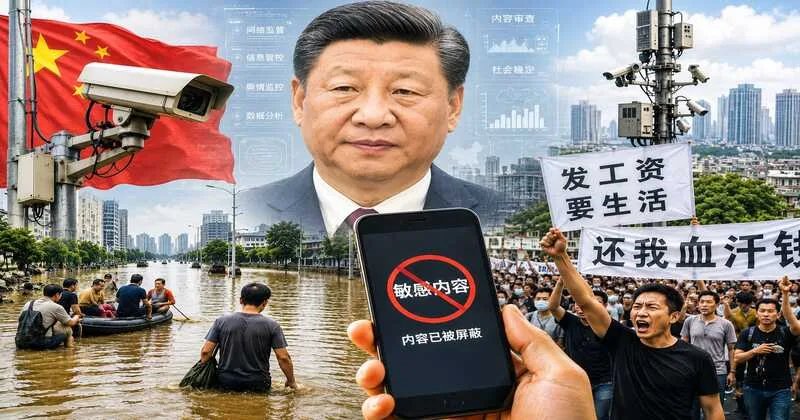
New Delhi: As floods, labour disputes and a growing number of social tensions expose mounting strains across China, authorities have significantly intensified surveillance and online censorship in an effort to prevent public anger from spreading on social media.
Reports from within the Chinese Communist Party (CCP), combined with accounts from residents and regime insiders, indicate that Beijing has ordered a sweeping crackdown on the circulation of videos and discussions highlighting government failures in disaster relief, unpaid wages, rights-defence protests and public grievances.
The latest measures come as local governments struggle to cope with severe flooding in several parts of the country while facing increasing criticism over flood-control failures and emergency response efforts. According to regime insiders, the CCP has instructed local authorities not only to strengthen flood-control operations but also to reinforce so-called “stability maintenance” measures, a term widely used by the Chinese government to describe its domestic security, surveillance and social control apparatus.
Authorities are reportedly concerned that ordinary citizens documenting events on the ground could transform local incidents into nationwide controversies. Videos showing neighbourhoods submerged under floodwaters, delayed rescue operations, or local officials failing to respond promptly have increasingly raised public questions over accountability and administrative failures.
Surveillance expands beyond online censorship
According to the various reports, the authorities are no longer limiting themselves to deleting online content. Security agencies are reportedly investigating who recorded videos, who shared them across digital platforms and even what users discussed inside supposedly private chat groups.
Residents who post or circulate videos depicting government failures in disaster relief, workers protesting unpaid wages, homeowners defending property rights or disputes involving hospitals and medical negligence reportedly face police questioning. Depending on the circumstances, individuals may be detained for up to ten days under administrative procedures or face criminal charges in more serious cases.
Devastating footage of a severe flash flood completely overwhelming Kuancheng Manchu Autonomous County in Chengde, Hebei, China, last night.
Watch as the powerful current sweeps away cars as if they were toys. pic.twitter.com/XPMp6W1y4K
— Weather Monitor (@WeatherMonitors) July 13, 2026
Officials are said to be particularly concerned that many Chinese internet users continue to bypass the country’s extensive censorship system to access overseas social media platforms, where footage of protests, flooding and official failures circulates widely beyond Beijing’s control. The ability of such content to reach international audiences has reportedly heightened concerns among both central and local authorities.
Local officials are also believed to fear disciplinary consequences if incidents occurring under their jurisdiction attract widespread attention overseas or trigger criticism from Beijing. As a result, authorities have intensified efforts to suppress what they describe as “negative information,” particularly reports involving rights-defence activities, labour unrest and administrative failures.
Wave of viral incidents sparks official concern
The latest crackdown appears to have been driven partly by a series of widely circulated videos documenting protests and public disputes across China between July 7 and July 13.
The footage reportedly included family members demanding answers after a patient’s death following surgery in Xingtai, Hebei Province; relatives protesting after a villager died in an electricity-related accident, also in Hebei Province; high school students demonstrating against shortened summer holidays; construction workers in the Guangxi Autonomous Region climbing a bridge to demand unpaid wages; and migrant workers in Yunnan Province collectively seeking overdue salaries.
Several of the videos also showed police detaining or physically restraining protesters as authorities moved to disperse demonstrations. According to the reports, these incidents reinforced official concerns that economic distress, labour disputes and public dissatisfaction, combined with visible flood-control failures, could rapidly fuel broader online dissent if left unchecked.
In response, several government agencies, public institutions and hospitals have reportedly instructed employees to promote what the CCP describes as “positive energy” while refraining from posting, sharing or even liking content related to emergencies, disasters or social unrest.
The campaign has also expanded into neighbourhood-level governance. Community grid workers, grassroots personnel employed to monitor residential areas, have reportedly circulated notices warning residents against forwarding what authorities classify as “negative” videos through social media groups.
The warnings specifically discouraged users from sharing footage showing workers defending labour rights, elderly people collapsing without assistance or delivery workers enduring ten-hour workdays. Residents were reportedly told that anyone caught reposting such material could initially face police questioning and, if they failed to cooperate, administrative detention.
Police intensify enforcement across digital platforms
The government’s enforcement campaign became more visible on July 13, when the cyberpolice bureau under China’s Ministry of Public Security announced 25 cases involving what officials described as online rumours concerning floods and disasters, according to a report published by the Chinese news portal Sohu.
Authorities stated that four individuals were placed under criminal detention, while 23 others received administrative penalties. In addition, multiple social media accounts were permanently shut down. Officials also warned internet users against reposting, editing or using artificial intelligence to generate what authorities characterised as false disaster-related content.
China’s economy just grew at its slowest pace since 2022 and for the first time since the pandemic it’s running below Beijing’s own target.
Exports keep booming, domestic demand is historically sluggish and the property market is frozen.
READ: https://t.co/DnzDI5mtPj pic.twitter.com/pdsW4g55ZM
— Phil Rosen (@philrosenn) July 18, 2026
Meanwhile, censorship across China’s major online platforms has reportedly intensified considerably. Videos uploaded to Bilibili, WeChat, Douyin and even private chat groups that depict wage protests, labour disputes or broader social conflicts are now reportedly removed much more quickly than in previous months.
Sources familiar with platform moderation practices say videos showing companies unable to pay workers because banks froze corporate accounts, as well as footage of employees demanding unpaid wages, are now routinely blocked before gaining wider circulation. Material that remained online only a few months ago is now reportedly removed almost immediately.
According to accounts from residents and regime insiders, deleting content is often only the first stage of enforcement. Police reportedly trace original uploaders using account registration information, mobile phone numbers and chat histories. Even individuals who did not participate in demonstrations can reportedly be questioned or detained simply for filming protests, forwarding videos or commenting on related incidents in private messaging groups.
The tightening campaign underscores Beijing’s growing determination to contain public criticism as economic pressures, flood-related disruptions, labour disputes and broader social tensions converge, raising official concerns that local grievances could evolve into a wider challenge to political stability if allowed to spread unchecked online.