The BRICS Trade Union Forum’s Hyderabad declaration calls upon all BRICS governments to expand universal, adequate, and sustainable Social Protection systems that cover all workers, including unorganised-sector workers, self-employed workers, migrant workers, platform workers, agriculture workers and workers engaged in non-standard forms of employment.
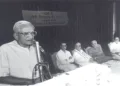
The 15th BRICS Trade Union Forum (TUF) Summit 2026 held from July 14-16 concluded with the unanimous adoption of the “Hyderabad Declaration”. This landmark achievement establishes a collaborative global framework for a fair, inclusive, and worker-centric future. The Summit was chaired by Sri Sunkari Mallesham, the Indian Presidency, and the All-India President of Bharatiya Mazdoor Sangh (BMS).
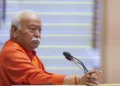
Hosted by the Bharatiya Mazdoor Sangh (BMS) under India’s 2026 BRICS Presidency, the three-day summit brought together 53 delegates representing national trade union centres from 13 member and partner countries. More than 60 prominent trade union leaders, HR experts, Industry representatives and academic & policy experts also joined the deliberations and contributed positively to the processes. The final day featured a valedictory address by His Excellency, Hon’ble Governor of Telangana, Shiv Pratap Shukla, who praised the historic consensus and emphasised mutual trust in industrial relations.
The Hyderabad Declaration congratulates the International Labour Organisation (ILO) and its tripartite constituents on the adoption of the historic Convention on Decent Work in the Platform Economy in 2026. The declaration says that the adoption of this convention has once again demonstrated the effectiveness of the Tripartite system within the ILO.
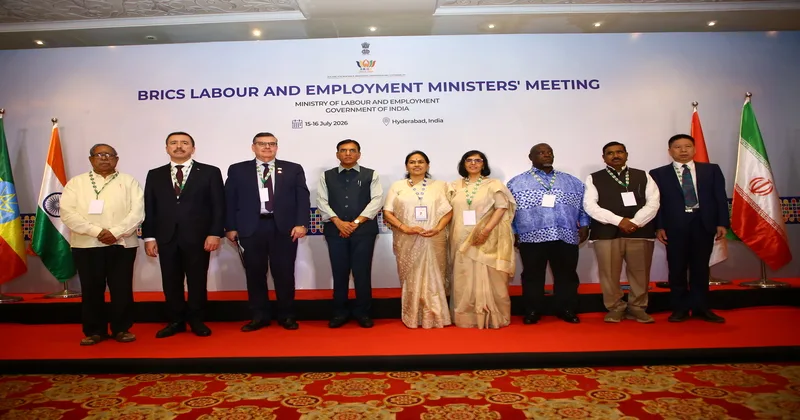
A high-level delegation was invited to present the Workers’ viewpoint at the BRICS Labour and Employment Ministers’ Meeting, which was also held in Hyderabad. The delegation was led by the Chairman of the BRICS Trade Union Forum. The members of the delegation are – Carlos August Muller, Brazil; Sergei Chernogaev, Russia; Bojji Surendran, India; Huxiang Zhu, China and Masale Godfrey Selematsela, South Africa.
Key Pillars of the Hyderabad Declaration
The historic declaration reflects the collective commitment of the BRICS nations to construct resilient, future-ready labour markets by mutual cooperation. It prioritises four core structural areas:
- Women and the Future of Work: Eliminating gender pay gaps, driving inclusion, and strengthening female labour force participation.
- Universal Social Security: Expanding robust social safety nets to protect every individual, with a focus on cross-border portability of social security benefits for migrant workers.
- Skills for the Future: Investing in continuous upskilling, re-skilling, and public-private-union tripartite partnerships.
- Human-Centric Technology: Establishing governance models to ensure technology and AI assist workers rather than replacing them.
Major Outcomes and Structural Milestone Permanent Institutional Mechanism
The declaration officially calls for the establishment of a permanent institutional mechanism for engaging with trade unions within the broader BRICS framework to ensure ongoing global policy advocacy.
Protection for the Gig and Platform Economy
Delegates welcomed the International Labour Organisation’s (ILO) latest standards. The declaration urges BRICS nations to quickly align national laws to guarantee collective bargaining and social protections for platform workers.
Synergies with “BRICS CONNECT” Declaration
The outcomes of the Trade Union Forum directly complement the BRICS CONNECT platform. This platform was simultaneously launched by India’s Ministry of Labour and Employment to streamline cross-border skills mapping and voluntary knowledge sharing.
The summit concluded with a unified pledge by the participating delegations to strive and mount pressure on governments to implement these recommendations effectively, ensuring economic transformations do not leave the global workforce behind.