There are places that are remembered for what lies beneath their soil. The Chotanagpur Plateau is one such land. Rich in coal, iron ore, bauxite, uranium and strategic minerals, it has powered India’s industries for decades. Economists measure its value through mineral reserves, industrial output and resource security. Yet, the greatest treasure of this plateau cannot be excavated. It cannot be mined, transported or exported. Its most precious resource has always been its people.
For generations, the forests and hills of Netarhat have quietly produced something even rarer than rare earth elements: rare intellect, rare character, rare discipline and rare leadership. If minerals build industries, enlightened minds build civilizations. As someone whose intellectual journey began at Netarhat Vidyalaya and later moved into semiconductor technologies, I have often felt that the true strength of Bharat lies not only in its natural resources, but in the minds and values we nurture with patience.
Modern nations are investing billions of dollars to secure gallium, germanium, silicon, rare earth magnets and critical minerals. Supply chains dominate geopolitics. Chips have become symbols of technological sovereignty. But no nation becomes a leader merely by possessing resources. Nations rise when they cultivate human capital, scientific temperament, ethical leadership and institutions that build character across generations. Natural resources may determine economic opportunity; human resources determine national destiny. That realization always takes me back to Netarhat.
A school born from the civilizational confidence of Bharat
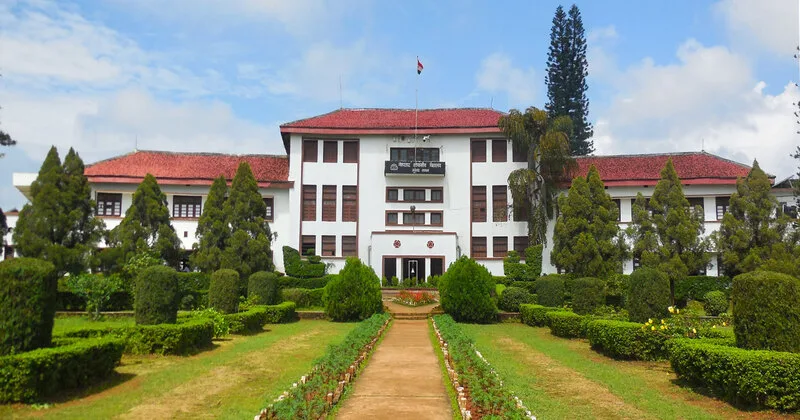
Established in 1954, in the formative years of independent India, Netarhat Vidyalaya represented one of the boldest educational experiments of the Republic. India had recently emerged from colonial rule. Infrastructure was limited. Resources were scarce. Yet the national imagination was large. The founders understood that the future of the nation would depend not merely on dams, factories and laboratories, but on the quality of young minds who would one day lead them.
This vision was deeply Indian. Long before modern management language started speaking about leadership development, holistic education, experiential learning and emotional intelligence, Bharat had evolved the Gurukul system. In the Gurukul, education was never reduced to information transfer. Vidya was inseparable from character, discipline, humility, self-reliance and service. The objective was not simply to create scholars; it was to create responsible human beings.
The ancient prayer, ‘Asato ma sadgamaya, tamaso ma jyotirgamaya, mrityor ma amritam gamaya’—lead me from untruth to truth, from darkness to light, from mortality to immortality—captures the spirit of education better than any modern slogan. True education does not merely help a child pass an examination. It helps the child move from confusion to clarity, from imitation to conviction, from selfish ambition to social responsibility.
Netarhat preserved this spirit without becoming trapped in nostalgia. It embraced modern science, mathematics, literature, languages and competitive academic rigour, but it kept alive the soul of the Gurukul: discipline with affection, excellence without arrogance, simplicity without deprivation and freedom with responsibility.
Admission through tapasya, Not privilege
The admission process itself reflected this philosophy. Netarhat was never designed as a school of entitlement. It was designed as a school of effort. Admission has traditionally been through open competition, testing the child through written examinations at approximately Class VI level, including languages and literature, mathematics and general knowledge consisting of life science and social science. The process further includes psychological tests, interviews and medical examination, with reservation followed as per government policy.
This layered process is important. It tells a child very early that opportunity must be earned, and once earned, it must be honoured. Selection is not the end of the journey; it is the beginning of tapasya. A student entering Netarhat does not merely enter a classroom. He enters a disciplined community where merit, conduct, effort, health, courage and social behaviour are all part of education.
In today’s world, where education is often discussed only in terms of fees, brands and placements, this principle deserves renewed attention. A nation that wants Viksit Bharat must create institutions where children from different backgrounds can rise through merit, live together in dignity and learn that duties come before demands. Fundamental rights are precious, but they become meaningful only when supported by fundamental duties. Netarhat taught this not as a chapter in civics, but as a daily habit.
The campus as Kutumb; Respect, belonging and samajik samrasta
Visitors often notice the physical beauty of Netarhat: the forests, the plateau, the changing seasons and the quiet rhythm of life. Alumni remember something deeper. They remember an institution where the campus functioned like a kutumb, an extended family. Teachers were respectfully addressed as Shriman Ji. The affectionate presence of Mata Ji gave the residential life a nurturing dimension. A school away from home became a second home, where intellectual growth and emotional security moved together.
This is where Netarhat planted the seed of samajik samrasta. Students from diverse social, linguistic and economic backgrounds lived, studied, played, prayed, worked and grew together. Shared routines dissolved invisible walls. Merit mattered, but so did conduct. Intelligence mattered, but so did humility. Seniority mattered, but never at the cost of dignity.
This value has remained central to my own understanding of life. I have always believed that the dhobi ji, mochi ji, nai ji, gardener, cook, junior colleague, senior teacher, administrator and scholar all deserve respect. A society becomes strong not when a few people rise, but when every person feels seen, valued and connected. This is the lived meaning of samajik samrasta. It is not a slogan. It is how we speak, how we behave, how we honour labour and how we build trust.
In the Indian way of life, kutumb prabodhan begins at home but does not end there. The family teaches gratitude, discipline, respect for elders, care for younger ones and sensitivity towards those who serve us. The institution expands that family into society. Netarhat did precisely this. It trained students to live not as isolated achievers, but as responsible members of a larger social organism.
Learning with the head, hand and heart
One of the most powerful features of the Netarhat model was its insistence that education must touch the head, the hand and the heart. Students were not trained only to read books and write examinations. They were introduced to music, singing, instrumental performance, dramatics, art, craft, wood work, metal work, gardening, agriculture, physical fitness, outdoor life and social responsibility. This was not extracurricular decoration. It was character formation through action.
I remember being given a small farm area where I learnt to work with soil, observe plants, experiment with organic fertilizer and understand the dignity of agriculture. A child who works with soil learns patience. A child who repairs, builds or grows something learns respect for labour. A child who participates in music or drama learns rhythm, expression and confidence. A child who lives in a hostel learns adjustment, cooperation and restraint.
Today the world calls this experiential learning, skill education, sustainability consciousness and life-skill development. Netarhat practised it long before such terms became fashionable. Wood work and metal work trained the hand. Agriculture trained patience and ecological responsibility. Music and art refined sensitivity. Debate and reading sharpened thought. Discipline strengthened willpower. Together, they created a complete education.
This is why Netarhat alumni often speak not only of marks and ranks, but of habits, values and memories. Great institutions do not merely teach subjects. They shape instincts. They make discipline natural, service respectable and excellence a way of life.
Atmadipa Viharatha: Be your own light
Another lesson that Netarhat quietly gave was self-reliance. The ancient call ‘Atmadipa viharatha’—be your own light—has special relevance for modern Bharat. A nation cannot become self-reliant only by announcing policies. Atmanirbhar Bharat requires atmanirbhar citizens: young people who can think, work, question, create and stand with inner confidence.
At Netarhat, students learnt to manage routines, respect time, care for shared spaces, participate in collective life and solve problems with limited resources. Simplicity became strength. Self-discipline became freedom. The child slowly understood that dependence weakens the mind, while responsibility awakens it.
This value is critical for the India of today. We speak of semiconductor fabs, artificial intelligence, quantum technologies, defence systems, biotechnology and advanced materials. But who will build these? Who will lead these laboratories? Who will take ethical decisions while deploying powerful technologies? Machines can process information. Only enlightened minds can exercise wisdom.
Education for service, Not merely success
The Indian civilizational view of education has always placed service above self-display. The Sanskrit phrase ‘Na tvaham kamaye rajyam, na swargam, na punarbhavam; kamaye duhkha-taptanam praninam arti-nashanam’ reminds us that the highest aspiration is not power, heaven or personal gain, but the removal of suffering from the lives of people. This is the moral foundation of national education.
Netarhat’s contribution must therefore be seen not only through the success of its alumni, but through the kind of citizenship it cultivated. The institution has produced administrators, scientists, engineers, doctors, defence officers, teachers, entrepreneurs and public servants. But its deeper achievement lies in producing people who understand that knowledge carries responsibility.
In the coming decades, Bharat will need technically competent professionals. But technical competence alone is not enough. We need innovators with ethics, administrators with empathy, scientists with national purpose, entrepreneurs with social responsibility and teachers who inspire curiosity rather than fear. Netarhat’s model speaks directly to this national need.
From Netarhat to Viksit Bharat 2047
India’s aspiration to become Viksit Bharat by 2047 is not merely an economic target. It is a civilizational opportunity. A developed India will certainly require highways, ports, airports, digital infrastructure, semiconductor manufacturing, research parks and innovation clusters. But alongside this physical infrastructure, India must invest equally in educational culture.
Infrastructure creates opportunity. Institutions create capability. Culture creates excellence. Netarhat shows that when these three come together, a school can become a nation-building force. The question before us is not only why Netarhat was exceptional. The question is why India has created so few institutions inspired by the same philosophy.
Imagine a network of residential centres of excellence across Bharat: institutions where the day begins with physical fitness, yoga or outdoor activity; where students learn mathematics, literature, coding, physics, biology, history and Indian knowledge systems; where afternoons include robotics, electronics, agriculture, wood work, metal work, music and art; where evenings are devoted to discussion, self-study, Sanskrit prayers, constitutional duties, social responsibility and reflection. Such institutions would not replicate the past mechanically. They would renew the Gurukul spirit for a knowledge-driven age.
Netarhat teaches us that great citizens are not produced accidentally. They are educated intentionally. Its deepest message is that education is not a transaction between teacher and student. It is a covenant between one generation and the next.
The wisdom within our minds
The Netarhat Plateau has long been known for mineral wealth. Its coal powered industries. Its iron ore strengthened infrastructure. Its strategic minerals supported national development. But its greatest contribution has always been invisible. Not minerals, but minds. Not ores, but ideas. Not rare earth elements, but rare human potential.
For me, Netarhat remains a living reminder that Bharat does not have to borrow its educational imagination from elsewhere. Our civilization has always known that knowledge must be joined with character, freedom with duty, ambition with humility and success with service. The task before us is to translate that wisdom into institutions for the twenty-first century.
Let us build laboratories, fabs, research parks and innovation centres. But let us also build schools where students learn to respect the dhobi ji and the scientist, the mochi ji and the minister, the gardener and the guru, the junior and the senior. Let us build institutions where children are taught to become their own light, to serve before they claim, to perform duties before demanding rights and to carry Bharat in their mind, conduct and work.
That would be the true tribute to Netarhat Vidyalaya. Not merely remembering its legacy, but renewing its philosophy. For the future of Bharat will ultimately depend not only on the wealth beneath our feet, but on the wisdom within our minds. If India succeeds in nurturing that wisdom with the same care with which Netarhat has done for generations, then Viksit Bharat 2047 will not remain an aspiration. It will become an inevitable national achievement.