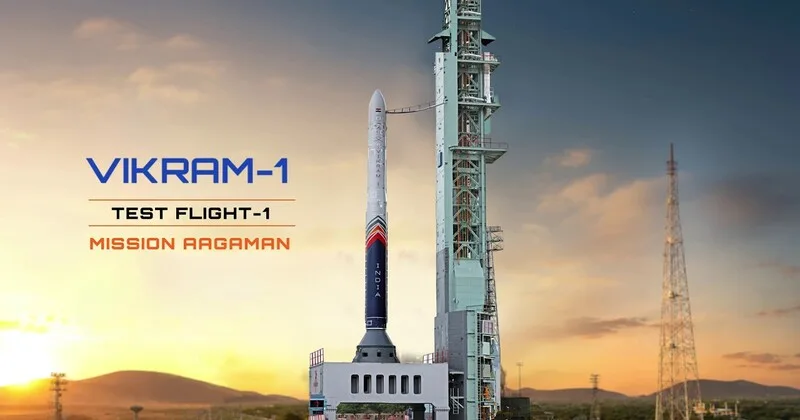
Sriharikota: Skyroot Aerospace’s Vikram-1 Test Flight-1 has successfully reached the orbit on July 18, Saturday, marking the maiden flight of India’s first privately developed orbital-class rocket. The rocket completed its final burn and injected its payloads into a nearly 450-km orbit, making India the third country in the world with private orbital launch capability.
The mission, named “Mission Aagaman”, was executed from the Satish Dhawan Space Centre. The 24-metre carbon-composite rocket completed all planned flight stages, including stage separations and the firing of its Orbital Adjustment Module (OAM). The Orbital Adjustment Module fired its 3D-printed liquid engine for the final push to orbit. The module is designed to start, stop and restart in space.
Historic. 🇮🇳
India’s first privately developed orbital rocket, Vikram-1 Test Flight-1 has successfully reached orbit after completing its final burn and injecting payloads into a 450 km orbit.
India is the third country in the world to achieve private orbital launch capability. pic.twitter.com/TSDZ6EynOR
— Aditya Raj Kaul (@AdityaRajKaul) July 18, 2026
During the flight, Kalam-1200, the solid first stage, carried the rocket through the thickest part of the atmosphere before separating cleanly. The payload fairing was then separated, exposing the satellites to space for the first time. The second stage, Kalam-250, completed its burn and separated, followed by the ignition of Kalam-100, the smallest and highest-flying solid stage of Vikram-1. The solid-propulsion phase concluded with the separation of Stage 3, paving the way for the Orbital Adjustment Module to complete the mission.
The Vikram-1 rocket, powered by three solid-fuel stages and a liquid orbital adjustment module, is designed to deploy payloads up to 350 kg into a 450-km Low Earth Orbit (LEO). The maiden flight carried multiple payloads, including the “Diamond Lotus”, a lab-grown diamond from Bengaluru-based Cosmos Diamonds.
These include Skyroot’s SCOPE satellite, DCUBED’s technology demonstration payload, Grahaa Space’s SOLARAS S3 satellite and Cosmoserve Space’s Embrace, a robotic arm designed to capture orbital debris.
The maiden flight also carried two symbolic payloads, “Cosmic Bloom”, a floral-shaped artwork and an 18-karat gold micro-rocket. The micro-rocket features microscopic sculptures of C. V. Raman, Vikram Sarabhai and A. P. J. Abdul Kalam, each smaller than a grain of rice, thus paying tribute to India’s pioneering scientists.
A special gesture inscribed in Vikram-1, is a handwritten postcard from PM Modi with the words, “Vande Mataram”. It travels to space alongside handwritten messages from the Skyroot team, investors, policymakers and well-wishers across the globe, making Mission Aagaman a celebration carried by many hands and shared by millions.
Defining moment in India’s space journey: PM Modi
Prime Minister Narendra Modi congratulated Skyroot Aerospace on the successful launch of Vikram-1, describing it as a defining moment in India’s space journey and saying the growing participation of the private sector is opening new frontiers and accelerating innovation. In a post on X, PM Modi said he spoke to the Skyroot Aerospace team and congratulated them on the successful launch of Vikram-1.
Spoke to the team of Skyroot Aerospace and congratulated them on the successful launch of Vikram-1.
This is a defining moment in India’s space journey. The growing participation of our private sector is opening new frontiers and accelerating innovation.
This achievement will… pic.twitter.com/epWjOY8yKa
— Narendra Modi (@narendramodi) July 18, 2026
“Spoke to the team of Skyroot Aerospace and congratulated them on the successful launch of Vikram-1. This is a defining moment in India’s space journey. The growing participation of our private sector is opening new frontiers and accelerating innovation. This achievement will encourage countless youngsters to dream bigger and innovate fearlessly”, PM Modi wrote on X.
Space reforms facilitating greater private participation: ISRO Chairman
Indian Space Research Organisation (ISRO) Chairman V Narayanan also congratulated Skyroot Aerospace after its Vikram-1 Test Flight-1 successfully reached the orbit, describing it as a major milestone for India’s private space sector. Narayanan said the successful mission marked the first time an Indian private rocket had been placed in orbit.
He credited the 2020 space sector reforms for enabling greater private participation and said the achievement reflected the success of those policy initiatives. “The Prime Minister has always guided us and I thank him for his support”, V. Narayanan further added. Congratulating the Skyroot Aerospace team, Narayanan said the company and its employees deserved appreciation for the achievement.
He also acknowledged the role of the Indian National Space Promotion and Authorisation Centre (IN-SPACe) for facilitating private participation in the sector and thanked the ISRO team for its support.
“When private participation in the space sector began, we had only one startup. Today, we have more than 400 space startups. This is just the beginning under the leadership of our Prime Minister as we move towards making India a developed nation”, Narayanan said.
IN-SPACe Chairman Pawan K Goenka lauded the hard work which led to the success in the first attempt. “The team has worked extremely hard for many years to get to this point and succeed in the very first attempt”, he added. He congratulated the Skyroot Aerospace team for successfully achieving the milestone, highlighting the efforts behind the development of the private-sector rocket.
Skyroot Aerospace CEO and Founder Pawan Kumar Chandana said the mission was a historic moment as it marked the first time an Indian private company had built an orbital-class rocket, developed the launch infrastructure and successfully carried out an orbital mission. “A team with an average age of just 28 years has built India’s first private orbital rocket. The rocket is completely built with carbon composite”, Chandan added.
400 space startups are driving investment, innovation & India’s footprint in space value chain
India’s space sector has undergone a historic transformation driven by the Government of India’s forward-looking reforms. The Indian Space Policy 2023, has opened the entire space value chain to private participation, fostering innovation, investment and enterprise across the space ecosystem. Indian industry is now participating in satellite manufacturing, launch services, space applications and downstream services. The impact of these reforms is already visible in the numbers.
India’s space startup ecosystem has grown from just one startup in 2014 to over 400 in 2026, reflecting the rapid expansion of private participation and innovation across the space sector. Government reforms have also accelerated the growth of India’s space economy. Valued at approximately USD 8.4 billion today, the sector is projected to grow fivefold to USD 40-45 billion by 2030. It is further aimed to reach USD 100 billion by 2040.
Sustained government support, enabling regulations and strong public-private partnerships continue to drive this growth, positioning India as a global hub for space technology, manufacturing, innovation and commercial space activities. The Indian National Space Promotion and Authorisation Centre (IN-SPACe) acts as an autonomous single-window agency to authorise and promote space activities by Government entities and NGEs.
Strengthened by the Indian Space Policy 2023, IN-SPACe also provides a stable and predictable regulatory framework and facilitates end-to-end industry participation. Additionally, it enabled access to ISRO facilities, technologies and technical expertise and streamlined approvals through transparent guidelines. As of June 2026, IN-SPACe has registered over 4,500 organisations, issued 133 authorisations and signed 106 Memoranda of Understanding(MoUs).
Additionally, as of February 2026, IN-SPACe facilitated USD 150 million in investments into Indian space startups during CY 2025, with the top 10 startups securing a confirmed order book of the same value. By June 2026, IN-SPACe had also facilitated 118 technology transfer agreements and signed 189 Joint Project Implementation Plans (JPIPs), Technology Partnership Agreements (TPAs) and Business Partnership Agreements (BPAs), accelerating technology commercialisation and industry collaboration.
IN-SPACe Seed Fund scheme provides early-stage financial assistance to space startups and Micro and Small Enterprises. It supports them in developing innovative space technologies and practical applications for various uses. Moreover, the scheme offers grants of up to ₹1 crore to eligible applicants working in this space. Along with funding, it also provides mentorship, training and networking support to help startups grow. Additionally, the scheme grants funds to Indian space startups working on agriculture-related technologies. It supports solutions for disaster management and urban development that rely on space technology.
₹1,000 crore Venture Capital (VC) under IN-SPACe aimed to accelerate private participation in the space sector. This fund provided early-stage capital to promising startups working in space technology and related fields. It also attracts private investment into the sector while supporting the production of domestic space startups. The initiative aims to expand India’s space economy fivefold over the coming decade. The fund will be deployed over five years, starting from FY 2025-26 through FY 2029-30. Annual investments under this fund will range between ₹100 crore and ₹250 crore.
IN-SPACe introduced the Technology Adoption Fund (TAF). This fund aimed to accelerate the deployment of indigenous space technologies developed by NGEs. It also supports the transformation of early-stage technologies into commercially viable products for the market. The scheme offers funding of up to 60 per cent of the project cost for startups and MSMEs. Large industries can receive funding of up to 40 per cent of their project cost. This funding is subject to a maximum limit of ₹25 crore per project.
The Indian Space Policy 2023 also defined the role of NewSpace India Limited (NSIL) as ISRO’s commercial arm. NSIL manufactures and procures space systems on commercial principles. It also delivers end-to-end space solutions to both Government entities and NGEs. NSIL further expands private participation through PSLV productionisation and small satellite technology transfer. It also supports satellite services while marketing space products and spin-off technologies.
Over the years, NSIL has witnessed a tenfold increase in revenue, reflecting its expanding commercial footprint in the global space sector. As of December 2025, over 70 Technology Transfer Agreements had enabled the transfer of ISRO-developed technologies to industry, accelerating their commercialisation.
As of July 2026, NSIL has launched a total of 141 satellites, including 138 international/customer satellites and 3 Indian satellites, reinforcing India’s position as a trusted global launch service provider.
The Foreign Direct Investment (FDI) policy for the space sector was liberalised to make it more investor-friendly. The revised policy permits up to 74 per cent automatic FDI in satellite manufacturing and operations, 49 per cent automatic FDI in launch vehicles and spaceports, and 100 per cent automatic FDI in the manufacturing of satellite components and subsystems. The reform is expected to accelerate investments, promote technology transfer and collaborative research, and further improve the ease of doing business in India’s space sector.
India’s space sector stands at the threshold of a new era, driven by Government-led reforms and a vibrant private ecosystem. The Indian Space Policy 2023, thus, liberalised FDI norms and dedicated funding initiatives have opened the entire space value chain to any potential players. These reforms have fostered a dynamic ecosystem marked by growing startups, indigenous innovation and expanding commercial activities. Moreover, Vikram-1 represent more than a technological milestone. It reflects the growing confidence and capabilities of India’s private space industry.
(With Inputs from ANI)