A student walks out of a state university after two years, family circumstances have decided to work. In the old arrangement of education system, that was the end of the education, two years of study reduced to a bundle of marksheets as a waste in a steel almirah, legible to no one, redeemable nowhere. Four years later, if he or she found a way back to a classroom, he or she would start again from the first semester.
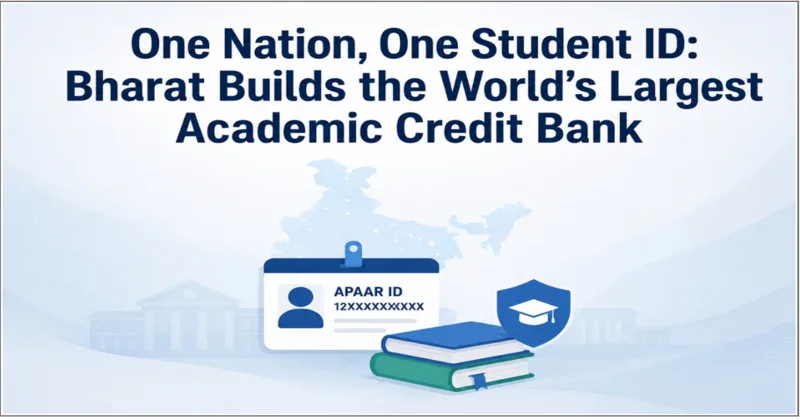
That overburdening of gap has changed as they held a twelve-digit number that belongs for lifetime. As of 2 July 2026, 26.35 crore such numbers have been verified and issued across Bharat. The Academic Bank of Credits and the APAAR ID that unlocks it and have quietly become one of the largest student identity systems anywhere in the world.
Two things are working here and they are easy to confuse. The Academic Bank of Credits is the vault. A Ministry of Education platform, regulated by the University Grants Commission, it stores, manages, transfers and redeems the academic credits a student earns from any recognised award-granting institution. Credits go in, credits come out. Nothing gets lost in between them.
Second is APAAR – the Automated Permanent Academic Account Registry, which is the key. A unique twelve-digit identification number, issued under the One Nation, One Student ID initiative, it gives every learner a single academic identity that follows them rather than the other way round. Accessible through DigiLocker and the ABC platform, it pulls together records from higher education, skill and vocational training, and other professional learning programmes onto one surface. School education records are being creditised and mapped to the same ID under NAD-ABC.
And for the parts of the country where a laptop and a stable connection are still not a given, the nearest Common Service Centre will generate an APAAR ID. The digital divide is not something the system pretends away.
How a credit actually moves
A student registers on the ABC portal and receives an APAAR ID linked to Aadhaar and DigiLocker. Students at eligible Higher Education Institutions and Skill Awarding Bodies can use the facility. Award Granting Institutions, those empowered to issue certificates, degrees and marksheets to be upload credit data directly to the NAD-ABC portal against each student’s APAAR ID. Marksheet and certificate issuance runs through the National Academic Depository, which is the backbone the whole structure rests on.
From there, the student accumulates, transfers and redeems across institutions without forfeiting progress. Two rules give the system its discipline. Credits carry a shelf life of seven years, or whatever period the relevant academic discipline prescribes. And once a credit is redeemed, it is spent, it cannot be recycled for another transfer or redemption. A bank that let you withdraw the same rupee twice would not be a bank for long.
For all examinations held in 2025, the UGC mandated every Higher Education Institution to upload credit data to the NAD-ABC portal by 30 June 2026. The report drawn two days after that deadline is worth reading in full.
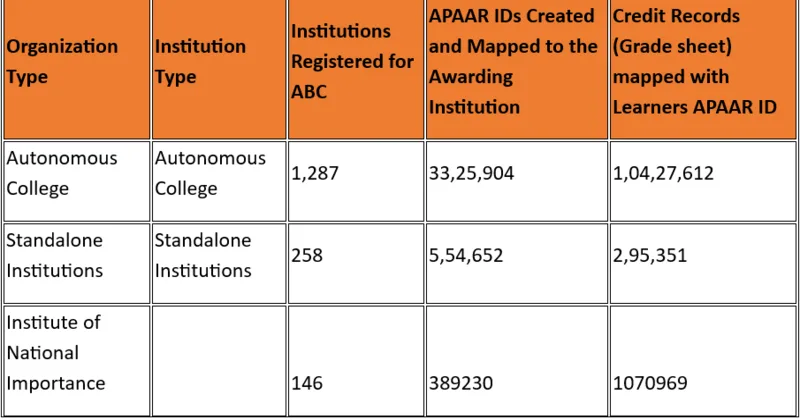
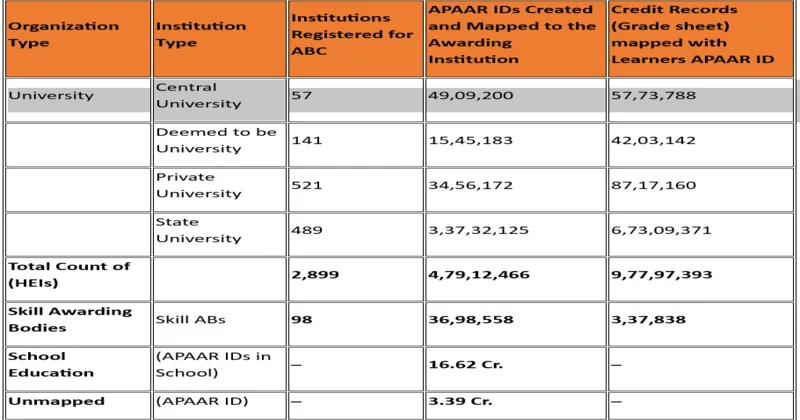 489 institutions, 3.37 crore IDs mapped, 6.73 crore credit records, is not an elite-campus phenomenon. The bulk of the weight is being carried by the universities where most of Bharat actually studies.
What the student gets out of it
The infrastructure exists to serve a purpose, and the purpose is flexibility.
Multiple entry multiple exit: ABC is what makes MEME under NEP 2020 operable rather than aspirational, a certificate after one year, a diploma after two, a degree after three or four. More than 700 universities and 6,600 colleges are offering multiple entry and exit options. This is the provision that turns the Gorakhpur student’s two years from a loss into a deposit.
SWAYAM: Students may draw up to 40 per cent of their credits from the SWAYAM online platform, with around 450 universities having adopted the regulation. A student at a modest college can now take a course taught at a far better-resourced one and have it count.
The national credit framework: Aligned with NEP 2020, the NCrF covers academic, vocational and experiential learning within a single credit vocabulary. As of 2026, 196 universities across the country have adopted it — which is the mechanism by which ABC bridges formal, informal and experiential learning instead of merely gesturing at the idea.
Records on demand: Academic records and digital certificates are available anywhere, at any time, through a consent-based document exchange system that compresses verification timelines rather than stretching them across weeks of registrar correspondence.
And a small, telling perk: Authenticate an APAAR ID between the ages of 13 and 30, it unlocks up to 10 per cent off base airfares and an additional 10 kg baggage allowance. A minor benefit, but it signals something this is meant to be a live identity a student uses, not a dormant record number. The intended outcome, across all of it lower dropout rates and a stronger reason to keep learning.
Security and the plumbing beneath
An academic ledger is only as credible as its locks. The platforms run on robust security protocols and encryption standards, with access authenticated through the APAAR ID and Aadhaar-linked DigiLocker credentials and protecting the record while keeping it reachable across every integrated system.
Beneath that sits the plumbing that makes ABC a component of Bharat’s Digital Public Infrastructure for education, under the Digital India Programme:
- Integration with NAD-DigiLocker gives students verified, self-serve access to their own records
- SAMARTH ERP, the cloud-based e-governance platform, offers a standardised gateway for students and university administrations alike
- APIs let institutional platforms verify a student’s APAAR ID and issue records directly on NAD-ABC
- Single sign-on with APAAR ID for institutional platforms
- CSCs in remote villages act as ground-level registration points
- The Digital India Corporation and NeGD, under MeitY, featured ABC-NAD in the Digital India ‘Ask Our Experts’ series in November 2024
What comes next
Here is the honest limitation of everything described so far it is a very good centralised database. Trustworthy, encrypted, sovereign but centralised.
The next layer addresses that. Blockchain for Digital Credentials, developed by the Digital India Corporation, is Bharat’s sovereign blockchain platform for secure, verifiable and tamper-proof digital credentials at scale. Institutions can adopt it two ways through DIC’s managed blockchain infrastructure for a quick start, or by running dedicated nodes for greater autonomy.
Two commitments are built in and worth naming plainly all academic data stays within Bharat’s sovereign digital infrastructure and the platform is fully compliant with the Digital Personal Data Protection Act. A student’s academic history is not going to be adjudicated on servers in another jurisdiction. The system uses for itself is that ABC and APAAR help a learner build their education brick by brick across institutions, across years.
It is an apt image, because bricks are only useful if they stay where you put them. What 26.35 crore verified IDs and 9.78 crore mapped credit records represent is not a technology achievement so much as a promise being kept in the ledger, that nothing a student learns has to be learned twice, that a pause is not a forfeit, and that the record of a life’s education belongs to the person who earned it. The student in Gorakhpur will find two years exactly where they had left them.