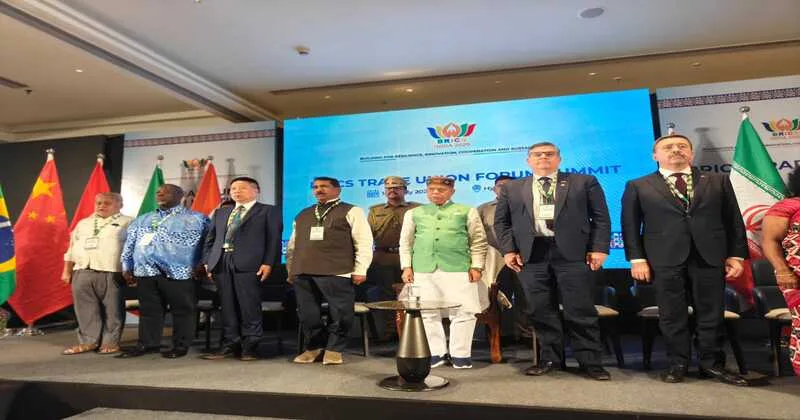
Hyderabad, July 15: The 15th BRICS Trade Union Forum (TUF), held under India’s Presidency in Hyderabad from July 14-16, adopted a comprehensive declaration calling for a human-centric approach to artificial intelligence (AI), universal social security, stronger labour rights, gender-inclusive workplaces and the establishment of a permanent institutional mechanism for trade unions within the BRICS framework. The declaration also urged member countries to accelerate skill development, protect workers affected by technological disruption and climate transition, and ensure that economic growth remains equitable and worker-centric.
Held under the theme “Building for Resilience, Innovation, Cooperation and Sustainability,” the Forum brought together representatives of national trade union centres from BRICS member and partner countries to deliberate on emerging global labour challenges amid rapid technological and economic transformation.
Organised actively by the Bharatiya Mazdoor Sangh (BMS), the assembly welcomed over 46 international delegates alongside 70 national trade union representatives, academics, and labour experts from Bharat. BRICS trade union forum summit 2026 Chairman & BMS National President Sunkari Mallesham said that “When workers prosper, Nation Prosper, when nation cooperates, humanity prospers”.
Forum Congratulates ILO on Historic Platform Economy Convention
One of the key highlights of the declaration was the Forum’s welcome of the International Labour Organization’s (ILO) newly adopted Convention on Decent Work in the Platform Economy, 2026.
The BRICS Trade Union Forum urged member governments to align their domestic labour laws with the convention and ensure decent working conditions for gig and platform workers. It stressed that workers engaged in digital platforms should enjoy trade union rights, collective bargaining, social protection and fair working conditions irrespective of their employment classification.
The declaration reaffirmed the importance of the ILO’s international labour standards and described tripartite dialogue among governments, employers and workers as the most effective framework for ensuring sustainable labour relations.
AI Must Assist Humans, Not Replace Them
Artificial Intelligence emerged as one of the central themes of the Hyderabad Declaration.
The Forum acknowledged that AI, automation, robotics and digitalisation are transforming workplaces at an unprecedented pace, creating opportunities for productivity and innovation while simultaneously posing serious risks to employment, privacy and labour rights.
Expressing concern over job displacement, digital surveillance, algorithmic discrimination and increasing informalisation of work, the declaration called upon governments to formulate comprehensive regulatory frameworks governing AI deployment in workplaces.
Significantly, the Forum declared that AI systems should not make final decisions regarding hiring, promotions, disciplinary actions, performance evaluation or termination without meaningful human oversight. Workers, it said, must retain the right to challenge automated decisions affecting their employment.
The declaration further stated that technology should serve humanity rather than become a tool for profit maximisation at the cost of workers’ dignity and rights.
Call for Ethical AI Governance
The Forum recommended that BRICS governments formulate worker-friendly industrial policies that ensure the ethical, transparent, accountable and non-discriminatory use of AI.
It also advocated:
- Protection of workers’ personal data.
- Digital literacy programmes.
- Safeguards against unfair algorithmic decision-making.
- Participation of trade unions in designing and monitoring AI systems.
- Equitable sharing of productivity gains arising from technological advancements.
The declaration asserted that workers should actively participate in technological decision-making processes rather than remain passive recipients of technological change.
Universal Social Security Becomes Central Demand
The Forum described social security as a universal human right and called for “Social Security for All” to become the new global development mantra.
It urged BRICS governments to expand comprehensive social protection systems covering:
- Informal workers
- Agricultural workers
- Gig workers
- Platform workers
- Migrant workers
- Self-employed persons
- Workers engaged in non-standard employment
The declaration also stressed the importance of portability of social security benefits across national borders as labour mobility continues to increase globally.
It further recommended that retirement benefits remain an integral component of lifelong social protection systems.
Lifelong Learning Essential in AI Era
Recognising that technological disruption will continuously reshape labour markets, the Forum called for a shift away from the traditional concept of “one-time education.”
Instead, it advocated lifelong learning, continuous reskilling and regular upskilling throughout workers’ careers.
The declaration urged governments, employers, educational institutions and trade unions to jointly establish accessible learning ecosystems capable of preparing workers for future occupations driven by AI, automation and green technologies.
It stressed that no worker should lose employment merely because technological change outpaces skill development.
Proposal for BRICS Skill Development Network
To deepen cooperation among member countries, the Forum proposed the establishment of a BRICS Skill Development Network.
The network would facilitate:
- Mutual recognition of professional skills and certifications.
- Exchange of training methodologies.
- Research collaboration.
- Worker education programmes.
- Sharing of best practices in vocational education.
The Forum also advocated Recognition of Prior Learning (RPL) mechanisms to formally acknowledge traditional, informal and experiential skills across BRICS nations.
Women Workers at Centre of Inclusive Growth
The declaration devoted significant attention to women workers and gender equality.
It described women not merely as beneficiaries of development but as key agents of economic transformation.
The Forum highlighted persistent challenges including:
- Unequal pay
- Workplace discrimination
- Occupational segregation
- Violence and harassment
- Unpaid care responsibilities
- Digital exclusion
It urged BRICS countries to improve childcare and elder-care services, promote family-friendly workplaces, strengthen maternity protections and expand access to digital skills, STEM education and green jobs for women.
The Forum also encouraged all BRICS countries to ratify and effectively implement ILO Convention No. 190 on ending violence and harassment in the world of work.
Green Transition Must Protect Workers
While endorsing climate action and low-carbon economic transitions, the declaration cautioned against placing the burden of climate policies solely on workers and vulnerable communities.
The Forum called for a “Just Transition” that guarantees:
- Income protection
- Social security
- Reskilling opportunities
- Sustainable employment pathways
- Investment in green industries
- Renewable energy
- Climate-resilient infrastructure
- Public services
It also urged developed countries to fulfil climate finance commitments while ensuring that such financing does not increase debt burdens on developing nations.
Permanent Institutional Role for Trade Unions
One of the major institutional recommendations was the creation of a permanent mechanism for dialogue between BRICS governments and trade unions.
The declaration argued that organised labour should become an integral part of BRICS governance and decision-making processes.
Trade unions, it said, must regularly participate in discussions concerning economic, industrial and social policies affecting workers.
The Forum also proposed the creation of a BRICS Network for Trade Union Cooperation focusing on Artificial Intelligence, digital work and skill development.
Peace and Stability Essential for Decent Work
The declaration expressed concern over continuing global conflicts and geopolitical instability, warning that wars disproportionately affect workers, migrants and vulnerable communities.
It called upon all parties involved in international conflicts to exercise restraint, respect international law and prioritise peaceful dialogue.
According to the Forum, lasting peace, stability and a non-hegemonic international order are indispensable for sustainable development and decent work.
Strengthening South-South Cooperation
The Hyderabad Declaration reaffirmed support for South-South cooperation and endorsed a greater developmental role for the New Development Bank (NDB).
The Forum also backed initiatives aimed at equitable global economic governance and expressed support for the Global Coalition for Social Justice.
It further called for stronger collection of gender-disaggregated labour statistics to enable better policymaking.
Human-Centric Development Remains Core Message
Concluding its declaration, the BRICS Trade Union Forum emphasised that workers remain central to economic growth, technological transformation and social progress.
It reaffirmed that future BRICS cooperation must promote a more equitable, inclusive and multipolar global order in which technological innovation, economic development and climate action proceed without leaving workers behind.
The Forum called upon governments, employers, trade unions, labour ministries, social security institutions, the ILO and the International Social Security Association (ISSA) to work together in implementing the declaration’s recommendations and building resilient labour markets for the future.
Earlier on July 14, B Surendran, Organising Secretary of BMS & Chief Coordinator of BRICS TUF welcomed all the delegates attending the summit and wished good luck for the fruitful and historic outcome of the deliberations of the summit.
In the session representatives from the BRICS countries Carlos Augusto Muller, (Brazil); Yuki Otsuji, Workers Specialist ILO-Delhi; Justice (Retd.) Nagaresh N High Court Kerala. Sergei Chernogaev, Chairman, Federation of Independent Trade Unions of Russia (FNPR); Huxiang Zhu of China; and Masale Godfrey Selematsela from South Africa were present on the Dias.
Hiranmay Pandya, Former President, BMS gave a vote of thanks and Surendra Pandey, Gen. Secretary, BMS conducted the session.
The event serves as a critical platform to address rapid shifts in global labour dynamics. It reinforces the collective mandate to secure equitable labour rights and formal protection for the last mile worker. The summit focuses heavily on addressing systemic vulnerabilities in the free-market model. The forum aims to establish alternative socioeconomic frameworks that target real poverty alleviation, representative democracy, and fair wealth distribution.