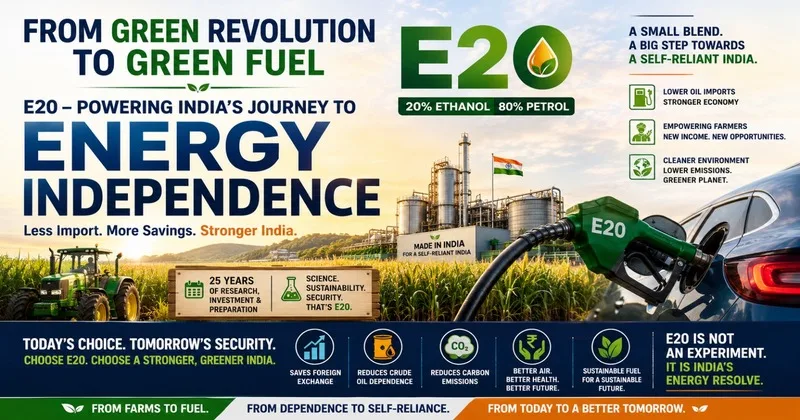
India must import approximately 88 per cent of its crude oil to meet its energy requirements. Consequently, whenever crude oil prices rise in the international market, it directly impacts India’s economy, foreign exchange reserves and the pockets of the common citizen.
In this context, E20, petrol blended with 20 percent ethanol, represents the initial phase of a long journey toward energy self-reliance; a journey that holds the potential to transform the nation’s economic and strategic standing in the years to come. The unfortunate reality is that an initiative which ought to be understood within its broader national context is becoming a subject of controversy due to incomplete information and misleading claims circulating on social media.
Instances where new initiatives faced opposition but were vindicated by time. The history of India’s development journey reveals that almost every major transformation began amidst skepticism and opposition. For example, at the inception of the White Revolution, it was claimed that the organized milk production in villages would not be feasible. When the digital payment system was introduced, many dismissed it as impractical; yet today, India operates the world’s largest digital payment network.
Similarly, various concerns are being raised regarding ethanol-blended petrol. Some claim it is harmful to older vehicles, others label it as fuel that damages engines and some attempt to dismiss it merely as a government experiment; however, a look at the facts and scientific studies presents a completely different picture.
E20: Not an experiment, but the result of 25 years of meticulous preparation
It is often propagated that India suddenly decided to blend 20 percent ethanol into petrol; however, the reality is that work in this direction began as early as 2001. Initially, ethanol blending was tested on a limited scale. It took the form of a formal program in 2004 and by 2006, fuel with a five percent blend became available in several states.
Even then, the government did not rush the process. For nearly two decades, continuous efforts were made to increase production capacity, conduct scientific trials, consult with automobile companies, establish new distilleries and integrate farmers into ethanol production. The National Policy on Biofuels (2018) and the E20 Roadmap (2021) marked significant milestones in this entire process.
In essence, the decision that people today perceive as a sudden policy implementation is actually the outcome of approximately twenty-five years of preparation, investments worth thousands of crores of rupees and the collaborative efforts of thousands of scientists, engineers, agricultural experts and the industry.
Why has energy security become a national necessity?
Today, India is among the world’s fastest-growing economies. Industries, vehicles and road networks are expanding and the demand for energy is steadily rising; however, this growth brings a major challenge: the import of crude oil. The country purchases the majority of its crude oil requirements from abroad. This means that whether there is a conflict in West Asia, a disruption in global supplies or a spike in oil prices in the international market, India is directly affected. This is precisely why energy self-reliance has now become a matter of national security.
This is where the importance of initiatives like E20 becomes evident. If 20 per cent of petrol requirements can be met through ethanol produced from India’s farms, dependence on foreign oil will gradually decrease. This will save foreign exchange, provide farmers with a new market and ensure that a significant portion of the energy supply is generated domestically.
The transition from ‘Annadata’ to ‘Urjadata’
Indeed, it is a matter of satisfaction that India’s farmers have been feeding the nation for decades. Now, for the first time, they are also being made key participants in the energy economy. Ethanol, produced from sugarcane, maize, rice and other agricultural sources, is emerging as a new avenue for farmers’ income. This transformation represents an effort to link rural India with the country’s energy security. Just as the Green Revolution made farmers the heroes of food grain production, the Ethanol Mission is making them partners in energy production as well.
The need for a scientific perspective beyond the noise of social media
Today, social media has become the primary source of information, yet it can also be the greatest source of misconceptions. An individual’s personal experience cannot represent the reality of the entire nation. Public policy is evaluated based on scientific tests, institutional studies and comprehensive data. A similar approach is required regarding E20. Instead of viewing it merely as a political debate or a social media trend, it must be understood as part of India’s long-term energy policy. Just as the results of the Green Revolution did not manifest overnight, this journey towards energy self-reliance also demands patience, scientific thinking and sustained investment.
Does E20 damage older vehicles?
The primary concern raised regarding E20 is that it might damage the engines of older vehicles. Numerous videos and messages circulating on social media claim that ethanol harms engines, rubber hoses and fuel systems; however, when these claims are weighed against scientific tests and actual data, a different picture emerges.
According to the Ministry of Petroleum and Natural Gas, extensive testing covering over 40,000 kilometers was conducted prior to the implementation of E20. These tests examined various aspects, including engine performance, rubber components, fuel lines, metal corrosion, emissions, fuel efficiency, and durability. The automobile industry, research institutions and oil companies actively participated in these trials.
Moreover, during the servicing of millions of vehicles, no evidence was found of engine failures or widespread technical issues attributable to E20. Had this fuel been truly damaging on a large scale, vehicle manufacturers would have faced millions of warranty claims, and the entire automobile industry would have plunged into a severe crisis. That did not happen. This underscores the importance of distinguishing between anecdotal experience and scientific findings.
The question of mileage
The second major argument concerning E20 relates to mileage. The government itself acknowledges that mileage in some vehicles may drop by three to five percent; however, can a fuel be evaluated solely on the basis of mileage? Ethanol has a higher octane rating, which leads to better combustion, enhanced anti-knock capability, improved engine efficiency and reduced pollution. As vehicle manufacturers design engines with E20 in mind in the future, performance is likely to improve further. Therefore, viewing E20 solely through the lens of mileage would mean overlooking its broader benefits.
Why hasn’t the price of petrol dropped?
It is entirely natural for the average citizen to ask why the price of petrol has not decreased despite the blending of 20 per cent ethanol. In reality, the notion that ethanol is always cheaper than petrol is not entirely accurate. In India, ethanol is procured under a policy designed to ensure fair prices for farmers. Various costs, such as transportation, storage, quality testing and taxes, are associated with it; consequently, in many situations, its actual cost can equal or even exceed that of petrol.
Moreover, the objective of E20 is not to make petrol cheaper; its primary aim is to shield India from the volatility of the international oil market. If a significant portion of petrol requirements is met through domestically produced ethanol, the impact of global crises on India will be relatively mitigated. This constitutes the core economic rationale behind the policy.
Why wasn’t an option for pure petrol retained?
Many also ask why pure petrol is not made available to those who do not wish to use E20. At first glance, this suggestion appears simple, but implementing it in practice is extremely difficult. India has over a hundred thousand petrol pumps, along with vast pipeline networks, refineries, terminals and depots. If separate arrangements had to be made for pure petrol, E10, and E20 at every location, the costs of storage, transportation, and distribution would multiply. Ultimately, this would place an additional financial burden on the consumer; therefore, the government considers a uniform fuel supply system to be more practical.
A new foundation for farmers’ income
One of the major achievements of the E20 initiative is that it has linked the agricultural and energy sectors. For years, farmers were viewed solely as producers of food grains, sugarcane or other crops; now, however, those very crops are helping to meet the nation’s energy needs.
According to the government, approximately ₹1.66 lakh crore has been paid to farmers so far through the ethanol blending program. This is undoubtedly a new model for integrating the rural economy with the energy sector. The future expansion of biofuel-based industries will also create new opportunities for employment and investment in rural areas.
Saving foreign exchange and environmental benefits
India imports approximately 88.5 percent of its crude oil requirements. Every year, a massive amount of foreign exchange, running into lakhs of crores of rupees, is spent on this. The Ethanol Blending Programme is an effort to gradually reduce this dependence.
According to government data, this programme has resulted in foreign exchange savings of approximately ₹1.97 lakh crore to date. Additionally, domestic ethanol has substituted the import of 316 lakh metric tonnes of crude oil, and carbon dioxide emissions have been reduced by approximately 952 lakh metric tonnes. At a time when the entire world is grappling with the challenge of climate change, this initiative by India is also considered significant in the move towards clean energy.
The next chapter of ‘Atmanirbhar Bharat’
India’s development journey demonstrates that no major achievement is attained overnight. It took years for the Green Revolution to make the country self-reliant in food grains. It took decades for the White Revolution to make India the world’s largest milk producer. The digital revolution, too, did not succeed overnight.
The E20 initiative should be viewed in this same context. It marks the initial phase of a long journey towards an energy-independent India. In the coming years, alongside ethanol, biofuels, green hydrogen, compressed biogas, electric mobility and other indigenous energy sources will collectively reshape India’s energy landscape.
A need for foresight, not misconceptions
Raising questions about any new policy is a natural part of the democratic process; however, answers to those questions should be sought based on facts, scientific studies and national interests. The same approach needs to be adopted regarding E20.
Today, India is striving to chart a new path towards self-reliance in the energy sector. If this journey achieves its intended goal, history will remember E20 in the coming years as the opening chapter of India’s energy revolution that while ensuring farms remained sources of food, also transformed them into a robust foundation for the nation’s energy security.