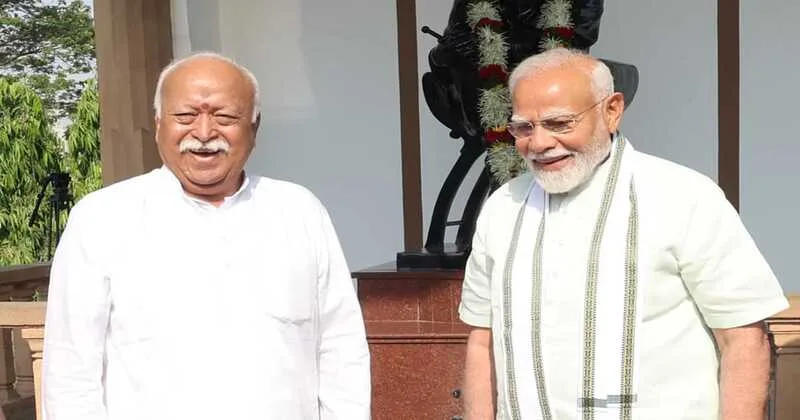
New Delhi: When Prime Minister Narendra Modi and RSS Sarsangchalak Mohan Bhagwat recently appeared on Instagram and engaged directly with young people, the interactions quickly captured attention across social media. Gen Z and Gen Alpha gathered around the conversations, and both leaders demonstrated an ability to occupy a digital space that is increasingly shaping how younger generations communicate, consume information and form opinions.
While PM Modi is a seasoned politician who has consistently adapted to changing communication technologies, what was particularly striking was Mohan Bhagwat’s agility throughout his interaction with young people.
Watching both leaders engage with the younger generation offers an interesting opportunity to look beyond politics and examine their approach through the lens of CEO India and CEO Bharat.
The interactions also prompted a larger personal question: if leaders whose schedules are among the most demanding can make time to listen to and engage with the next generation, why can’t the rest of us do the same? Set politics aside for a moment, and these interactions become an interesting leadership and management case study.
Resistance Is Feedback, Not Just Opposition
Successful leaders do not necessarily interpret every criticism as hostility. They understand that resistance can also be a source of feedback. Listening more carefully when faced with criticism is an important element of stakeholder management. It allows leaders to understand concerns, identify underlying issues and assess situations objectively. The ability to listen, particularly when the environment is critical, is therefore an important leadership quality.
Meet People Where They Are
Gen Z and Gen Alpha inhabit a fundamentally different communication ecosystem. Instagram, YouTube, podcasts, live sessions and other digital platforms are where young people increasingly discover information and participate in conversations.
A leader cannot always expect the next generation to come to traditional public spaces. Leaders increasingly need to enter the spaces where their stakeholders already are.
The principle is simple: Go where your stakeholders are. Engage them there.
Digital engagement is therefore not merely a social-media strategy. It is becoming an important component of modern leadership.
Communication During Criticism
One of the most important decisions leaders face during periods of criticism is whether to withdraw or communicate more.
Silence can create assumptions. Communication can reduce uncertainty. Visibility becomes particularly important during difficult periods because employees look to their CEOs, citizens look to their leaders, and organisations look to their decision-makers for reassurance and clarity.
Increasing communication, visibility and interaction during periods of intense public discussion can therefore become an important element of crisis communication.
Great leaders do not see only opposition during a crisis. They can also see an opportunity to listen, explain and reconnect.
Listening Is Leadership
Listening is often underestimated as a leadership skill. Understanding questions, hearing opposing viewpoints, responding respectfully and attempting to find answers are all elements of what management literature describes as adaptive leadership.
Leadership is not something that can simply be declared or imposed through authority. Respect has to be earned. The reactions of many young people following these interactions demonstrate why accessibility and listening can matter greatly in building a connection with a new generation.
Learning Agility
Experience and age do not eliminate the need to learn. In fact, the willingness to adopt new communication methods can be one of the clearest indicators of leadership agility. A leader responsible for a society comprising multiple generations must be capable of communicating with both a 90-year-old and a nine-year-old.
The ability to adapt the communication method without necessarily changing one’s core values is an important leadership trait.
The CEO Scorecard
If these interactions were converted into a management-school case study, several leadership dimensions would immediately stand out:
-Communication
-Stakeholder Management
-Adaptability
-Emotional Intelligence
-Learning Agility
-Crisis Communication
-Brand Leadership
-Long-term Thinking
-Humility to Learn
These qualities extend far beyond politics. They are equally relevant to CEOs, entrepreneurs, institutional heads, educators and public leaders.
Vision: The Future Is Today’s Youth
A leader who wants to influence the future must understand the generation that will shape it. Reaching young people through Instagram, YouTube, podcasts and live conversations demonstrates an understanding of where the next generation communicates.
Great CEOs do not simply wait for the next generation to enter their boardroom.
They enter the next generation’s world.
Youth engagement, therefore, should not always be viewed through the narrow lens of immediate outcomes. It can also represent long-term relationship building.
Adaptability: Reinvent Communication Without Abandoning Core Values
Leadership communication has changed dramatically. Formal speeches are increasingly supplemented by conversations. One-way communication is evolving into two-way engagement. Traditional platforms are being complemented by digital spaces. The core values of a leader may remain unchanged, but the way those values are communicated must evolve with society. That is the essence of adaptive leadership.
Stakeholder Management: Every Critic Is Still a Stakeholder
Not everyone who disagrees with a leader is an enemy.
Every leader essentially has three choices when confronted with disagreement:
-Ignore
-Fight
-Engage
Effective stakeholder management often requires choosing engagement. Listening does not necessarily mean agreeing. It means recognising that the other person has a perspective that deserves to be understood. That distinction is critical in both corporate and public leadership.
Crisis Communication: Visibility Builds Confidence
During a crisis, absence can create uncertainty. Employees look towards their CEO. Citizens look towards their leaders. Stakeholders want to know that someone is present, listening and responding. This makes visibility an important component of crisis leadership.
-During periods of intense public discussion, leaders can strengthen communication by:
-Increasing engagement
-Maintaining visibility
-Improving transparency
-Encouraging interaction
-Addressing concerns directly
A simple management principle applies: Silence creates assumptions. Communication creates clarity.
Emotional Intelligence
Daniel Goleman’s framework of emotional intelligence identifies five important components:
-Self-awareness
-Self-regulation
-Motivation
-Empathy
-Social skills
At a practical level, emotional intelligence can be remarkably simple.
Listen carefully.
Do not interrupt.
Do not take disagreement personally. Try to understand what the other person is actually saying. These behaviours can make a significant difference to how leaders connect with people.
Psychological Safety
People are more willing to contribute when they feel safe enough to speak. When leaders invite young people to ask questions and genuinely listen to their responses, they create an environment where participation becomes easier.
Some may describe this as the leader’s “aura”. In management terminology, it can be understood through the concept of psychological safety. A leader who creates space for questions and disagreement is more likely to generate meaningful conversations.
Learning Agility: Never Stop Learning
Perhaps the most important leadership quality is the ability to learn and adapt. Learning new platforms, experimenting with new communication models and understanding how younger generations consume information require humility and curiosity. Age, experience and position should never become barriers to learning. That is perhaps one of the most striking lessons from these interactions.
Brand Leadership: Authenticity, Accessibility and Consistency
Brand leadership rests on three important pillars:
-Authenticity
-Accessibility
-Consistency
These qualities can manifest differently depending on the nature of a leader’s role.
As Mohan Bhagwat has traditionally been associated with grassroots engagement through shakhas and direct interaction. Such engagement has long been part of the organisational culture of the RSS.
Modi, given the scale of his responsibilities as Prime Minister, naturally operates at a different level of accessibility. However, his increasing use of digital platforms and newer communication formats reflects an effort to connect more directly with younger audiences. The platforms may differ, but the leadership principle remains similar: stay connected to your stakeholders.
Long-Term Thinking
There is a fundamental difference between a leader who focuses only on immediate results and one who thinks several decades ahead. If engagement with young people is viewed only as a short-term strategy, its value remains limited.
But if it is viewed as long-term relationship building and an effort to understand the generation that will shape India’s future, it becomes an example of strategic leadership. That long-term perspective is particularly relevant for both business and public institutions.
Humility to Learn
Leadership does not require having every answer. Great leaders must also know when to listen. As Jim Collins’ work on leadership emphasises, effective leaders combine determination with humility and recognise that they do not have all the answers. The simple attitude of saying, “Tell me. I’m listening,” can itself be a powerful leadership behaviour. When people occupying positions of enormous influence remain willing to listen to younger generations, that willingness reflects intellectual humility.
From Political Interaction to Management Case Study
The recent interactions involving Modi and Bhagwat can certainly be viewed through a political lens. But there is another way to examine them. Take politics out of the equation and consider the interactions purely as a leadership case study.
The lessons are straightforward:
-Do not fear criticism; study it.
-Go to your stakeholders instead of waiting for them to come to you.
-Keep learning, regardless of age or position.
-Build dialogue before distrust becomes permanent.
-Consistency matters more than one-time engagement.
-Listening earns legitimacy.
-Communication sustains trust.
-Adapt your communication without necessarily abandoning your core values.
Leadership is ultimately about people. Whether the setting is a corporate boardroom, a political organisation, a government institution or a social movement, leaders must understand the people they seek to influence.
The ability to listen, adapt, communicate and build the next generation of leaders may ultimately matter more than the position one occupies.
As a quote attributed to Mohan Bhagwat puts it: “A good leader is not merely someone who leads. A true leader constantly strives to create those who will lead tomorrow.” That idea is particularly relevant from a management perspective.
In organisational leadership, success is not simply about what a leader accomplishes personally. It is also about whether that leader creates capable people who can carry the mission forward. A leader who consistently creates leaders eventually earns the trust to lead.
Build Your Own CEO Scorecard
The most useful takeaway from this discussion may be to apply the same framework to leaders around us.
Whether evaluating a CEO, entrepreneur, manager, public figure or institutional head, consider scoring them across these ten dimensions:
-Vision
-Communication
-Adaptability
-Stakeholder Management
-Emotional Intelligence
-Learning Agility
-Crisis Communication
-Brand Leadership
-Long-term Thinking
-Humility to Learn
The resulting scorecard can become a practical tool for understanding leadership capability. Leadership is not merely about authority. It is about the ability to listen, learn, adapt, communicate, inspire and create leaders who can carry the responsibility forward. And perhaps that is the biggest lesson from watching leaders step outside traditional communication formats and enter the world of the next generation.