New Delhi: For five thousand years, Bharat has written its story in stone, palm-leaf and pigment temples that outlasted empires, manuscripts that quietly outlived their scribes. Today, that vast inheritance finally finds a new guardian, the digital archive. Preserving this priceless heritage in code and pixel is civilisational survival, not mere modernisation.
In a written reply to the Lok Sabha, Union Minister for Culture and Tourism Shri Gajendra Singh Shekhawat laid out what amounts to a comprehensive status report on one of the quieter but more consequential transformations underway in India today, the digitisation of the nation’s museums, archives and cultural institutions. Far from a single scheme or a single ministry initiative, what emerges from the reply is a sprawling, coordinated architecture spanning software developed in Pune, manuscript portals, AI-based restoration, augmented reality galleries and mobile apps for monuments converging all on a single civilisational goal, making Bharat’s heritage as accessible to a child in Manipur with a smartphone as it is to a scholar walking through a museum in Kolkata.
The numbers behind this reply are worth dwelling on, because they rarely surface outside parliamentary records. They show a government approaching heritage not as a static inheritance to be merely protected, but as living, searchable, shareable digital content built on indigenous technology and distributed deliberately across the length and breadth of the country, not concentrated in a handful of metropolitan flagship institutions.
JATAN and the Architecture of a National Digital Repository
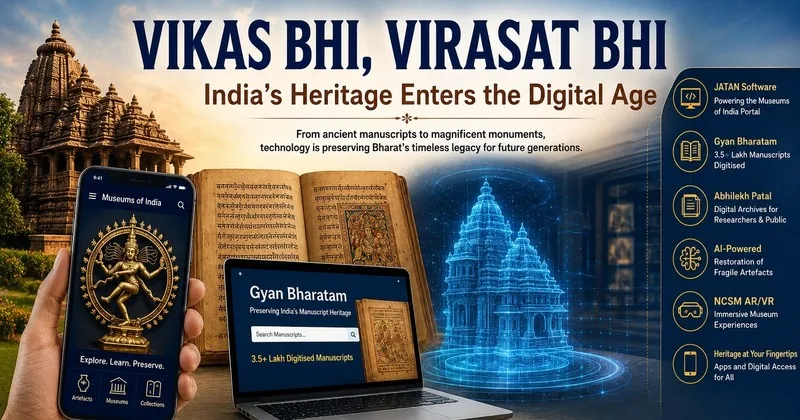
At the technological core of this effort sits JATAN, a software platform developed indigenously by the Centre for Development of Advanced Computing (C-DAC), Pune, purpose-built for digitising museum collections and archival resources. JATAN is not a vanity project; it is the backbone of the Museums of India portal, a national digital repository that already hosts digitised collections from eight National Level Museums, two Archaeological Survey of India (ASI) Site Museums and the Dr Babasaheb Ambedkar Museum in Pune. This is Atmanirbhar Bharat applied to culture rather than licensing foreign digital-asset-management software; the Ministry of Culture has built and scaled a home-grown platform capable of handling India’s uniquely vast and varied museum inventory.
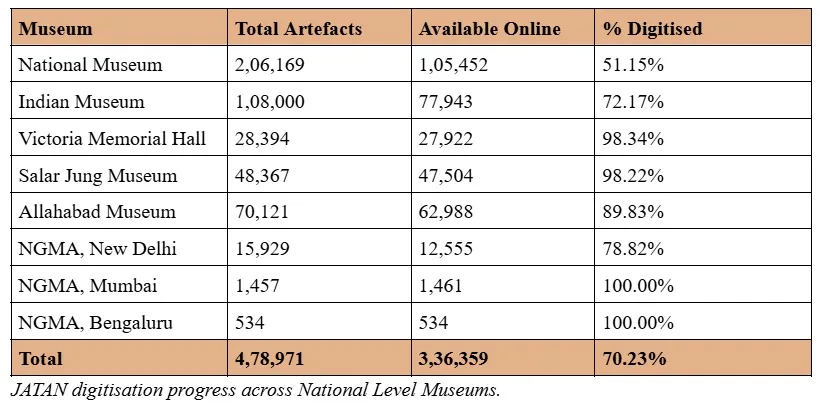
The scale of what has been digitised so far is documented in granular detail. The National Museum alone holds over 2 lakh artefacts, of which more than a lakh are already available online. The Victoria Memorial Hall, Salar Jung Museum and the National Gallery of Modern Art branches in Mumbai and Bengaluru have crossed the 98-100 % digitisation mark, effectively completing their public digital footprint. Across all eight institutions tracked, of nearly 4.79 lakh artefacts, over 3.36 lakh better than seven in ten are already viewable online through the Museums of India repository. That is not incremental progress; it is a near-complete digital mirror of some of India’s most significant cultural collections, built and made publicly accessible within a few years.
Gyan Bharatam and the Revival of Manuscript Heritage
Where JATAN handles museum objects, the Gyan Bharatam Mission tackles a parallel and arguably even more urgent challenge: India’s vast, fragile and dispersed manuscript heritage. Launched under the Ministry of Culture, the mission aims to safeguard this heritage and revive the civilisational knowledge traditions embedded within it for future generations. More than 3.5 lakh digitised manuscripts are already available for public access on the Gyan Bharatam portal a figure that speaks to both the scale of India’s textual heritage and the urgency of preserving it before further physical decay. For a civilisation whose knowledge systems have historically survived through oral transmission and handwritten manuscripts vulnerable to time, insects and neglect, digitisation is not merely convenience; it is conservation in the truest sense.
Complementing this is the National Archives of India’s Abhilekh Patal portal, through which archival records are regularly uploaded for researchers, scholars and the general public, with usage statistics openly published. The Indira Gandhi National Centre for the Arts (IGNCA) has built its own comprehensive digital archives spanning manuscripts, photographs, rare books, audio-visual recordings and cultural documentation, including sustained work on Mithila art, traditions and manuscripts.
Where Technology Meets Curiosity: AR, VR and AI in the Galleries
Beyond archiving, the National Council of Science Museums (NCSM), the apex body overseeing 26 science museums and centres across the country, has positioned itself at the frontier of museum display technology. Its research and development efforts integrate augmented reality, virtual reality, artificial intelligence, computer vision and sensor-based interaction into exhibits, alongside advances in motion tracking, eye-tracking, smart content adaptation and touchless interaction. The stated goal is to make learning dynamic, personalised and accessible to every kind of visitor, a far cry from the static glass-case museum experience of a previous generation.
This philosophy is visible on the ground. The Birla Industrial & Technological Museum in Kolkata, an NCSM constituent unit, opened a National Science & Technology Digital Archive in December 2024, preserving the papers, letters and manuscripts of eminent Indian scientists. NCSM also prepares a detailed Annual Action Plan each year for the upgradation, renovation and modernisation of its museums and centres, with projects such as the Palampur Science Centre in Himachal Pradesh reflecting a continuous, institutionalised commitment to keeping visitor experience current rather than treating modernisation as a one-time exercise. The Indian Museum, Kolkata, aligning with the vision of Vikas Bhi, Virasat Bhi, has partnered with IIT Kharagpur for AI-based restoration of archaeological artefacts and separately collaborated with Google Arts & Culture to build a virtual exhibition, introducing AI-based interactives and AR-based visitor engagement tools for a more immersive gallery experience. The Archaeological Survey of India has gone further still, launching mobile-based applications for its museums at Hampi in Karnataka and Nalanda in Bihar, offering virtual tours and digital access to displayed artefacts directly on a visitor’s phone, turning heritage sites into always-accessible digital destinations even for those who cannot travel to see them in person.
Carrying Culture to the Frontier: SPoCS and the Northeast
Perhaps the most quietly significant element of this digital push is its geographic reach. Under the Scheme for Promotion of Culture of Science (SPoCS), NCSM has modernised and upgraded six Science Centres located precisely in regions that have historically had thinner access to cultural and scientific infrastructure Ranchi in Jharkhand, the Sukanta Academy of Arts, Science & Culture in Tripura, the Nagaland Science Centre in Dimapur, the Shillong Science Centre in Meghalaya, the Mizoram Science Centre in Aizawl and the Manipur Science Centre. In a country where cultural infrastructure has often clustered around a handful of metropolitan centres, the deliberate extension of upgraded science and heritage infrastructure into the Northeast signals a policy intent that goes beyond digitisation for its own sake it is digitisation as a tool of cultural integration and equitable access.
This is reinforced by the work of the Centre for Cultural Resources and Training (CCRT), which organises training programmes for teachers and students alongside educational visits to museums and heritage monuments from the National Museum and Red Fort in Delhi to the Salar Jung Museum in Hyderabad, the Assam State Museum in Guwahati and the Rani Damayanti Archaeological Museum in Damoh ensuring that digital access is paired with lived, experiential engagement with heritage rather than replacing it.
Documenting the Physical: NMMA and Antiquities on Record
Digitisation has also extended to the physical fabric of heritage itself. Through the National Mission on Monuments and Antiquities (NMMA), the ASI has undertaken digital documentation of antiquities and built heritage sites nationwide. In concrete terms, 723 antiquities at the ASI Museum in Goa and 8,450 antiquities at the ASI Museum in Nagarjunakonda have already been digitally documented and uploaded onto the JATAN platform quiet, painstaking cataloguing work that ensures India’s antiquities exist in permanent digital record even where the physical objects remain vulnerable to time, theft or disaster.
Culture as Digital Public Infrastructure
Taken together, these initiatives reveal something more ambitious than a set of disconnected digitisation projects. The Ministry of Culture is, in effect, building a layered digital public infrastructure for heritage such as indigenous software (JATAN) at the technical base, national repositories (Museums of India, Gyan Bharatam, Abhilekh Patal) for storage and access, immersive technologies (AR, VR, AI) for engagement and geographically distributed physical upgrades (SPoCS) to ensure this is not a metropolitan-only privilege. Each layer reinforces the others, and each is being built largely with indigenous capability, consistent with the wider Atmanirbhar Bharat vision extended into the cultural domain.
For a civilisation as old and as textually and artefactually rich as Bharat, the stakes of this digital transformation are not merely administrative convenience. Every manuscript uploaded to Gyan Bharatam, every artefact catalogued through JATAN and every antiquity documented under NMMA is an act of civilisational memory-keeping, ensuring that Vikas Bhi, Virasat Bhi is not a slogan but a lived, measurable and increasingly digital reality.