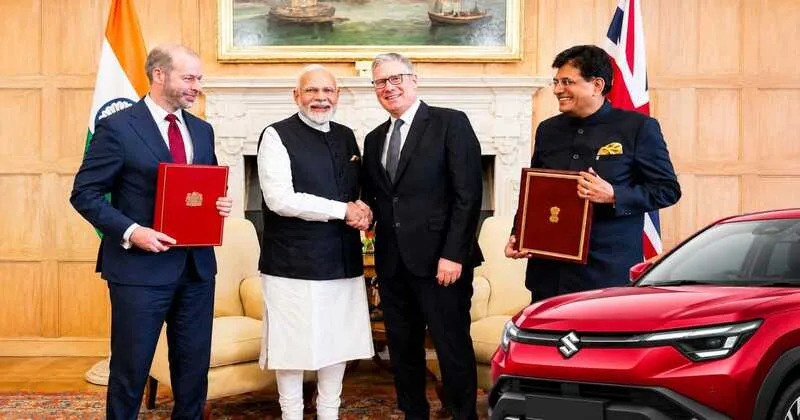
The India-UK Free Trade Agreement (FTA), set to come into force on July 15, 2026, marks a significant milestone in the economic partnership between New Delhi and London. Announced on June 17 following talks between Prime Minister Narendra Modi and British Prime Minister Keir Starmer on the sidelines of the G7 Summit, the agreement seeks to deepen bilateral economic integration while targeting USD 100 billion in bilateral trade by 2030.
While much attention has focused on the phased reduction of import duties on British luxury cars entering India, the agreement also creates an equally important long-term opportunity for India’s automobile industry. Through a carefully calibrated quota-based framework, the FTA opens a structured pathway for Made-in-India electric, hybrid and hydrogen-powered passenger vehicles to gain preferential access to one of Europe’s largest right-hand-drive automobile markets.
The agreement reflects a balanced approach. It gradually liberalises access for British vehicles in India while simultaneously creating a long-term export avenue for India’s rapidly expanding clean mobility sector. For Indian manufacturers such as Maruti Suzuki, Mahindra & Mahindra (M&M), and Tata Motors Passenger Vehicles, the FTA offers the prospect of expanding their international presence in the United Kingdom through phased duty-free access.
A calibrated route to the UK EV market
The opportunity for Indian manufacturers comes through a calibrated mechanism rather than immediate liberalisation. Unlike conventional internal combustion engine (ICE) vehicles imported from the UK into India, electric, hybrid and hydrogen-powered passenger vehicles manufactured in India will receive customs duty concessions only from the sixth year of implementation. This phased approach provides domestic manufacturers with time to strengthen production capabilities while ensuring gradual market opening.
Concluding a very important UK visit. The outcomes of this visit will benefit our future generations and contribute to shared growth and prosperity. Gratitude to the PM Keir Starmer, the UK Government and people for their warmth. Here are highlights from the visit…… pic.twitter.com/nUaiGh9DNc
— Narendra Modi (@narendramodi) July 24, 2025
Under the agreement, duty concessions will apply to three vehicle price categories: vehicles priced below GBP 20,000 (approximately INR 25 lakh), vehicles priced between GBP 20,000 and GBP 40,000 (approximately INR 50 lakh), and vehicles priced between GBP 40,000 and GBP 80,000 (approximately INR 1 crore). Vehicles priced above GBP 80,000 will not qualify for tariff benefits under the agreement. The phased mechanism ensures that India-made clean mobility vehicles gain preferential entry into the UK market through a structured quota system instead of immediate unrestricted access. This framework is intended to provide predictable market access while supporting the long-term competitiveness of India’s automobile industry.
Quotas expand as market access deepens
A key feature of the agreement is the gradual expansion of export quotas over time. In the sixth year, India will be permitted to export a total of 17,600 vehicles under the preferential framework. This allocation includes 6,800 vehicles in the under-GBP 20,000 category, 6,800 vehicles in the GBP 20,000-40,000 category, and 4,000 vehicles in the GBP 40,000-80,000 category. The quota expands steadily throughout the implementation period. By the fifteenth year, annual preferential exports will rise to 88,000 vehicles, representing a fivefold increase from the initial allocation. At that stage, the under-GBP 20,000 category will receive an annual quota of 34,000 vehicles, the GBP 20,000-40,000 category will also receive 34,000 vehicles annually, while the GBP 40,000-80,000 segment will expand to 20,000 vehicles each year.
The expanding quotas provide Indian manufacturers with progressively larger access to the UK market while ensuring a predictable roadmap for long-term export planning. The United Kingdom remains one of Europe’s largest right-hand-drive automobile markets, making it a natural export destination for vehicles manufactured in India. The phased duty-free access is therefore expected to strengthen the competitiveness of locally manufactured electric vehicles while supporting their growing international presence.
Domestic automobile manufacturers have welcomed the opportunities emerging from the agreement. Maruti Suzuki has already established an export footprint for its electric vehicle programme. The company recently commenced exports of the Maruti Suzuki eVITARA to European markets and has reportedly shipped around 36,000 units within nine months of launch. The United Kingdom has emerged as one of the model’s leading destinations, positioning the company to potentially benefit once the preferential quota system becomes operational.
Rahul Bharti, Senior Executive Officer, Corporate Affairs, said the company believes India possesses the competitiveness to benefit from trade liberalisation and utilise it for export opportunities. He noted that the commencement of eVITARA exports to Europe, with the UK emerging as a major market, places the company in a favourable position under the new framework. Mahindra & Mahindra also views the agreement as an opportunity for expanding India’s electric vehicle exports. According to Velusamy R, President, Automotive Business, the India-UK FTA is a positive development that could create new opportunities for India-manufactured electric vehicles. He added that the UK, being a right-hand-drive market, would be evaluated as part of the company’s global expansion strategy for electric SUVs.
Tata Motors Passenger Vehicles described the agreement as a step towards strengthening sustainable mobility exports. The company stated that the phased, quota-based framework creates a calibrated pathway by opening new export opportunities for Indian-made electric vehicles in the UK while supporting the long-term competitiveness of the domestic industry.
A Balanced automotive partnership
The agreement is not limited to creating export opportunities for Indian manufacturers. It also reshapes India’s import regime for British-built vehicles through a phased reduction in customs duties. Over a five-year period, import duties on British-made vehicles will decline from as high as 110 per cent to as low as 10 per cent under a quota-based mechanism. During the first year, petrol vehicles with engines above 3,000cc and diesel vehicles above 2,500cc will see duties reduced from 110 per cent to 30 per cent, subject to an annual quota of 10,000 units.
The India-UK trade pact is a testament to how New India does business.
In my article, I write about how the India-UK CETA is a truly people-centric agreement that will benefit Indian farmers, businesses, artisans & people across the country.
By unlocking the premium UK market,… pic.twitter.com/IKej7fjgAu
— Piyush Goyal (@PiyushGoyal) June 23, 2026
Petrol vehicles between 1,500cc and 3,000cc, diesel vehicles up to 2,500cc, and petrol vehicles up to 1,500cc will attract a 50 per cent duty, down from 66 per cent, each within annual quotas of 5,000 units. By the end of five years, import duties across all ICE categories will fall to 10 per cent, while annual import quotas will expand to 37,000 vehicles. Vehicles imported beyond these quotas will continue to attract higher duties, although these will also decline gradually over time. This calibrated approach balances expanded market access with domestic industry considerations. Notably, electric, hybrid and hydrogen-powered vehicles imported from the United Kingdom will not receive immediate tariff concessions.
These categories remain outside the concessional framework during the first five years. Only from the sixth year onwards will select alternative-fuel vehicles priced above GBP 40,000 (approximately Rs 49.94 lakh) become eligible for phased duty reductions under quota limits. Ahead of implementation, Jaguar Land Rover has already reduced prices on select completely built units, including the Range Rover SV and Range Rover Sport SV. However, the Defender and Discovery models will not immediately benefit because they are manufactured in Slovakia rather than the UK, and their future pricing may instead depend on the proposed India-EU FTA.
Other British luxury manufacturers, including Bentley, McLaren, Rolls-Royce and Aston Martin, are also expected to benefit from the phased duty reductions, although formal price revisions have yet to be announced.
The India-UK FTA, therefore, represents more than a conventional tariff reduction agreement. While it provides British manufacturers with greater access to the Indian market through a phased and quota-based framework, it also creates a long-term pathway for Made-in-India electric, hybrid and hydrogen-powered vehicles to expand into one of Europe’s most important right-hand-drive markets. By combining calibrated market liberalisation with steadily increasing export opportunities, the agreement positions India’s automobile industry to strengthen its global footprint while contributing to the broader objective of doubling India-UK bilateral trade to USD 100 billion by 2030.