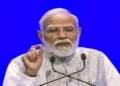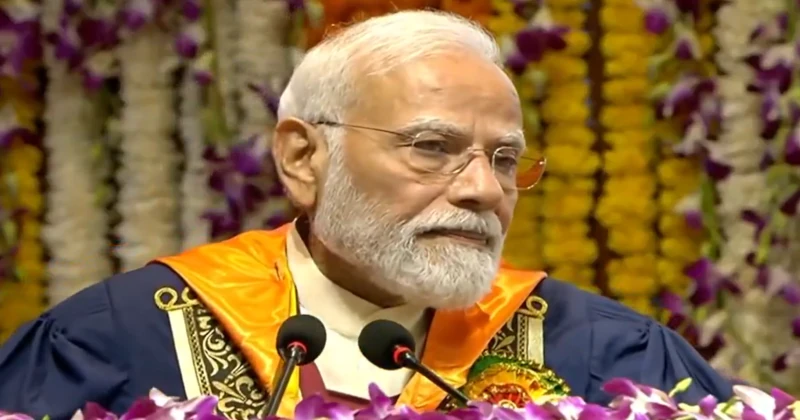
NEW DELHI: Prime Minister Narendra Modi on August 8, delivered a pointed message to the graduating students of IIT Delhi, urging them to look beyond the structured world of classrooms and examinations and prepare themselves for a future defined by rapid technological change, shifting global equations and opportunities that may not yet exist.
Addressing the 57th Convocation Ceremony of IIT Delhi, where more than 3,000 students, including 587 PhD scholars, graduated, Modi said the completion of their academic journey was not an end but the beginning of a far more unpredictable phase of life.
“IIT has a syllabus, but life doesn’t,” was the underlying message of the Prime Minister’s address as he asked the young graduates to preserve their curiosity, remain open to change and continue learning throughout their lives.
PM Modi congratulated the graduating students and urged them to experience the moment fully before stepping into their next chapter. Many, he noted, were preparing to enter their first jobs, move to new cities, launch startups or appear for competitive examinations.
“IIT has a syllabus, but life doesn’t”
PM Modi giving life lessons to the students of IIT Delhi.. pic.twitter.com/uqMqikpZ60
— Political Kida (@PoliticalKida) August 8, 2026
“From orientation to convocation, you must be satisfied with your journey, but also excited about the start of a new chapter,” he said. ‘Those who keep learning will succeed’
The Prime Minister’s central message was directed at a generation graduating at a time when technology is transforming industries, professions and the global balance of power at unprecedented speed.
“You are graduating from this institution at a time when the world is changing very rapidly,” Modi said, pointing to the rapid shifts in strategic equations and the changing global balance of power.
According to him, technology is the biggest force driving these transformations.
The Prime Minister cautioned the graduates against assuming that the knowledge acquired during their years at IIT would remain sufficient throughout their careers. “Today, no one can say with certainty what the world will look like over the next 20–30 years,” he said.
His prescription was simple: keep learning. “Keep your curiosity alive in life. Keep your learning instinct alive. Those who learn, win,” PM Modi said. He also emphasised that periods of disruption should not be viewed merely as threats. For those willing to innovate and take risks, challenges can become opportunities.
“Challenges become chances for those with courage to find new solutions,” he said, adding that the ability to approach problems differently was among the qualities students had developed at IIT Delhi.
The Prime Minister also linked the aspirations of the graduating students with India’s larger push towards technological, industrial and economic self-reliance.
He said India was working towards becoming self-reliant across sectors and pointed to the country’s growing semiconductor ecosystem as an example of a new field opening opportunities for young Indians.
“Today, India is working towards becoming self-reliant in every sector, including economic self-reliance, technological self-reliance and industrial self-reliance,” Modi said. He expressed confidence that Indian youth would play a central role in building advanced technologies and manufacturing capabilities within the country.
Delhi: Addressing the 57th Convocation Ceremony of IIT Delhi, PM Narendra Modi says, "Today, India is working towards becoming self-reliant in every sector, including economic self-reliance, technological self-reliance and industrial self-reliance…" pic.twitter.com/kbVQzZ9qcs
— IANS (@ians_india) August 8, 2026
“And I firmly believe that everything from chips to ships will be built here through your efforts,” he said. Referring to India’s expanding drone sector, PM Modi said young entrepreneurs and innovators were already creating new possibilities.
Delhi: Addressing the 57th Convocation Ceremony of IIT Delhi, PM Narendra Modi says, "And I firmly believe that everything from chips to ships will be built here through your efforts. Somewhere, a young person is confidently saying, 'First in my bloodline to make a chip in… pic.twitter.com/crToA8wEZW
— IANS (@ians_india) August 8, 2026
The Prime Minister’s message was therefore not simply about finding employment after graduation, but about creating technologies, industries and enterprises that can strengthen India’s position in an increasingly competitive global economy.
Amid the emphasis on technology, innovation and national development, PM Modi also delivered a more personal message to the graduates: success should not come at the cost of relationships.
He asked students not to forget the institution, teachers, mentors, staff members and others who had supported them during their time at IIT Delhi. “You will always be grateful to all of them. Therefore, as you leave this institution, do not forget them or abandon these relationships. Carry them with you,” he said.
Delhi: Addressing the 57th Convocation Ceremony of IIT Delhi, PM Narendra Modi says, "You will always be grateful to all of them. Therefore, as you leave this institution, do not forget them or abandon these relationships. Carry them with you. My suggestion is that before you… pic.twitter.com/o4Cy0sbR6w
— IANS (@ians_india) August 8, 2026
The Prime Minister even suggested that students meet and connect with members of the IIT Delhi community before leaving the campus. “Wherever you may be in the future, try to keep these relationships alive and cherished forever,” he said.
For PM Modi, the value of an IIT education therefore extended beyond degrees and professional credentials. The network of people and relationships built during the years at the institution, he suggested, should remain an enduring asset.
The Prime Minister also drew attention to the changing nature of India’s technology landscape, arguing that young Indians were entering an era where fields such as semiconductors, artificial intelligence, drones and advanced computing could generate entirely new career paths.
The speed of technological advancement, he said, was reshaping not only industries but also professions themselves. The implication for the graduates was clear: the careers they begin today may look very different two decades from now. That uncertainty, however, should not become a source of fear.
Instead, PM Modi urged students to develop the ability to adapt, learn and innovate continuously. ‘There should have been many more’ girls among medal winners.
Delhi: Addressing the 57th Convocation Ceremony of IIT Delhi, PM Narendra Modi says, "Today, several students are being honoured with medals for their achievements. I extend my heartfelt congratulations to all of you. It would have been even better if more girls had received… pic.twitter.com/DpPADHwcuL
— IANS (@ians_india) August 8, 2026
The Prime Minister also presented IIT Delhi’s top honours to meritorious students, including the President’s Gold Medal, Director’s Gold Medal, Shankar Dayal Sharma Gold Medal and Perfect Ten Gold Medals.
While congratulating the award winners, PM Modi also highlighted the representation of women among the top performers. “It would have been even better if more girls had received these medals. Why just one or two? There should have been many more,” he said. The remark stated the need for greater participation and representation of women in India’s premier technology and research institutions.
PM Modi said the achievements of the graduating students were a matter of pride not only for their families but also for the country. “Just as your families are feeling proud today, I, too, am proud of all of you,” he said.
Earlier, the Prime Minister inaugurated Param Pragya, an AI-powered high-performance supercomputing facility at IIT Delhi’s Sonipat campus. According to the Prime Minister’s Office, the facility is expected to strengthen IIT Delhi’s capabilities in artificial intelligence, data science, advanced computing and interdisciplinary research.
The inauguration came against the backdrop of India’s growing emphasis on developing domestic capabilities in emerging technologies and building the computational infrastructure required to support cutting-edge research. For the graduating students, the message from the campus was therefore both personal and national: their degrees mark the completion of one structured journey, but the real test begins outside the classroom.
The world they are entering will not follow an IIT syllabus. Technologies will change, industries will be disrupted, new professions will emerge and geopolitical equations will continue to shift. The graduates who succeed, PM Modi suggested, will not necessarily be those who know the most today but those who remain willing to learn, adapt and create tomorrow.