Christianity, Christendom and “Isaaiyat”(the Hindi term for Christianity) are all synonymous terms referring to the same faith. Jesus Christ is called “Jesus Christ” in English and “Isa” in the Quran. Similarly, the followers of Jesus Christ are called “Masihi” (Messianic/Christian), while the terms “Christian” and “Isaai” are derived from “Christ” and “Isa” respectively.
During the 19th century, the term “Evangelical” was widely used among American Protestants (who do not recognize the authority of the Pope), and almost all American Protestants were willing to identify themselves as Evangelicals. By the mid-20th century, Evangelical Protestants had become part of the mainstream. Here, “mainstream” referred to affluent people living in suburban communities.
The term “Evangelical” or “Evangelical Christian” originated in 16th-century Germany, where Protestants identified themselves as Evangelicals in contrast to Roman Catholics (who regard the Pope’s authority as supreme). Therefore, in 16th-century Germany, the term Evangelical meant a person who accepted the authority of the Bible as the basis for understanding the Gospel.
In India, people often adopt Christianity under pressure or inducement, but instead of fully embracing Christian practices, they frequently return to Hindu traditions. Rather than adopting an aggressive approach like the Tablighi Jamaat, Evangelical churches have responded strategically by incorporating practices such as lighting lamps, celebrating festivals, and adapting traditional forms of worship to fit Christian theological frameworks. This process is often described as “liberal romantic syncretism”—an attempt to reconcile differences between religious and philosophical traditions and establish unity.
According to this view, such efforts constitute a deliberate project aimed at weakening the deeper foundations of Sanatani (Hindu) culture, eliminating its rituals, hollowing out its polytheistic character, and reorganizing it under Christianity. Hindu temples are imitated in church structures, Hindu devotional songs are adapted under different names and Hindu festivals are reinterpreted through Biblical narratives, gradually blurring the distinction between religion and religious orthodoxy.
The northeastern states of India, such as Mizoram, Meghalaya, and Arunachal Pradesh, were once part of the larger Assam region at the time of India’s independence. In Manipur, the Christian population was 11.84 per cent at the time of independence and increased to 41.29 per cent according to the 2011 Census.
In Nagaland, it grew from 46.05 per cent to 87.16 per cent by 2011. In Mizoram, it increased from 83.81 per cent before 1981 to 87.16 per cent. In Meghalaya, the Christian population rose from 35.21 per cent in 1961 to approximately 74 per cent. In Arunachal Pradesh, it increased from 0.79 per cent in 1971 to 18.72 per cent in 2001 and further to 30.26 per cent in 2011.
The renowned historian David Bebbington categorized Evangelicalism into four primary characteristics:
Conversionism: The belief that an individual must undergo a personal conversion experience and follow Jesus Christ, implying that religious conversion to Christianity is necessary.
Biblicism: The belief in the supreme authority of the Bible, accompanied by high regard and obedience to its teachings.
Activism: The expression of the Gospel through missionary work and social reform efforts. It emphasizes the importance of encouraging non-Christians to accept Jesus Christ as their Savior.
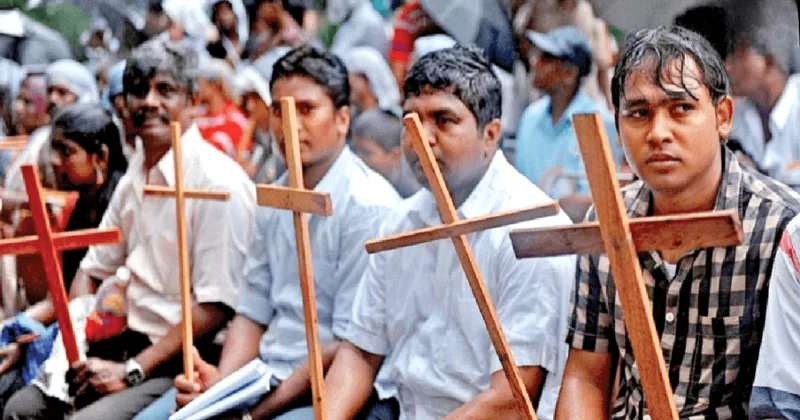
Crucicentrism: A focus on the sacrifice of Jesus Christ on the Cross, through which the salvation of humanity is believed to be possible.
In the Indian context, Article 25 of the Constitution guarantees the fundamental right to religious freedom. It further states that every citizen has the freedom of conscience and the right to profess, practice, and propagate religion according to their beliefs. However, it is argued that Christian missionaries and their support networks often do not fully communicate this aspect to the public.
The rationale behind sending Christian missionaries to India and the methods through which they should operate were outlined in the Charter Act of 1813 passed by the British Parliament. The educational policies associated with Thomas Macaulay could only be implemented because his father, Zachary Macaulay, had already laid the foundations for the spread of English influence and Christianity in India.
Before 1813, missionaries were not officially permitted to come to India and propagate Christianity. The East India Company consistently argued against granting such permission. However, members of the London-based “Clapham Sect”, a group of devout Christians, opposed this restriction. Eventually, they advanced the theory that long-term British rule could be sustained through a partnership between “the Crown’s flag” and “the Christian Cross”. This argument prevailed, leading to the passage of the Charter Act of 1813, which officially opened India to missionary activity.
Zachary Macaulay’s role is often overlooked in history. In simple terms, if Lord Macaulay can be described as the mason who anglicized the Indian education system, then Zachary Macaulay can be seen as the engineer who designed the blueprint for the penetration of English and Christian influence into Indian society and education.
Christian missionaries in India primarily rely on social service activities for religious conversion, including education, medical assistance and prayer meetings. These activities often target poor, tribal and socially disadvantaged communities, where promises of a better life, improved healthcare, or financial benefits are allegedly used as inducements. According to this perspective, such practices violate the spirit of Article 25 of the Constitution.
It is further argued that Christian missionary organizations promote conversion through educational institutions commonly known as convent schools. Another major avenue is hospitals, where patients seeking medical treatment are allegedly influenced psychologically toward Christianity while in vulnerable circumstances. Additionally, socially marginalized or economically disadvantaged individuals, particularly within Hindu communities, are identified and offered various incentives to convert.
According to this viewpoint, these activities are directed by external networks based outside India, including institutions and actors from the United States, the United Kingdom, the Vatican and other international organizations. Therefore, it is argued that the Government of India should review its laws and policies. Otherwise, the day may not be far when India becomes fully influenced by an Evangelical-Christian system.