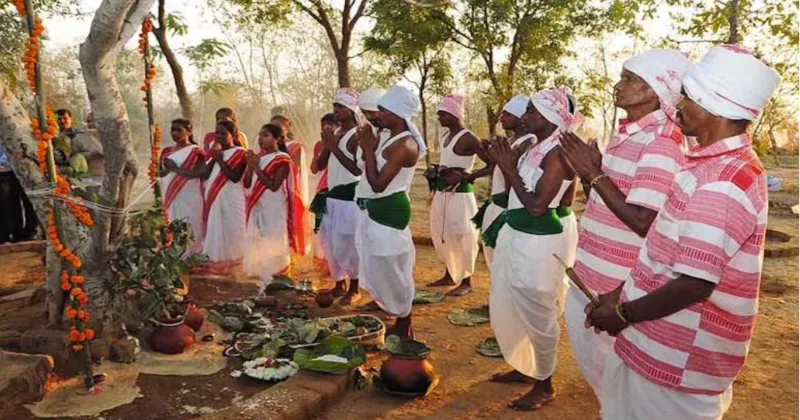
India’s tribal society has always been one of the oldest and strongest carriers of the Sanatan civilizational spirit. Though regional variations in customs, attire, language, rituals and traditions emerged over centuries due to geography invasions and social evolution the spiritual essence of tribal life has remained deeply rooted in the broader Hindu worldview. Nature worship, reverence for ancestors belief in rebirth, devotion to local deities, respect for cosmic forces such as the Sun, Moon, forests, rivers, mountains and animals all these traditions form the foundational core of both tribal and non-tribal Hindu society.
The Atharva Veda proclaims “Mata Bhumi Putroham Prithivyah” “The Earth is my mother and I am her son.” This philosophy is not merely symbolic for tribal communities it is their lived reality. Tribal society has preserved the sacred relationship between humans and nature for thousands of years. Indian civilization itself is often described as an “Aranya Sanskriti” a forest civilization because many of its deepest spiritual insights emerged from forests, mountains and hermitages where sages and forest communities coexisted. Historically India’s Sanatan civilization remained a target of foreign invaders and colonial powers. Turkic, Mughal and later British rulers attempted not only to capture political authority and economic resources but also to weaken India’s cultural unity. Tribal communities because of their simplicity geographical isolation and strong indigenous traditions became especially vulnerable to these attempts.
One of the most systematic colonial strategies to divide Indian society emerged through the British census system. Beginning in the late nineteenth century British administrators deliberately classified tribal communities separately from Hindus under categories such as “Animists,” “Aboriginals” and “Others.” This was not an innocent administrative classification it was part of the larger “divide and rule” strategy. Colonial ethnographers attempted to portray tribal communities as racially and culturally disconnected from the broader Hindu civilization in order to fragment India’s demographic unity. The British also enacted laws such as the Criminal Tribes Act of 1871 under which several tribal and nomadic communities were unjustly branded as “criminal by birth.” This deeply discriminatory legislation stigmatized entire communities and institutionalized social exclusion. Many tribal groups who had resisted British rule were deliberately targeted through such laws.
Christian missionaries actively supported colonial narratives by portraying tribal communities as separate from Hindu civilization and vulnerable to “civilizing missions.” Conversion campaigns expanded through missionary schools, financial inducements, healthcare networks and social outreach programs. Simultaneously colonial scholars promoted theories suggesting that tribal people were “original inhabitants” distinct from mainstream Indian civilization. These theories later evolved into divisive political narratives around “separate identity” “indigenous versus outsider” and anti-Hindu mobilization. Yet historical, spiritual and cultural evidence consistently demonstrates the organic connection between tribal communities and Sanatan traditions. Tribal societies worship forms of Lord Shiva, local deities, sacred mountains, serpents, ancestors and cosmic powers in ways deeply similar to broader Hindu traditions. The Santhal community’s worship of Marang Buru the reverence for Nag deities among tribal groups and rituals related to ancestors and rebirth all reflect continuity with Sanatan philosophy.
The history of tribal resistance against foreign rule is also another powerful but often neglected chapter of Indian history. Long before mainstream nationalist movements gained momentum, tribal communities fought against colonial oppression and exploitation. The Santhal Rebellion of 1855 led by Sidhu and Kanhu Murmu shook British authority in eastern India. Birsa Munda’s Ulgulan movement in the late nineteenth century became a symbol of tribal assertion against British rule, missionary influence and exploitative landlords. Birsa Munda is today remembered not merely as a tribal icon but as one of India’s greatest resistance leaders. Similarly the massacre at Mangarh Dham in 1913 remains one of the most tragic yet under-recognized episodes in India’s freedom struggle. Under the leadership of Govind Guru Thousands of Bhil trials had gathered to resist exploitation, forced taxation, alcoholism and colonial oppression. British forces along with princely state armies opened indiscriminate fire on the gathering killing thousands. Many historians regard this massacre as even larger than the Jallianwala Bagh Massacre yet it remained marginalized in mainstream historical discourse for decades.
Even after Independence the Congress governments largely continued the same colonial frameworks regarding tribal identity that had been created by the British. Instead of dismantling the divisive classifications imposed during colonial rule Congress-era administrations institutionalized them further through census structures, bureaucratic policies and identity-based political engineering. The British had separated tribal communities from the broader Hindu civilizational fold under labels such as ‘Animists’ and ‘Aboriginals’ to weaken India’s cultural unity. Congress governments failed to reverse this colonial distortion and instead allowed the same divide-and-rule mentality to continue under a different political framework.
For decades, tribal communities were denied a clear and dignified recognition of their place within the broader Sanatan civilizational identity. Unlike other communities, tribal were not even properly given the option to identify themselves as Hindus within several administrative and political structures. This deliberate ambiguity strengthened narratives that portrayed tribal communities as culturally disconnected from Bharat’s ancient civilizational heritage. Instead of correcting colonial propaganda Congress-era politics often encouraged fragmentation through vote-bank calculations identity divisions and selective appeasement.
Over time ideological ecosystems supported by missionary networks Left-oriented activism and sections of the political establishment intensified campaigns presenting tribal communities as completely separate from Hindu civilization. Congress governments remained either silent or complicit while divisive narratives such as ‘indigenous versus outsider’ and ‘tribal versus Hindu’ gained institutional and academic legitimacy. The same colonial mind-set once used by the British to fragment Indian society was effectively repackaged in post-Independence politics.
From 2004 to 2013 tribal policies under the UPA government reflected this contradiction even more sharply. While constitutional language spoke about empowerment the ground reality for many tribal communities remained displacement, exploitation and alienation. The Forest Rights Act of 2006 was projected as a historic reform yet implementation remained weak due to bureaucratic apathy and pressure from mining lobbies. Simultaneously aggressive mining expansion under the National Mineral Policy of 2008 devastated several tribal belts across central and eastern India.
In states such as Chhattisgarh, Jharkhand and Odisha thousands of tribal families lost ancestral lands due to mining projects industrial corridors and extractive commercial policies without proper rehabilitation. Congress governments repeatedly spoke about tribal welfare while allowing corporate exploitation and administrative neglect to continue on the ground. Tribal identity was politically romanticized during elections but economically ignored in practice. The Niyamgiri struggle in Odisha exposed this contradiction before the entire nation. The Dongria Kondh tribe had to fight a prolonged battle to protect their sacred mountains from mining interests backed by powerful political and corporate forces. Only after sustained resistance and judicial intervention was the project halted in 2013. The episode became a symbol of how tribal communities were forced to defend not only their lands but also their spiritual and civilizational identity against systems that treated forests merely as commercial resources. For many tribal communities both British colonialism and Congress-era politics represented different phases of the same civilizational disconnect. The British attempted to divide tribal society from the Hindu fold through colonial anthropology and racial theories. Congress governments failed to undo those divisions and in many cases deepened them through identity politics bureaucratic categorization and ideological appeasement. Instead of fully integrating tribal hero’s traditions and spiritual systems into the mainstream narrative of Bharat they often kept tribal society politically isolated and economically vulnerable.
Against this backdrop the 2014 electoral transition marked a major turning point in Indian politics. The rise of Narendra Modi was viewed by many supporters as the beginning of a broader cultural and civilizational resurgence often described as a “Sanatan Renaissance.” Many tribal communities felt that after decades of neglect and fragmented representation their traditions, sacred places, heroes and contributions to Indian civilization were finally receiving greater national recognition. In recent years renewed attention has been given to tribal icons such as Birsa Munda, Govind Guru, Rani Durgavati, Tantya Bhil, Alluri Sitarama Raju as well as legendary women figures like Rani Gaidinliu and Jhalkari Bai through memorials, museums, educational initiatives, commemorative events and national programs aimed at integrating tribal and indigenous history into the mainstream consciousness of Bharat.
Today debates surrounding census classification tribal identity and cultural belonging continue. Certain ideological groups still attempt to politically separate tribal communities from the Hindu fold through identity-based campaigns. However historical memory, spiritual traditions, epics, rituals, festivals and civilizational continuity continue to demonstrate the deep organic connection between tribal communities and the Santana ethos of Bharat. The tribal communities of India are not isolated fragments detached from Indian civilization they are among its oldest guardians. Their traditions preserve ecological wisdom, spiritual balance, ancestral reverence and cultural resilience that have survived centuries of invasions, colonial manipulations, missionary interventions and political divisions. In many ways tribal society represents the living soul of India’s ancient Santana civilization resilient, rooted and eternal.
Against this backdrop the upcoming ‘जनजातीय सांस्कृतिक समागम’ being organized on May 24 at the historic Red Fort in Delhi holds deep civilizational significance. More than just a cultural event it represents the reassertion of tribal communities within the broader Sanatan identity of Bharat. For decades colonial and later political narratives attempted to portray tribal society as separate from India’s civilizational mainstream. This gathering symbolically challenges those divisions by bringing tribal traditions spiritual heritage and cultural pride to the heart of the national capital. In many ways the event reflects a larger effort to restore tribal communities to their rightful place as among the oldest guardians of Bharat’s ancient civilizational ethos.