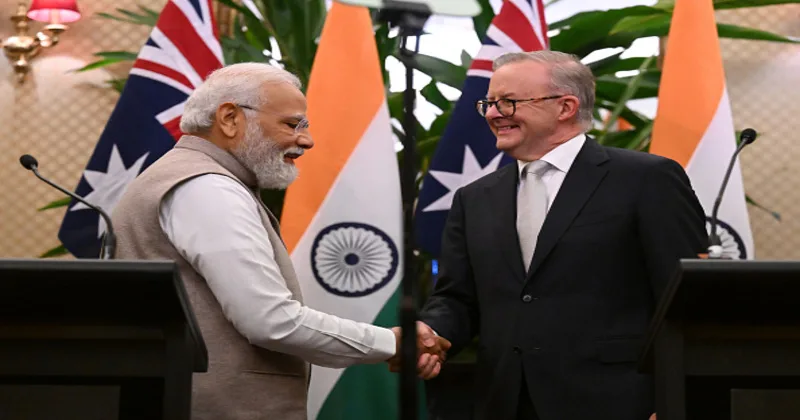
Prime Minister Narendra Modi’s visit to Melbourne, Australia, from July 8 to 10, 2026, is expected to mark a decisive moment in one of the longest-pending strategic initiatives between India and Australia, the implementation of their civilian uranium partnership.
The Australia–India Annual Leaders’ Summit, hosted by Australian Prime Minister Anthony Albanese, is set to focus on finalising a commercial uranium supply agreement alongside discussions on critical minerals, cybersecurity, emerging technologies, clean energy, supply-chain resilience, bilateral trade and the Comprehensive Strategic Partnership.
The Australia leg forms part of Modi’s six-day tour of Indonesia, Australia and New Zealand from July 6 to 11, during which he will hold bilateral meetings with the leaders of all three countries, interact with business leaders and address members of the Indian diaspora. Among the multiple agreements expected during the Melbourne summit, the uranium supply pact has emerged as the most strategically significant because it directly supports India’s long-term nuclear energy ambitions and its broader energy security goals.
For more than a decade, India and Australia have had the framework for civilian nuclear cooperation in place. The Civil Nuclear Cooperation Agreement, signed in 2014, established the legal foundation for Australian uranium exports to India. However, despite the agreement, commercial implementation has remained stalled for years because of complex technical issues linked to nuclear non-proliferation safeguards.
Those obstacles now appear to have been substantially resolved. According to reports, both governments have successfully addressed the long-standing technical concerns that prevented implementation of the agreement, creating an opportunity for the two Prime Ministers to conclude a definitive commercial arrangement during the Melbourne summit.
The agreement assumes greater significance because Australia possesses approximately 28 per cent of the world’s known uranium reserves, making it one of the world’s most resource-rich uranium producers. Access to Australian uranium would diversify India’s nuclear fuel imports while reducing long-term dependence on traditional suppliers, including Russia’s state-owned nuclear company Rosatom.
A decade-old agreement moves towards implementation
The uranium negotiations have gained fresh momentum in recent months. Ahead of Prime Minister Modi’s three-nation visit, Ministry of External Affairs Joint Secretary (Indo-Pacific) Vishwesh Negi confirmed that discussions had entered an advanced stage.
Referring to the bilateral nuclear supply arrangement, Negi said India and Australia already possess a nuclear supply agreement that has remained unimplemented for several years. He added that recent discussions between the two sides had been forward-looking and expressed hope that they would reach a logical conclusion. Government discussions have continued in parallel, with both sides working towards finalising the commercial framework while acknowledging that negotiations were still underway before the summit.
The uranium agreement is expected to become the centrepiece of the India-Australia Annual Leaders’ Summit, reflecting the growing strategic convergence between the two Quad partners. Beyond nuclear fuel supplies, both countries are expected to strengthen cooperation in critical minerals, advanced technologies, cybersecurity, clean energy and resilient supply chains, sectors increasingly viewed as essential to Indo-Pacific economic and strategic stability.
The summit will also include the India-Australia CEOs Forum, where business leaders from both countries are expected to explore investment opportunities spanning manufacturing, technology and clean energy.
Australia’s broader diplomatic agenda during the week also includes signing a new security agreement with Fiji, building upon the security partnership established in 2019 and following a preliminary understanding reached in May. The move reflects Canberra’s wider effort to deepen security engagement across the Pacific amid intensifying regional competition with China.
Nuclear energy and India’s AI ambitions
The timing of the proposed uranium agreement coincides with India’s accelerated push to expand nuclear power generation as part of its long-term energy transition strategy.
The Modi government is simultaneously promoting India as a major destination for global artificial intelligence data centres, an objective that requires massive additions to reliable round-the-clock electricity generation. Nuclear power is increasingly being positioned as a stable low-carbon energy source capable of meeting those future electricity requirements.
India’s expanding civilian nuclear programme therefore requires dependable long-term uranium supplies. While the country possesses domestic uranium deposits, their quality remains relatively poor compared to major global producers.
Indian uranium ore contains concentrations ranging from 0.02 per cent to 0.45 per cent, significantly below the global average of 1 to 2 per cent. In contrast, some Canadian uranium deposits contain concentrations as high as 15 per cent. Because of these geological limitations, extracting uranium domestically is substantially more expensive than importing higher-grade ore.
As a result, more than 70 per cent of India’s uranium requirements are currently met through imports. Domestic production nevertheless continues to play an important role by supporting India’s strategic nuclear programme and providing an additional safeguard against disruptions in international supply chains.
The government is simultaneously increasing domestic uranium production to support future reactor expansion. Even with these efforts, however, domestic output is expected to satisfy only about 30 per cent of the projected fuel requirements of India’s civilian nuclear power plants in the coming decades.
India currently consumes approximately 1,500 to 2,000 tonnes of uranium annually. In 2025, the country’s uranium requirement stood at about 1,884 tonnes. With nuclear power capacity expanding rapidly, annual uranium demand is projected to increase to around 5,400 tonnes, while domestic production is still expected to meet only about 30 per cent of total requirements. Expanding a diversified global uranium supply network. The anticipated Australia agreement comes as India actively broadens its international uranium procurement network.
India recently concluded a long-term uranium supply agreement with Canada under which Canadian mining company Cameco will supply approximately 22 million pounds, equivalent to around 10,000 tonnes, of uranium between 2027 and 2035. The contract is valued at approximately 2.6 billion Canadian dollars. Within a month, India also finalised another uranium supply arrangement with Kazakhstan’s state-owned company Kazatomprom, although financial and supply details of that agreement have not been made public.
These successive agreements form part of India’s larger strategy to secure sufficient nuclear fuel for an ambitious expansion of nuclear power generation. The government has set a target of increasing installed nuclear power capacity from approximately 9 GW at present to 100 GW by 2047, representing an expansion of more than tenfold over the next two decades.
An Australian uranium agreement would therefore complement recently concluded partnerships with Canada and Kazakhstan while strengthening the diversification of India’s nuclear fuel supply sources.
For Australia, the agreement opens a significant long-term export market while reinforcing strategic cooperation with one of its key Indo-Pacific partners. For India, it strengthens energy security, supports nuclear expansion, reduces dependence on any single supplier and provides additional fuel security for a rapidly growing civilian nuclear programme.
If concluded during Prime Minister Modi’s Melbourne visit, the uranium supply pact would finally operationalise the framework established in 2014, ending years of negotiations and transforming a dormant agreement into a functioning strategic energy partnership. Beyond commercial uranium trade, it would also underline the expanding India-Australia relationship across energy, technology, security, critical minerals and the broader Quad framework, while supporting India’s long-term objective of building a larger, cleaner and more reliable nuclear-powered energy future.