



NEW DELHI: From Neha Bora’s One Piece T-shirt to Prashant Bhushan’s ‘Regime Change’ Statement, Emerging Signals in the Politics of CJP, left-wing organisations, and Congress Need to Be Examined Not as Isolated Incidents, but as Part of a Larger Political Narrative.
Politics aimed at changing the government in Bharat is no longer confined to election rallies, political party manifestos, and debates inside Parliament. The protests led by the Cockroach Janata Party (CJP) against Chief Election Commissioner Gyanesh Kumar in October 2026 have raised a political question that would be dangerous to ignore.
The question is whether, in the name of political opposition, circumstances are gradually being created in which efforts are made to remove a democratically elected government by moving beyond the electoral process and relying on public pressure, street-level disorder, and the erosion of public confidence in constitutional institutions.
This question cannot be examined merely through a slogan, a T-shirt, a YouTuber’s statement, or a political leader’s speech. The bigger picture emerges when these incidents are connected, one link at a time. The protests held in Delhi and other cities during the first half of October, demands for the resignation of the Chief Election Commissioner, one-sided reports in international media about alleged deletions of names from electoral rolls, the mobilisation of Left-wing organisations, and Congress leaders coming forward in support of the agitation—all these developments have become part of an alleged regime-change conspiracy.
A one piece T-shirt is not just fashion: The changing language of political symbols
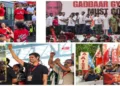
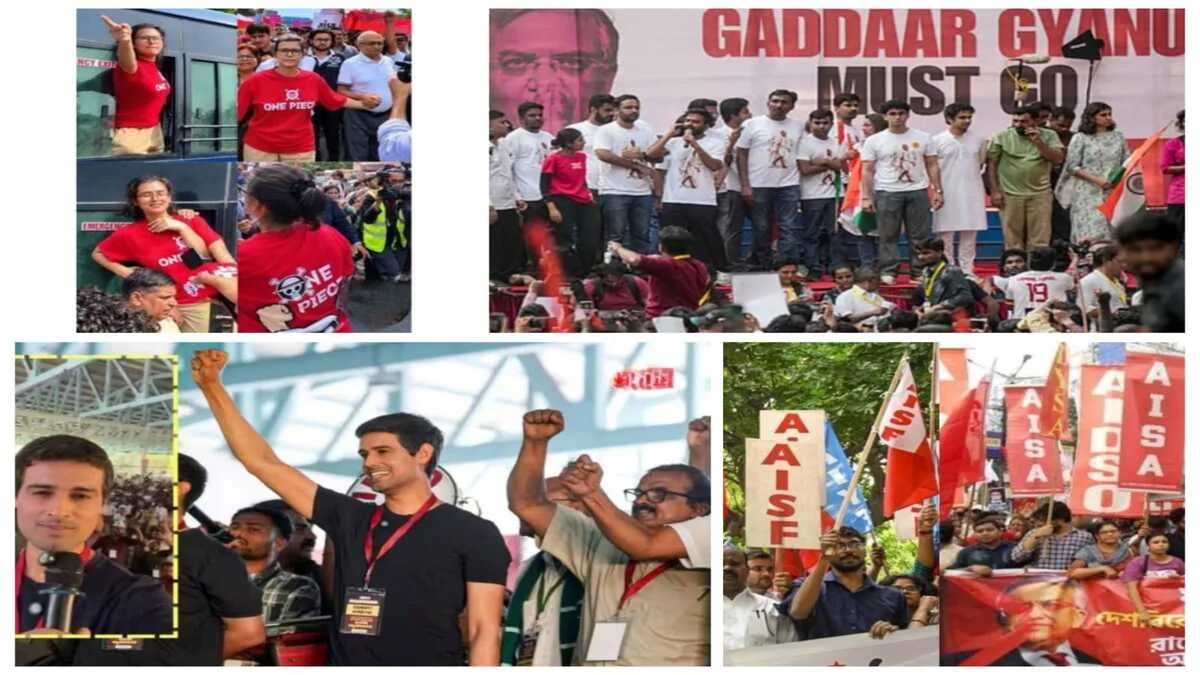
On 10 October, during a protest in Delhi against the Special Intensive Revision (SIR) of electoral rolls, Neha Bora, president of the radical communist organisation All India Students’ Association (AISA), was seen wearing a red one-piece T-shirt. The T-shirt carried the pirate emblem associated with One Piece, the Japanese manga and anime series. Photographs of the T-shirt subsequently became a topic of discussion on social media.
The Jolly Roger symbol from One Piece has also appeared during regime-change protests in Nepal, Indonesia, and other countries. In these movements, such symbols have been used to express resistance to established governments and to represent youth discontent.
The presence of this symbol during youth protests in Nepal, followed by the appearance of a Left-wing political activist wearing the same symbol during a political movement in Bharat, is being presented as an indication of the movement’s underlying intentions.
The Bangladesh context
The Bangladesh experience is also important for understanding the politics surrounding the current alleged regime-change project in Bharat. In 2024, a regime-change movement in Bangladesh played a decisive role in the fall of Sheikh Hasina’s government. It was described as a student movement, much as the protests in Bharat are being described. The developments were presented internationally as an example of the political power of young people, particularly Generation Z, their discontent with the government, and their capacity to bring about a change of power.
Now, hardline communist leader Neha Bora has also spoken about drawing inspiration from Bangladesh’s regime-change movement. Treating such a statement as an ordinary remark would mean overlooking the broader political context in which it was made. When a movement cites a change of government in another country as a source of inspiration, it becomes necessary to examine what aspects of that movement it seeks to emulate.
The developments in Bangladesh were not confined to a single slogan or a day’s events. They involved a prolonged dispute over the reservation system, the mobilisation of student organisations, widespread protests, and a confrontation with the government. Following the fall of the government, several incidents of violence and atrocities against Hindus were also reported.
In the context of Bharat, symbols associated with regime-change movements in Nepal and Bangladesh, along with examples of political upheaval in those countries, are now being invoked in political campaigns. When the Bangladesh movement is described as a source of inspiration on the one hand, and demands extending beyond the resignation of constitutional functionaries to the language of “regime change” emerge on the other, the two developments need to be examined together.
Prashant Bhushan’s statement
Meanwhile, during a press conference held in Delhi on 15 October by CJP and organisations associated with it, Prashant Bhushan stated: “From here I am saying, youth will lead us in the change of regime. This is a fight for regime change.”
Does anyone still believe that the political objective of this movement is limited to demanding the resignation of the Chief Election Commissioner? Bhushan explicitly described it as a struggle for a change of regime.
Consider what has been presented to the public for so many days: that the movement concerns the decisions of the Election Commissioner, the electoral-roll revision process, or the functioning of the Election Commission. However, when a prominent figure associated with the movement, who is also described as one of its principal advisers, publicly declares “regime change” to be its objective, it becomes necessary to examine whether the movement’s ambitions extend well beyond its stated electoral concerns.
The participation of Left-wing organisations in this entire campaign is also significant. The presence of hardline Marxist and Maoist leaders associated with AISA, the Students’ Federation of India (SFI), and the All India Students’ Federation (AISF) is being cited as evidence of a broader gathering of political forces opposed to the existing democratic order.
Dhruv Rathee’s dangerous appeal to discontent within institutions
Dhruv Rathee’s promotion of CJP from the very beginning, his participation in a protest organised under CJP’s leadership in Bengaluru, and his subsequent appeal to the armed forces in the context of “regime change” are also being presented as links in the same chain of events.
In a democratic system, the roles of the armed forces and the police are governed by clear constitutional and legal boundaries. However, addressing these institutions in the context of a particular political struggle in a manner that suggests they should determine their role on the basis of an agitation’s claims rather than their constitutional obligations constitutes a dangerous narrative.
The decision will be made on the streets
In Indian politics, the streets have always been important spaces for political movements. From the freedom struggle to anti-corruption campaigns, public demonstrations have influenced political developments. However, it is essential to distinguish between the language of protest and the language of bypassing constitutional processes.
When leaders such as Yogendra Yadav say that the decision will now be made on the streets and that Parliament will be driven by the streets, it is necessary to ask what kind of decision they are referring to. Do they mean that the future of an elected government should be determined by a show of strength on the streets rather than through elections?
Calling Gyanesh Kumar ‘Gyaanu’ and the public image of constitutional offices
The use of nicknames such as “Gyaanu” for Chief Election Commissioner Gyanesh Kumar, along with personal jibes directed at him, is another significant example.
When public ridicule of an officeholder becomes the central feature of a political campaign, rather than a substantive debate about the functioning of the office, the consequences can extend beyond the individual and affect the standing of the institution itself.
The credibility of the Election Commission is greater than the reputation of any one individual. If questions arise about a decision taken by the Commission, they should be debated on the basis of documents, data, legal procedures, and available evidence. However, if a sustained effort is made to create the perception that those occupying constitutional offices are merely political targets, public confidence in these institutions may gradually weaken.
The use of allegations such as “sellout” or claims that the Chief Justice has “compromised” also forms part of what is being described as the broader regime-change project. It is essential to understand that criticism of institutions and a campaign to render those institutions irrelevant in the eyes of the public are not the same thing.
Political change does not occur solely through electoral arithmetic. It also depends on shaping public trust, discontent, expectations, and perceptions of the existing system. One element of a political strategy aimed at weakening a government may be criticism of its decisions. However, when the credibility of institutions, the role of security forces, symbols associated with movements abroad, and the language of street mobilisation begin to feature in the same public discourse, the entire sequence of events needs to be examined from a broader political perspective.
What is unfolding in Bharat today cannot be reduced to a single protest or a statement by one leader. The expansion of CJP, the participation of Left-wing organisations, Congress’s anti-government politics, Neha Bora’s symbolic presentation, and Prashant Bhushan’s “regime change” statement are being presented as interconnected developments that point towards a larger political agenda.
The central concern, therefore, is whether a political movement that begins by questioning electoral procedures is gradually expanding its objectives towards changing the government outside the electoral process. Such claims must be examined through verifiable evidence, public statements, and the actual conduct of those involved. In a constitutional democracy, governments are changed through the electoral process, and the legitimacy of political opposition rests on its commitment to constitutional methods.