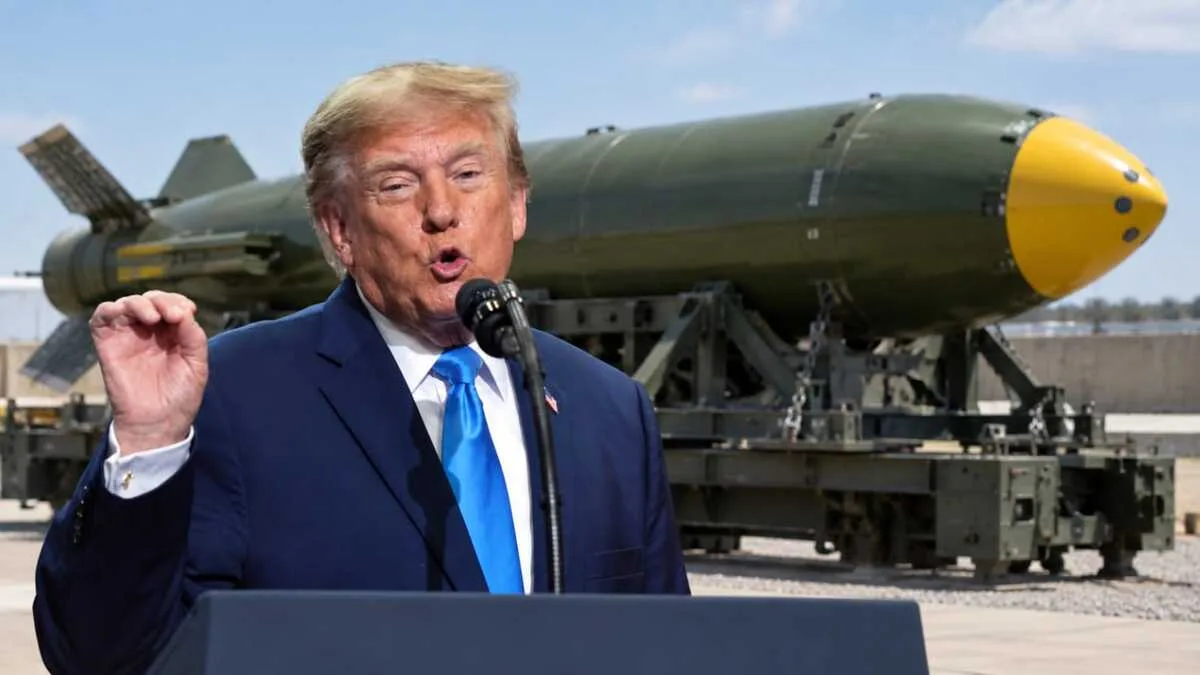
WASHINGTON DC: US President Donald Trump has confirmed that the United States is considering using the GBU-43/B Massive Ordnance Air Blast (MOAB), popularly known as the ‘Mother of All Bombs’, against Iran, while ruling out the use of nuclear weapons and the deployment of American ground troops in the country.
Speaking to Newsmax at the White House on 15 October, Trump described the MOAB as an exceptionally powerful conventional weapon, dismissing concerns that its potential use would involve a nuclear strike. His remarks come amid reports that the Pentagon has drawn up military options involving the massive bomb as Washington continues its conflict with Tehran.
“The Mother of All Bombs is not nuclear,” Trump said, emphasising that the weapon was conventional despite its destructive power. Comparing its impact to that of a small nuclear weapon, he said it was an extremely large bomb but contained no nuclear capability.
The president did not confirm whether he had approved its deployment against Iranian targets. However, his comments indicate that the option remains under consideration as the US military assesses potential targets, including an underground Iranian facility suspected of being associated with the country’s nuclear programme.
Trump also categorically rejected the prospect of using America’s nuclear arsenal against Tehran. Asked whether he would consider such a move, he responded that it was unnecessary, adding that the United States would not deploy nuclear weapons against Iran. He also ruled out sending American ground forces into the country, suggesting that Washington’s military strategy would continue to rely on other forms of military pressure.
Pickaxe mountain facility under US radar
One of the potential targets identified by Trump is Pickaxe Mountain, a suspected Iranian nuclear facility believed to be buried beneath extensive layers of rock. Its underground location could complicate military efforts to destroy it, potentially requiring weapons capable of penetrating heavily fortified structures. “We may have to go there”, Trump told Newsmax, referring to the site. He added that the United States could strike the facility and destroy it quickly.
The remarks reinforce Washington’s stated objective of preventing Iran from acquiring nuclear weapons. Trump has repeatedly argued that Tehran must never be allowed to develop such a capability, claiming that Iranian leaders would use nuclear weapons if they obtained them. “We want to make it so that they will never have a nuclear weapon, because if they had it, they would use it, in my opinion, instantaneously”, he said.
The US-Iran conflict has continued for approximately seven months, with Washington maintaining that preventing Iran from obtaining a nuclear weapon remains a central objective of its military campaign. On October 8, Trump said the United States would not launch fresh strikes against Iran before the 3 November midterm elections, citing what he described as productive negotiations with Tehran aimed at ending the war. However, neither the president nor his administration has subsequently provided substantial details about the progress of those discussions.
The continued military activity has raised questions about the extent of the pause Trump announced. US military officials this week confirmed that American forces had struck an Iranian Islamic Revolutionary Guard Corps (IRGC) surveillance boat in the Gulf of Oman. The military released video footage showing helicopters destroying the vessel. The operation took place on October 6, two days before Trump’s announcement that Washington would refrain from conducting additional strikes before the elections.
IEA accelerates oil releases as prices remain elevated
The conflict has also continued to put pressure on global energy markets, with crude oil prices remaining elevated amid concerns about supply disruptions. The International Energy Agency (IEA) said on 15 October that its member countries would accelerate the release of approximately 100 million barrels of oil from emergency reserves to strengthen supplies and ease pressure on energy markets.
Following a meeting this week, the agency said members had agreed to take all necessary steps to complete the remaining releases in a timely manner, taking individual national circumstances into account. Since the conflict began, IEA member countries have released approximately 330 million barrels of the 400 million barrels pledged in March. The United States accounts for more than 40 per cent of the oil released so far.
Despite the emergency measures, prices remained high. Brent crude, the international benchmark, was trading at around $100 per barrel before rising to approximately $106 on October 16. West Texas Intermediate, the US benchmark, also climbed to around $98 per barrel.
The developments highlight the growing international economic consequences of the prolonged conflict, even as Washington continues to weigh further military action against Iran alongside diplomatic efforts to bring the war to an end.